The Ulutas Medical Journal · ISSN 2149-0430 (print), 2149-388X (online) · https://www.ulutasmedicaljournal.com/?mno=128774
Original Article · Open access
Using Puzzle or Brochure to Teach Children Inhaler Technique: Evaluation of Alternative Methods Against Face to Face Education
Also available in: العربية · Türkçe · 中文
- Department of Pediatric Allergy and Asthma, Hatay State Hospital, Hatay, Turkey ROR
- Department of Pediatric İnfection Diseases, Hatay State Hospital, Hatay, Turkey ROR
- Depatment of Child Health and Disease, Faculty of medicine, Mustafa Kemal University, Hatay, Turkey ROR
Abstract
- Introduction
- Inhaler drugs are the basis of the treatment in asthma due to their local effects. Errors in inhaler techniques in asthma increase health care costs, hospitalization, and result in a lack of disease control. A brochure and a puzzle material were prepared as alternatives to face-to-face training in this study. It is aimed to evaluate the adequacy of these training materials in the diagnosis and the first month of treatment.
- Materials and Methods
- Patients aged between 4-12 years diagnosed with asthma and their family members aged between 20-49 years who had not received inhaler drug training before were included in the study. A prospective, cross-sectional, quasi-experimental study was planned.
- Results
- A total of 109 family members and patients were included. There was no difference between the groups in inhaler technique total scores in diagnosis. There was no difference in inhaler technique full score rates between the groups in the diagnosis and the first month.
- Conclusion
- It was determined that puzzle games and brochures can be used as an alternative for treatment applications such as inhaler drugs with spacers. Further studies are needed to evaluate the effect of puzzle games and brochures with face-to-face training on long-term memory retention.
Keywords
Full text
Introduction
Inhaled drugs (inhaled steroids and as-needed beta-agonists) are the first choice in the long-term treatment of asthma due to their local effects (1). Using inhaler drugs with spacer (with a mask or mouthpiece) is the preferred treatment method for children according to international guidelines (2–4). A spacer reduces technical coordination problems and inhaled drugs accumulate less in the upper airways and reach the lung more effectively (5, 6). Errors in inhaler technique result in an increase in health care costs, an increase in hospitalization, and result in lack of disease control (7). Physicians are often the first people to teach patients how to use inhaler drugs with spacer and they should check patients' inhaler technique (8). Patient education is crucial for the correct inhaler technique. However, it was shown that approximately 1/3 of asthmatic patients did not receive training from healthcare professionals, 1/3 of them trained only verbally and 1/3 of them received only practical training using a placebo (9). Incorrect inhaler use is common in asthmatic children despite proper inhaler training (10). It has been observed that the inhaler technique of some asthmatics can deteriorate over time (4, 11). It is recommended to review the inhaler technique in routine examination of patients (1). Inhaler technical training usually is carried out by a physician in the outpatient clinic and typically, 3-5 minutes are spent face-to-face with the patient and family members.
Game education materials are not preferred in healthcare educations. Children practice their spatial skills with toys such as construction materials, board games, and puzzles (17). Aral et al. stated that puzzles could affect positively the development of skills in children such as perception, comparison, and recognition of similarities and details, visualization of the mind, problem-solving. As a result, children can learn with fun and it can positively influence the children’s motivation for education (18). Outpatient education in the inhaler technique remains inconsistent due to inadequate health care professionals and limited hospital sources. In this study, a brochure and a puzzle game material were prepared as alternative training materials to face-to-face education. It is aimed to evaluate the adequacy of these training materials in the diagnosis and the first month of treatment.
Materials and Methods
A prospective, cross-sectional, experimental study was planned. It was conducted may and between June and September 2019. Participants (family members) who accepted the informed and written consent and patients aged between 4-12 years; who were diagnosed as asthma with history, physical examination, and tests; who had not received inhaler education before were included in the study. Family members (parents or others) who could not speak and read. The face-to-face training is thought to be the best method by some researchers (12, 13). Dialogues of health care professionals with patients are stronger and patients have a chance to ask anything. It also helps patients to reduce anxiety, to get additional information, and correct errors (14). A few studies are investigating the effect of graphic designs on understanding healthcare education materials. Adding pictures to written education tools makes texts easy to understand and interesting to read. The presence of pictures in educational materials allowed readers to visualize and understand what was written (12, 15, 16). Turkish, who had visual problems and cognitive impairment, had received inhaler drug training before were excluded from the study. Patients who could not speak Turkish, who had visual problems and cognitive impairment, had received inhaler drug training before were excluded from the study to conduct healthy and objective research.
A brochure and puzzle were used. We aimed at family participation for inhaler training. We used our puzzle in healthcare professionals (one hundred two) in our hospital with a study and it was found that our puzzle can be used as a complementary tool to face-to-face training for inhaler training.
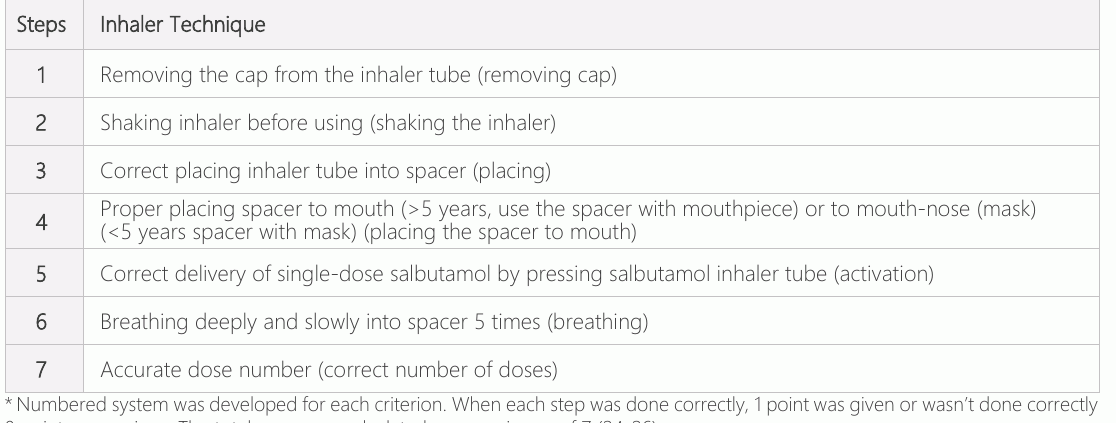
There were three groups in this study; Group 1: An inhaler training brochure with written and visual content was given to the patients. The brochure included five steps of inhaler training. After reading the brochure (family members helped the children and they worked together), the participants (patients and family members together) demonstrate the inhaler technique with spacer, and scoring was done by a researcher (Table-1). After scoring, the errors in steps were shown on the brochures.
Group 2: The rules of the puzzle were explained to the family members and patients. The puzzle was made of pieces (given in mixed) of visual picture (our puzzle) and a blank puzzle. After reading the rules, family members helped the patients and they played together. The participants (patients and family members together) demonstrate inhaler technique with spacer and scoring was done by a researcher (Table-1). After scoring, the errors in steps were shown on the finished puzzle.
Group 3: Inhaler technical training with spacer was given as face to face (in five minutes) to family members and patients together. After face-to-face training, they were asked to demonstrate inhaler technique with spacer together (family members allowed to help children), and scoring was done by a researcher (Table-1). After scoring, the error step was shown with face-to-face training.
All groups were not given any training other than those mentioned above. In the first month, the participants (not all participants, only to patients who came for a control examination) were asked to demonstrate inhaler technique with spacer, and scoring was done again by a researcher. All patients have started the same inhaled steroids (twice a day) and as-needed bronchodilators as recommended by international guidelines (1).
Evaluation of Inhaler Technical Skill (Scoring): Inhaler technical skill scores were evaluated by a researcher for all groups in diagnosis and the first month (Table-1). In our study, five steps, seven scoring system was used, each step was scored. We chose this method because we think that its steps are easy to understand, its effectiveness is shown (19, 20). Inhaler technique scoring was calculated as a maximum of 7.
Statistical Method
Statistical analyses were performed using SPSS version 18 software. The suitability of the variables to normal distribution was examined using visual (histogram and probability graphs) and analytical methods (Kolmogorov-Smirnov/Shapiro-Wilk tests). Descriptive statistics were given using the median for numerical non-normally distributed variables and mean for normally distributed variables. The frequencies for categorical variables were shown as % and ratios. P values less than 0.05 were evaluated as statistically significant results.
Results
Sociodemographic Characteristics
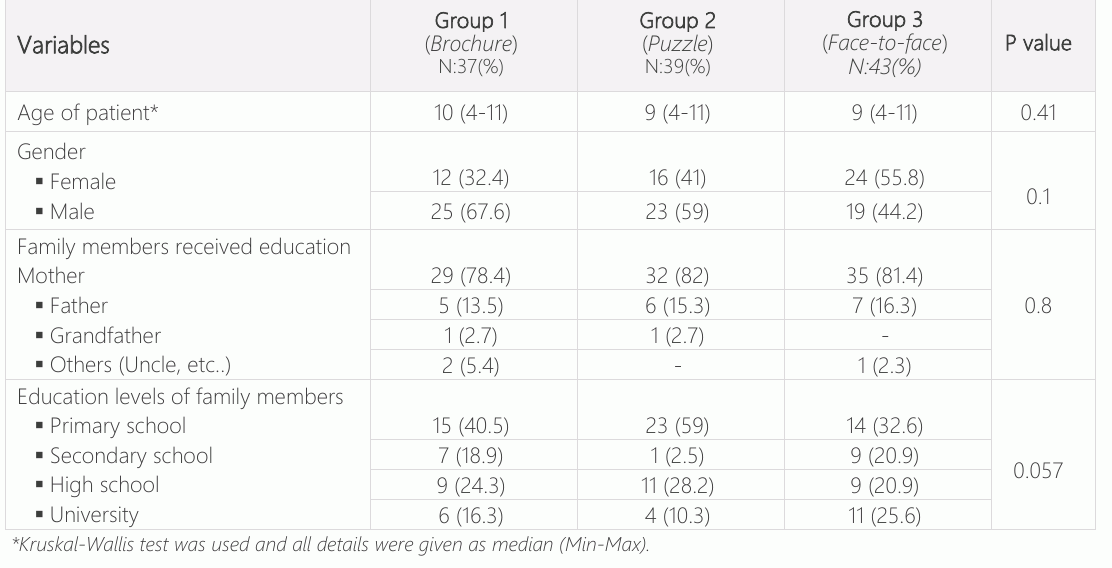
Table-2 shows the demographic characteristics of the participants. Group 1 included thirty-seven; group 2 included thirty-nine, and group 3 included forty-three patients and family members. The median of the patients’ age was 8 years (minimum: 4-maximum: 11), the median of the family members’ age was 35 (minimum: 20 - maximum: 59). The majority of family members who received education were mothers in all groups.
Inhaler Technical Score
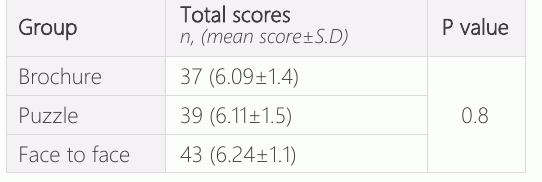
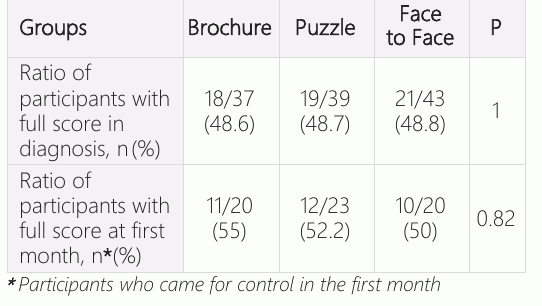
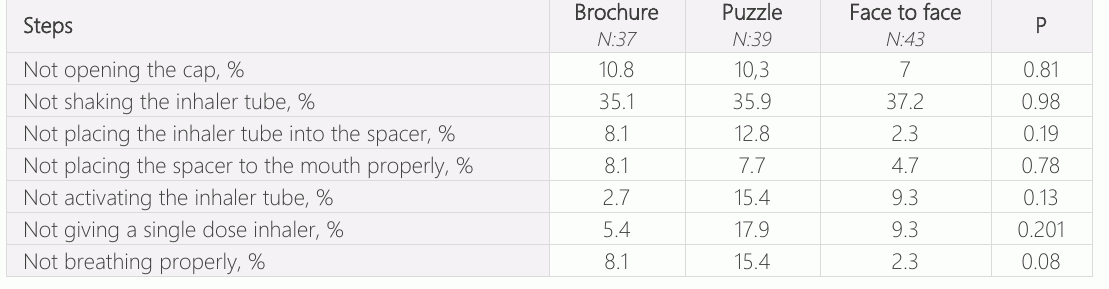
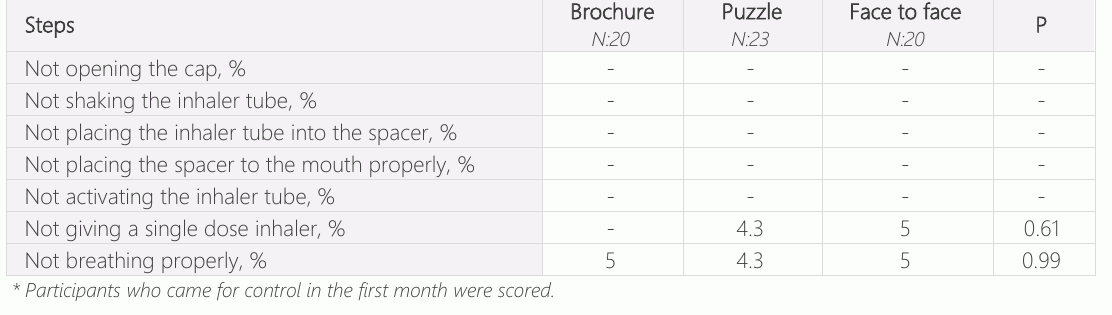
There was no difference between the groups in inhaler technique total scores in diagnosis (p=0.8) (Table-3). There was no difference between the groups in inhaler technique full score rates in the diagnosis (p=1) and the first month (p=0.82) (Table-4). The most common errors were found not shaking inhaler tube in all groups in diagnosis (Table-5). In the first month, none of the groups made any errors at this step (Table-6). There was no difference between the groups in error rates in all inhaler steps in diagnosis and the first month (Table 5 and 6).
Discussion
The inhaler technique of asthmatic patients should be checked at every routine examination (1, 3). However, this is not always possible in outpatient conditions where many patients are examined. So, alternative methods may be effective for inhaled drug training in the absence of allied health personnel. In the study conducted by Bieger and Clock, the effect of using pictures with texts on comprehension was assessed by measuring the speed and accuracy of performance of 120 undergraduate students. It was shown that adding visual shapes to written texts containing dimensional information reduces the number of errors and they completed the tasks in considerably less time. They hypothesized that the amount of time spent encoding spatial information in the text can be greater than pictorially. Also, they stated that there are more abstract in textual representations than pictorial representations of the object so a reader of text may require more time to construct a mental image of the object and get information (21). The non-systematic review by Houts et al. also assessed the effects ofpictures on health communication. The research included studies comparing the effect of pictures and text vs. text-only in health education material and verbal instructions. They concluded that adding pictures to written and spoken language can increase patient attention, adherence, comprehension, and recall Health education materials could be improved by the addition of pictures. Also, their review suggests that pictures can help patients with low literacy skills for understanding (22) Whitehouse conducted a study on 80 children (four age groups and two modalities-pictures vs. word) recruited from one government and two private schools. They stated that all groups showed better recall of pictorial relative to word stimuli (23).
We aim to make it easy to understand the puzzle and brochure in our study. So, we used pictures containing five steps of the inhaler training. Face-to-face training in healthcare education is thought to be the best method by researchers (12, 13). Paudel et al. conducted a study on 20 adults newly diagnosed with asthma and COPD. Patients received face-to-face training on rotahaler technique in the registered pharmacies. 70% of the patients were able to perform all steps. Consequently, they suggested that face-to-face education could be an effective method for rotahaler education in asthma and COPD (24).
The puzzle is a kind of educational game. According to Michalewich et al. puzzle must have some criteria(25). Active learning methods such as puzzles accelerate students' learning and enhance students' satisfaction (26, 27). In the literature, we could not find any puzzle study about inhaler training for patients. In our puzzle, we used rules and criteria for participants as suggested by literature (25). Walia et al. evaluated 138 patients who had been diagnosed with asthma over five years of age and who had been trained by a nurse with face-to-face education for using inhaler drugs with spacer. 66.7% of the patients had a full score. They also found that the most common errors were not breathing correctly (30.4%) and not shaking inhaler tube (7.2%) (28). Shaw et al. evaluated 122 children aged between 2 and 7 years. They found that the most common mistakes after face-to-face inhaler training (baseline) with spacer were not shaking inhaler tube (72.1%) and not breathing correctly (45.9 %). When they evaluated inhaler scoring with twelve steps, they found 53.2% of the participants who scored more than 10 points (29). Kamps et al. conducted a study involving 66 asthmatic children aged between 1 and 16 years. They evaluated the technique of different types of inhaler drugs. Only 58 % of the patients completed all steps of inhaler drugs. When subgroup analysis was performed, 67% of the patients who used inhaler medication with spacer did all steps correctly. They found that the most common errors were not shaking the inhaler tube (29%) and not placing the spacer into the mouth properly (8%). As a result, they stated that short session for inhaler training was not enough and inhalation technique must be checked repeatedly at follow-up visits (30). Face-to-face education may be one of the best learning methods in health care training. In our study, it was compared with brochure and puzzle. There was no difference between the groups in total scores in diagnosis (p=0.8). Besides, there was no difference between the groups in the full score (7 points) rates in diagnosis (p=1) and the first month (p=0.82). Almost half of the participants (family members and patients have done the steps together) in each group did not do all the steps in diagnosis and the first month. The proportion of the participants who received full points of face-to-face education was lower than the literature. In our study, we gave a face to face training a family member and patient together. It might have affected perception and understanding. Also, the different scoring systems might have affected these results. Perhaps a longer time should be spent explaining inhaler training steps when a family member and a child are educated together. Also, multiple education systems (for example face to face training with puzzles or brochures) should be considered. Interestingly, whatever method was used only in inhaler education in our study did not make a significant difference in the rate of participants who got full points. Similar errors as were found in the literature that the most common inhaler technique errors in all groups in diagnosis after training was non-shaking the inhaler tube (35.1% brochure, 35.9 % puzzle, 37.2% face-to-face education, respectively). Results for common errors in inhaler training are different in the literature. This difference may be due to the different scoring systems and study designs used in each study. There was no difference between the groups in the inhaler technique errors in all steps (Table 5). In the first month, the most common errors were not giving a single dose of medication (brochure 0%, puzzle 4.3%, face-to-face 5% respectively) and five times deep breathing (brochure 5%, puzzle 4.3%, face-to-face 5%, respectively).
The permanence of the inhaler technique in memory for more than one month was not evaluated. Also, when a puzzle or brochure is used in conjunction with face-to-face education, it may be more useful in a patient’s inhaler training. Further studies are needed to evaluate these combinations and the effect of these combinations on long-term memory retention in inhaler training.
Conclusion
In our study, no difference was found between the groups in total scores in diagnosis, in full point rates, and the error rates in diagnosis and the first month. It was determined that puzzle games and brochures can be used as an alternative method to face-to-face training in treatment applications when education is important such as using inhaler drugs with spacer. However, when results were evaluated, it was found that nearly half of each group did not get full inhaler training scores. So, we think that other alternative methods or combinations are needed to increase these rates. Also, the most common errors made by the participants in diagnosis improved completely in the first month. Showing the errors to the participants after the training in diagnosis provided a reduction in the numbers of the errors in all steps at least.
Declarations
- Author contributions (CRediT)
- All authors contributed equally to all 14 CRediT roles (Conceptualization, Data curation, Formal analysis, Funding acquisition, Investigation, Methodology, Project administration, Resources, Software, Supervision, Validation, Visualization, Writing – original draft, Writing – review & editing).
- Funding
-
The authors report no involvement in the research by the sponsor that could have influenced the outcome of this work.
- Conflicts of interest
- The authors declared no conflict of interest for the present article.
- Ethics approval
- All participants (family members) accepted the informed/written consent. Ethical committee approval was obtained from Mustafa Kemal University (2019/57).
- Data availability
- A data availability statement was not reported in the published version of this article.
References (30)
22 of 30 references are linked to their DOI.
- Global Initiative for Asthma (GINA). Global strategy for asthma management and prevention. 2019. Available at: http://www. Ginaasthma.org PubMed Google Scholar
- Bell J, Newman S. The rejuvenated pressurised metered dose inhaler. Expert Opin Drug Deliver. 2007;4:215-234 DOI Crossref PubMed Google Scholar
- Bocutti L, Celano M, Geller RJ, Phillips KM. Development of a scale to measure children’s metered-dose inhaler and spacer technique. Ann Allergy Asthma Immunol. 1996;77:217-22 PubMed Google Scholar
- Brand PL. Key İssues in inhalation therapy in children. Curr Med Res Opin.2005;21:27-32 DOI Crossref PubMed Google Scholar
- Brand PL, Roorda RJ. Drug Delivery in Pediatric Patients with Asthma: Spacer Devices vs Nebulizers for [beta] 2 Agonists. Am J Drug Delivery. 2003; 1(1):61-70 DOI Crossref PubMed Google Scholar
- Demirkan K, Tolley E, Mastin T, Soberman J, Burbeck J, Self T. Salmeterol administration by metered-dose inhaler alone vs metered-dose inhaler plus valved holding chamber. Chest. 2000; 117(5):1314-8 DOI Crossref PubMed Google Scholar
- Dominelli GS, Dominelli PB, Rathgeber SL, Webster SB. Effect of Different Single-Session Educational Modalities on İmproving Medical Students’ Ability to Demonstrate Proper Pressurized Puzzle or Brochure to Teach Inhaler Technique Han et al. Metered Dose İnhaler Technique. Journal of Asthma. 2012; 49(4):434-439 DOI Crossref PubMed Google Scholar
- Duerden M, Price DB. Training issues in the use of inhalers. Dis Manage Health Outcomes. 2001;9(2):75-87 DOI Crossref PubMed Google Scholar
- Melani AS, Bonavia M, Cilenti V, Cinti C, Lodi M, Martucci P et al. İnhaler mishandling remains common in real life and is associated with reduced disease control. 2011;105(6):930-938 DOI Crossref PubMed Google Scholar
- Marquet C, Coudere L, Le Roux P, Jeannot E, Lefay V, Mallet E. İnhalation treatment errors in application and difficulties in acceptance of the devices are frequent in wheezy infants and young children. Pediatr Allergy Immunol. 2001;12:224-230 PubMed Google Scholar
- Price MR, Bratton DL, Klinnert MD. Caregiver negative affect is a primary determinant of caregiver report of pediatric asthma quality of life. Ann Allergy Asthma Immunol 2002;89:572– 577 DOI Crossref PubMed Google Scholar
- Hong J, Nguyen TV, Prose NS. Compassionate care: Enhancing physician-patient communication and education in dermatology: Part II: Patient education. J Am Acad Dermatol. 2013;68:346 e1-e10 DOI Crossref PubMed Google Scholar
- Mousavi S, Sabzevari S, Abbaszade A, Hosseinnakhaie F. The effect of preparatory face to face education to reduce depression and anxiety in open heart surgery adult patient in Shafa hospital in Kerman, 2008. Iran J Nurs Res. 2011; 6: 29-38. PubMed Google Scholar
- Hajbaghery MA, Karimi Z. Comparing the Effects of Face-to-face and Video based Education on İnhaler Use: A randomized, Two-group Pretest/posttest Study. Iran J Nurs Midwifery Res. 2018;23(5):352-357 PubMed Google Scholar
- Johnson-Laird PN. Mental models: toward a cognitive science language, inference and consciousness. Cambridge, MA: Harvard University Press; 1983 PubMed Google Scholar
- Mayer RE. Multimedia learning: are we asking the right questions? Educ Psychologist. 1997;32:1-9 DOI Crossref PubMed Google Scholar
- Vander Heyden KM, Huizinga M, Jolles J. Effects of a Class room Intervention with Spatial Play Materials on Children's Object and Viewer Transformation Abilities. Dev Psychol. 2017; 53(2):290-305 DOI Crossref PubMed Google Scholar
- Aral N, Kandır A, Can-Yaşar M. Okul öncesi eğitim programı (2002 Okul Öncesi Eğitim Programına Göre Geliştirilmiş II. Baskı). YA-PA Yayınları 2002 PubMed Google Scholar
- Walia M, Paul L, Satyavani A, Lodha R, Kalaivani M, Kabra SK. Asessment of İnhalation Technique and Determinants of Incorrect Performance Among Children with Asthma. Pediatr Pulmonol. 2006;41:1082-1087 DOI Crossref PubMed Google Scholar
- Burkhart VP, Rayens MK, Bowman RK. An evaluation of chidren’s metered-dose inhaler technique for asthma medications. Nurs Clin N Am. 2005;40:167-182 DOI Crossref PubMed Google Scholar
- Bieger GR, Glock MD. Comprehending spatial and contextual information in picture-text instructions. J Exp Educ 1986;54:181-8 DOI Crossref PubMed Google Scholar
- Houts PS, Doak CC, Doak LG, Loscalzo MJ. The Role of Pictures in Improving Health Communication: A Review of Research on Attention, Comprehension, Recall, and Adherence. Patient Educ Couns 2006;61(2):173-90 DOI Crossref PubMed Google Scholar
- Whitehouse AJO, Maybery MT, Durkin K. The development of picture-superiority effect. British Journal of Developmental Psychology 2006;24(4):767–773 DOI Crossref PubMed Google Scholar
- Poudel RS, Shrestha S, Piryani RM, Prajapati A, Khatiwada D. Face-to face Training as an Effective Approach for Teaching Rotahaler Technique in Newly Diagnose Patients of Asthma and COPD. J Nepal Med Assoc. 2015;53(198):148-50 DOI Crossref PubMed Google Scholar
- Michalewicz Z, Michalewichz M. Puzzle-Based Learning. Introduction to Critical Thinking, Mathematics and Problem Solving (1 st ed.). Victoria, Australia: Hybrid 2008 PubMed Google Scholar
- Boctor L. Active-learning strategies: The use of a game to reinforce learning in nursing education. A case study. Nurs Educ Pract 2013;13:6-100 DOI Crossref PubMed Google Scholar
- Prince M. Does active learning work? A review of the research. J Eng Educ 2004;93:223-231 DOI Crossref PubMed Google Scholar
- Walia M, Paul L, Satyavani A, Lodha R, Kalaivani M, Kabra SK. Assessment of inhalation technique and determinants of incorrect performance among children with asthma. Pediatr Pulmonol 2006;41:1082-1087 DOI Crossref PubMed Google Scholar
- Shaw N, Le Souef P, Turkovic L, McCahon L, Kicic A, Sly P.D. Pressurised metered dose inhaler-spacer technique in young children improves with video instruction. Eur J Pediatr 2016;175: 1007-1012 DOI Crossref PubMed Google Scholar
- Kamps AWA, Ewijk BV, Roorda RJ, Brand PLP. Poor inhalation technique, even after inhalation instructions in children with asthma. Pediatr Pulmonol. 2000;29(1):39-42 DOI Crossref PubMed Google Scholar
Respond to this article
Comments on a published article are welcome as a Letter to the Editor.
Get an e-mail when new articles in your fields are published
Questions to the authors
Questions are moderated: an editor approves each question, the authors answer, and an editor approves the answer before both appear here.
No answered questions yet.
Ask the authors a question
Discussion
Comments are moderated: they appear after the writer confirms the e-mail address and an editor approves them. Each comment carries a conflict-of-interest statement.
No comments yet.
Write a comment
Read the full text
Open the PDF here
Loading the PDF…
If the PDF does not show here, use the download button above.
How to cite this article
Kan A, Kara TT, El C, Hismiogullari A. Using Puzzle or Brochure to Teach Children Inhaler Technique: Evaluation of Alternative Methods Against Face to Face Education. Ulutas Med J. 2021;7(1):46-53. doi:10.5455/umj.20200826053317
Kan, A., Kara, T. T., El, C., & Hismiogullari, A. (2021). Using Puzzle or Brochure to Teach Children Inhaler Technique: Evaluation of Alternative Methods Against Face to Face Education. The Ulutas Medical Journal, 7(1), 46–53. https://doi.org/10.5455/umj.20200826053317
Kan, A. et al. (2021) 'Using Puzzle or Brochure to Teach Children Inhaler Technique: Evaluation of Alternative Methods Against Face to Face Education', The Ulutas Medical Journal, 7(1), pp. 46–53. doi: 10.5455/umj.20200826053317.
@article{umj128774,
  title = {Using Puzzle or Brochure to Teach Children Inhaler Technique: Evaluation of Alternative Methods Against Face to Face Education},
  author = {Kan, Ahmet and Kara, Tugce Tural and El, Cigdem and Hismiogullari, Aymen},
  journal = {The Ulutas Medical Journal},
  year = {2021},
  volume = {7},
  number = {1},
  pages = {46--53},
  doi = {10.5455/umj.20200826053317},
  url = {https://www.ulutasmedicaljournal.com/?mno=128774},
  issn = {2149-388X}
}