The Ulutas Medical Journal · ISSN 2149-0430 (print), 2149-388X (online) · https://www.ulutasmedicaljournal.com/?mno=301628
Original Research · Open access
Complementary Nutrition and Breastfeeding In Rotavirus Diarrhea
Also available in: العربية · Türkçe · 中文
- Mustafa Kemal University, Department of Pediatrics, Hatay, Turkey ROR
- Mustafa Kemal University, Department of Pediatric Surgery, Hatay, Turkey ROR
Abstract
- Background
- Rotavirus is the most common cause of acute gastroenteritis due to severe diarrhea and related hospitalizations and infant deaths, especially in the infant stage in both developed and developing countries. The aim of this study is to retrospectively determine the frequency, seasonal distribution and nutritional relationship of rotavirus in infants who were admitted to our hospital with the diagnosis of acute gastroenteritis. Material and Method: 383 infants who were admitted to the hospital between October 2016 and March 2018 with the diagnosis of acute gastroenteritis and examined for rotavirus antigen in feces.
- Results
- The average age of 383 infants taken to study is 8.2 months. 41.8% of the patients were female (n:160) and 58.2% were male (n:223). When stool specimens were examined, 33.68% (n:129) rotavirus antigens were detected in 383 cases. Of these 129 cases in whom rotavirus antigen was detected, 41.9% were female (n:54) and 58.1% were male (n:75).
- Discussion
- We think that rotavirus should be kept in mind as an agent of acute diarrhea especially in winter and spring in infants. Thus unnecessary and costly investigations and treatments can be prevented. Additionally, breastfeeding only in the first 180 days will reduce the frequency of rotavirus diarrhea in the infant period. Keywords: Breastfeeding, complementary nutrition, infant, rotavirus
Keywords
Full text
Introduction
The Acute gastroenteritis is the second most common cause of high morbidity and mortality in childhood. Rotavirus is the most common cause of acute gastroenteritis due to severe diarrhea and related hospitalizations and infant deaths, especially in the infant stage in both developed and developing countries (1–3). A total of 760,000 children who under the age of five lose their lives for the cause of acute diarrhea every year. Of these, 453,000 are rotavirus-dependent.
Rotavirus occurs in temperate climatic zones and usually occurs between autumn and spring. Bloodless and acute watery diarrhea is often accompanied by vomiting and fever. It can cause severe dehydration in infants (4).
Rotavirus causes mortality in all developing countries, where any treatment options are inadequate, and also morbidity and economic loss in developed countries (2, 5). In Europe, average of 700,000 children who under five years of age are admitted to the hospital due to rotavirus-induced severe gastroenteritis, and about 90,000 children are reported to be hospitalized due to severe dehydration, resulting in largescale economic losses (6).
Rotavirus infections occur around all year in tropical regions, but seasonally distributed in temperate climatic zones such as our country, and are more common in winter and early spring (7).
Detection of viral gastroenteritis is important for the epidemiology and monitoring of the disease. The aim of the current study is to retrospectively determine frequency, seasonal distribution and nutritional relationship of rotavirus in infants who were admitted to our hospital with diagnosis of acute gastroenteritis.
Material and Method
383 infants who were admitted to the hospital with the diagnosis of acute gastroenteritis and who were examined for rotavirus antigen in feces were admitted to this study in Mustafa Kemal University, Faculty of Medicine, Pediatrics and Diseases between October 2016 and March 2018. All patients were retrospectively analyzed according to age, gender, seasonal distribution, clinical and laboratory findings, continuation of breastfeeding, age at onset of supplementary food, examination of rotavirus antigen in feces and duration of hospital stay. Children who younger than 5 months and older than 24 months, chronic and immunocompromised cases and occurs blood and parasites in the feces were excluded. A test kit (Rota/Adeno virus Rapid Test Card, GenxBio, India) was used for the study of rotavirus antigen in fresh stool specimens taken in sterile closed containers.
Results
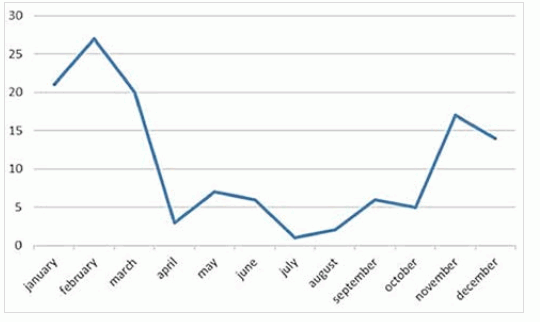
The average age of 383 infants taken to study is 8.2 months. 41.8% of the patients were female (n: 160) and 58.2% were male (n: 223). When stool specimens were examined, 33.68% (n:129) rotavirus antigens were detected in 383 cases. Of this 129 cases in whom rotavirus antigen was detected, 41.9% were female (n:54) and 58.1% were male (n:75). Rotavirus infection was detected most commonly on November, December, January, February, March, at least July and August. Rotavirus infections were seen frequently (46.3%) during winter months.
The clinical manifestations in patients were fever, nausea, vomiting, diarrhea, dehydration and oral feeding impairment. Hyponatremia and hypokalemia were detected in pathological laboratory findings. The mean sodium value of rotavirus positive cases was 131.1 mmol/L and the mean potassium value was 3.12, the mean sodium value of rotavirus negative gastroenteritis was 136.4 mmol/L and the mean potassium value was 4.1 mmol/L.
The mean age of onset of complementary nutrition was 5.9 months in patients with rotavirus negative cases and the age of onset of complementary nutrition in rotavirus positive patients was 3.7 months. Continued breastfeeding was determined 312 (81.4%) of the cases in the study. It was determined 83 (64.3%) of the rotavirus positive cases continued to breastfeeding. The frequency of rotavirus and the length of stay in hospital were longer in the group that started complementary nutrition early. The rate of rotavirus positivity was 18.2% in infants who fed only breast milk for the first 6 months, and 31.4% in infants who fed breast milk + formula mama.
Eighty-nine (%68.9) of rotavirus positive cases were under 1 year old and rotavirus was most frequently seen in children aged 7-12 months in our study. The treatment duration took 15.2 days in rotavirus positive cases and 8.1 days in rotavirus negative cases in this study.
Antibiotic therapy was prescribed to 86 (66%) patients who were found to be positive for rotavirus antigen by family practitoner and in department of pediatric emergency but no clinical improvement was found.
Discussion
Acute gastroenteritis, one of the major causes of morbidity and mortality in infants, is among the most common infections worldwide (3, 8–10).Among acute gastroenteritis agents, viruses are ranked first in the world. Rotavirus is the most common cause of childhood viral gastroenteritis. It leads to hospitalization around the world and leads to very high socioeconomic costs. In the literature, two million children who under five years of age are admitted to the hospital due to rotavirus gastroenteritis, and 527,000 of them have been lost (1, 9, 11–13). In the studies performed in various regions of our country, the frequency of rotavirus was found to between 9.9-39.8%(14–17). According to the World Health Organization (WHO), rotavirus rates in other countries of the world are reported at 5-25% in America, 20-40% in Europe, 30-50% in Asia and 10-65% in Africa (18). In our study, 129 of 383 patients with acute gastroenteritis were found to be rota virus related. Rotavirus antigen positivity was found to be 33.68% similarly to the litherature. Rotavirus infections can be encountered in tropical regions all year around. At areas with temperate climate, such as our country, show a seasonal distribution and usually appear in autumn, winter, and spring (19, 20). In many studies investigating the frequency of rotavirus infections in our country, it has been reported that the frequency of rotavirus is higher in winter months (21, 22). In our study, similar to the literature, rotavirus infections were found to be more frequent in winter than in other seasons. Rotavirus is a disease that with fecalorally transmitted.
Clinically, it can cause fever, vomiting, acute watery and bloodless diarrhea and dehydration after 12-72 hours of incubation. Especially in children under 2 years of age is more severe. (19) Our study population consisted of patients with fever, vomiting, acute watery and bloodless diarrhea and dehydration findings. Electron microscopy for detecting virus in stool, antigen detection by enzyme immunoassay or latex agglutination test, and culturing of virus in stool are the definitive diagnostic methods of viral gastroenteritis. Latex agglutination test is a common diagnostic test for detection of rotavirus antigen in feces (23, 24). In our study, latex agglutination test was used and 33.68% of all patients were rotavirus antigen positive. Studies have reported that the distribution of gender is not different in terms of rotavirus incidence, as well as studies reporting that rotavirus is seen more frequently in girls (16, 25, 26).In our study,41.9%of our cases were female (n:54), 58.1% of our cases were male (n:75). Unlike the literature, rotavirus infections were found to be moderately higher in boys than in girls. The reason for this may be the early start of formula mama for the better development of boys with geographical-cultural reasons.
It has been reported in the literature that diarrhea caused by rotavirus causes more severe clinical symptoms and longer hospital stay than other diarrhea agents. In a study reported that between 3 months and 18 years of age, hospitalization times were found to be 5 days on rotavirus-induced diarrhea (27, 28). In our study, the hospitalization time of patients with rotavirus antigen negative was 8.1 days while the hospitalization time of patients with rotavirus antigen positivity was 15.2 days. Similar to the literature, rotavirus-associated cases were found to have a longer stay in hospital. Our study can be attributed to the fact that our cases consisted of the most frequent and most severe episodes of illness who under 2 years of age.
Turkey Demographic and Health Surveys (TNSA)’s study reported that formula mama and other liquid based formula mama early onset is frequently observed. In TNSA-2013, 12% of infants started complementary nutrition before 6 months of age while this rate was 8% in TNSA-2008 (29). Rotavirus positive cases in our study were started at complementary nutrition mean 3.7 months while rotavirus negative cases were 5.9 months.
Findings in our study are consistent with the literature on the increase in starting rate over the years of complementary nutrition. It was determined that 312 (81.4%) of the all patients included in the study continued breastfeeding. It was determined that 83 (64.3%) of rotavirus positive cases continued breastfeeding. The rate of rotavirus positivity in infants fed only breastfeeding for the first 6 months was 18.2% while that for infants fed breastfeeding+ formula was 31.4%. This result suggests that early start of complementary nutrition improves the frequency of rotavirus infections and that breastfeeding alone in the first six months also reduces the frequency of rotavirus infections. In addition, parents should be aware that for the first 180 days, infants need only breastfeeding. The incidence of rotavirus infections, which is responsible for a large majority of childhood gastroenteritis, is high in both developing and developed countries. Identification of etiologic agent in the cases is extremely important in the treatment and follow-up. It will also prevent use of antibiotics (7, 14). Unnecessary antibiotic therapy was prescribed to 86 (66%) patients who were found to be positive for rotavirus antigen by family practitoner and in department of pediatric emergency but no clinical improvement was found.
In conclusion, in our study and in the light of other studies in the literature, we can say that rotaviruses are the most common cause of acute diarrhea in childhood period. Unfortu-nately, there are not enough studies on the etiology of diarrhea during the infant period in our country. In infants, nutrition, which is the most important indicator of well-being, be deteriorated rapidly in acute gastroenteritis. Therefore, antibiotic treatments are started empirically with the effect of anxiety in parents. The treatment costs of acute viral gastroenteritis, which actually require only supportive treatments, due to unnecessary antibiotic therapy are greatly increased. In addition, our study supports the idea that feeding only breastfeeding for the first six months reduces the frequency of rotavirus infections. For this reason, it is important that parents are made aware of the fact that only the first 180 days should be continued alone breastfeeding in infants.
We think that rotavirus should be kept in mind as an agent of acute diarrhea especially in winter and spring in infants. Thus unnecessary and costly investigations and treatments can be prevented. Additionally, breastfeeding only in the first 180 days will reduce the frequency of rotavirus diarrhea in the infant period.
Declarations
- Author contributions (CRediT)
- All authors contributed equally to all 14 CRediT roles (Conceptualization, Data curation, Formal analysis, Funding acquisition, Investigation, Methodology, Project administration, Resources, Software, Supervision, Validation, Visualization, Writing – original draft, Writing – review & editing).
- Funding
-
Funding information was not reported in the published version of this article.
- Conflicts of interest
- The authors declare that they have no conflict of interest in the current study.
- Ethics approval
- Ethics approval details were not reported in the published version of this article.
- Data availability
- A data availability statement was not reported in the published version of this article.
References (29)
12 of 29 references are linked to their DOI.
- Barbhuiya, NI, et al. Incidence and clinical profile of rotaviral infection among children below 5 years of age admitted with acute diarrhea in a tertiary care hospital of Tripura. Indian Journal of Child Health, 2018;5(2). DOI Crossref PubMed Google Scholar
- Kurugöl Z. and Salman N. Rotavirus infeksiyonları ve aşıları. ANKEM, 2008;22(3):160 -70. PubMed Google Scholar
- Bekdaş M, et al. Acute gastroenteritis during childhood in Bolu, Turkey: 3 years of experience. 2013, GJMEDPH. PubMed Google Scholar
- Hiçer S et al. Incidence assessment of rotavirus and adeno virus associated acute gastroenteritis cases in early child hood. Infez Med, 2011. 19(2):113-9. PubMed Google Scholar
- Bozdayi G et al. Diversity of human rotavirus G9 among children in Turkey. Journal of medical virology, 2008: 80(4): 733-740. DOI Crossref PubMed Google Scholar
- Soriano- Gabarró M et al. Burden of rotavirus disease in European Union countries. The Pediatric infectious disease journal, 2006;25(1):7 -11. DOI Crossref PubMed Google Scholar
- Elliott EJ. Acute gastroenteritis in children. British Medical Journal, 2007;334(7583): 35. DOI Crossref PubMed Google Scholar
- Kosek M, C. Bern, R.L. Guerrant. The global burden of diarrhoeal disease, as estimated from studies published between 1992 and 2000. Bulletin of the World Health Organization, 2003;81:197-204. PubMed Google Scholar
- Guarino A et al. European Society for Pediatric Gastro enterology, Hepatology, and Nutrition/European Society for Pediatric Infectious Diseases evidence-based guidelines for the management of acute gastroenteritis in children in Europe: update 2014. Journal of pediatric gastroenterology and nutrition, 2014;59(1):132-152. DOI Crossref PubMed Google Scholar
- Guarino A et al. European Society for Paediatric Gastro enterology, Hepatology, and Nutrition/European Society for Paediatric Infectious Diseases evidence-based guidelines for the management of acute gastroenteritis in children in Europe: executive summary. Journal of pediatric gastro enterology and nutrition, 2008; 46(5):619-621. DOI Crossref PubMed Google Scholar
- Regagnon C et al. Rapid diagnosis of rotavirus infections: comparative prospective study of two techniques for antigen detection in stool. Pathologie-biologie, 2006;54(6):343 -346. PubMed Google Scholar
- Rodriguez-Baez N et al. Astrovirus, adenovirus, and rotavirus in hospitalized children: prevalence and association with gastroenteritis. Journal of pediatric gastroenterology and nutrition, 2002;35(1):64-68. DOI Crossref PubMed Google Scholar
- Enweronu- Laryea CC et al. Prevalence of severe acute rotavirus gastroenteritis and intussusceptions in Ghanaian children under 5 years of age. The Journal of Infection in Developing Countries, 2011;6(02):148-155. DOI Crossref PubMed Google Scholar
- Biçer S et al. Çocuk Acil Servisinde Saptanan Rotavirus Gastro enteriti Olgulannın Sıklığı. Journal of Pediatric Infection/ Cocuk Enfeksiyon Dergisi, 2008;2(3). PubMed Google Scholar
- Kurugol Z et al. Rotavirus gastroenteritis among children under five years of age in Izmir, Turkey. Turkish Journal of Pediatrics, 2003;45(4):290 -294. DOI Crossref PubMed Google Scholar
- Akıncı N et al. Akut gastroenteritli çocuklarda adenovirus ve rotavirus. J Pediatr Inf, 2007;1(3):98-101. PubMed Google Scholar
- Gürbüz F, Tezer H, Sayli TR, Akut gastroenterit nedeniyle hastaneye yatan hastalarda etkenler ve klinik bulgular: Epidemiyolojik çalışma. Türkiye Çocuk Hastalıkları Dergisi, 2010;4(4). PubMed Google Scholar
- Organization, WH. Global Rotavirus Information and Surveillance Bulletin, Vol: 3. 2011, WHO Press, Geneva. PubMed Google Scholar
- Bicer S et al. Frequency of gastroenteritis in pediatric emergency department/Cocuk acil servisinde saptanan rotavirus gastroenteriti olgularinin sikligi. Journal of Pediatric Infection, 2008;96-100. PubMed Google Scholar
- İlktaç M. Akut gastroenteritli çocuklarda rotavirus sikliğinin araştirilmasi ve rotavirus sezonunun takibi: beş yillik sonuçlarin değerlendirilmesi. Ankem Derg, 2012;26(1): 25-29. PubMed Google Scholar
- Yüksel P et al. Çocukluk yaş grubu gastroenteritlerinde rota virus antijen pozitifliğinin değerlendirilmesi. Klimik Derg, 2011;24(1):48-51. PubMed Google Scholar
- Inci, A, Kurtoglu M, Baysal B. Bir Eğitim Ve Araştirma Hastanesinde Rotavirus Gastro-Enteriti Prevalansinin Araştirilmasi. İnfeksiyon Dergisi (Turkish Journal of Infection), 2009;23(2):79-82. PubMed Google Scholar
- Tünger O. Akut gastroenteritli çocuklarda rotavirus ve adeno virus tip, 1997;40: 41. PubMed Google Scholar
- Yaman A et al. İshalli çocuklarda rotavirüs prevalansının ELISA ve Lateks aglütinasyon metodu ile araştırılması. İnfeksion Derg, 1997;11(3):279-281. PubMed Google Scholar
- Şimşek Y et al. Çocuklarda Akut Gastroenteritte Rotavirüs Sıklığı ve Serotip Özellikleri. Turkiye Klinikleri Journal of Pediatrics, 2007;16(3):165 -170. PubMed Google Scholar
- Öner N et al. Trakya bölgesinde hastaneye yatan ishalli çocuklarda infeksiyon etkenleri diğer bölgelerden farklılık gösteriyor mu. The Journal of the Child, 2003;3:13-15. PubMed Google Scholar
- Lee BP et al. Nonmedical costs associated with rotavirus disease requiring hospitalization. The Pediatric infectious disease journal, 2005;24(11):9 84-988. DOI Crossref PubMed Google Scholar
- Chen SY et al. Molecular epidemiology and clinical manifestations of viral gastroenteritis in hospitalized pediatric patients in Northern Taiwan. Journal of clinical microbiology, 2007; 45(6):2054-2057. DOI Crossref PubMed Google Scholar
- Kahraman F, Gül SS. Türkiye’de Çocuk Yoksulluğu: Gaziantep Üzerine Bir Araştirma. Hitit Üniversitesi Sosyal Bilimler Enstitüsü Dergisi, 2015;8(1). DOI Crossref PubMed Google Scholar
Respond to this article
Comments on a published article are welcome as a Letter to the Editor.
Get an e-mail when new articles in your fields are published
Questions to the authors
Questions are moderated: an editor approves each question, the authors answer, and an editor approves the answer before both appear here.
No answered questions yet.
Ask the authors a question
Discussion
Comments are moderated: they appear after the writer confirms the e-mail address and an editor approves them. Each comment carries a conflict-of-interest statement.
No comments yet.
Write a comment
Tell me when this article is cited
Leave your e-mail address and confirm it. These notices are not being sent yet; your confirmed address is kept for them and used for nothing else.
Read the full text
Open the PDF here
Loading the PDF…
If the PDF does not show here, use the download button above.
How to cite this article
EL C, Celikkaya ME. Complementary Nutrition and Breastfeeding In Rotavirus Diarrhea. Ulutas Med J. 2018;4(2):97-102. doi:10.5455/umj.20180611124118
EL, C., & Celikkaya, M. E. (2018). Complementary Nutrition and Breastfeeding In Rotavirus Diarrhea. The Ulutas Medical Journal, 4(2), 97–102. https://doi.org/10.5455/umj.20180611124118
EL, C. and Celikkaya, M.E. (2018) 'Complementary Nutrition and Breastfeeding In Rotavirus Diarrhea', The Ulutas Medical Journal, 4(2), pp. 97–102. doi: 10.5455/umj.20180611124118.
@article{umj301628,
  title = {Complementary Nutrition and Breastfeeding In Rotavirus Diarrhea},
  author = {EL, Cigdem and Celikkaya, Mehmet Emin},
  journal = {The Ulutas Medical Journal},
  year = {2018},
  volume = {4},
  number = {2},
  pages = {97--102},
  doi = {10.5455/umj.20180611124118},
  url = {https://www.ulutasmedicaljournal.com/?mno=301628},
  issn = {2149-388X}
}