The Ulutas Medical Journal · ISSN 2149-0430 (print), 2149-388X (online) · https://www.ulutasmedicaljournal.com/?mno=47571
Letter to the Editor · Open access
Antimicrobial Resistance in Taiwan During COVID-19 Pandemic
Also available in: العربية · Türkçe · 中文
Abstract
Coinfection or secondary infection is not uncommon for COVID-19 patients, especially for patients with a critical illness (1). The appropriate antibiotic should be indicated for the population, however, we should also seriously concerned about another important issue about the possible altered antimicrobial resistance due to the increasing use of antibiotics during the COVID-19 pandemic (2-4). Therefore, we conducted this study to assess the change of antibiotic resistance before and after the COVID-19 outbreak using an open database-Taiwan Nosocomial Infection surveillance System (TNIS). The TNIS was launched by Taiwan Centers for Disease Control in 2007, which aimed to monitor the occurrence of healthcare-associated infections (HAIs) and to assess the epidemiologic trends of HAIs. In addition to HAI, this system also provided the antimicrobial susceptibility results from reporting hospitals, including a medical center and regional hospitals. This study used the recent report of TNIS, which showed the surveillance results of HAI and associated antimicrobial resistance to this June, for analysis (5). Percentage (%) change was defined as the difference in the number of antibiotic resistance rates between 2020 and 2019, divided by the resistance rate in 2019 and multiplied by 100
Keywords
Full text
Dear Editor, Coinfection or secondary infection is not uncommon for COVID-19 patients, especially for patients with a critical illness (1). The appropriate antibiotic should be indicated for the population, however, we should also seriously concerned about another important issue about the possible altered antimicrobial resistance due to the increasing use of antibiotics during the COVID-19 pandemic (2–4). Therefore, we conducted this study to assess the change of antibiotic resistance before and after the COVID-19 outbreak using an open epidemiologic trends of HAIs. In addition to HAI, this system also provided the antimicrobial susceptibility results from reporting hospitals, including a medical center and regional hospitals. This study used the recent report of TNIS, which showed the surveillance results of HAI and associated antimicrobial resistance to this June, for analysis (5). Percentage (%) change was defined as the difference in the number of antibiotic resistance rates between 2020 and 2019, divided by the resistance rate in 2019 and multiplied by 100.
database-Taiwan Nosocomial Infection First, this summary of antibiotic resistance surveillance System (TNIS).
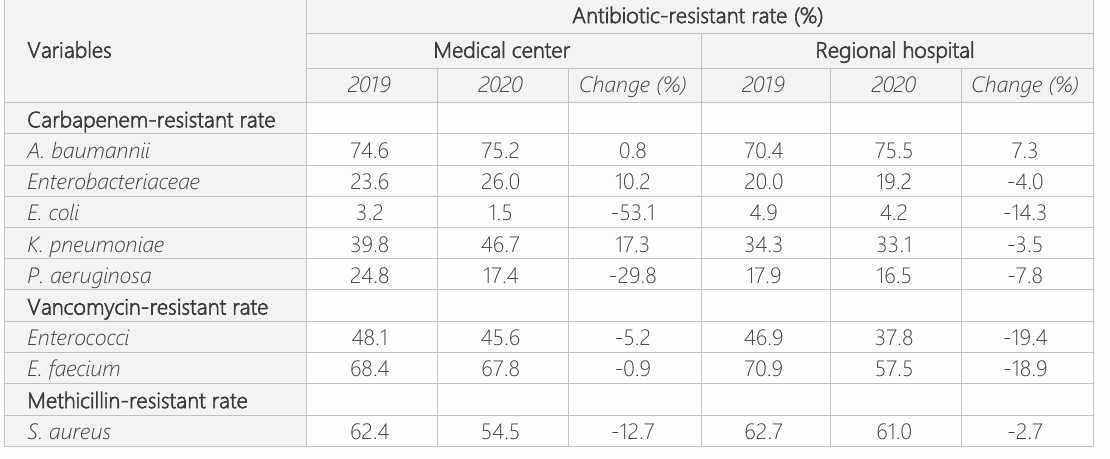
The TNIS was launched by Taiwan Centers for Disease Control in 2007, which aimed to monitor the occurrence of healthcare-associated infections (HAIs) and to assess the among the clinical isolates causing HAIs in the medical center’s intensive care unit (ICU) collected between January and July 2020 showed carbapenem-resistance rate among clinical isolates of Acinetobacter baumannii, Enterobacteriaceae, Escherichia coli, Klebsiella pneumonia, and Pseudomonas aeruginosa were 75.2%, 26%, 1.5%, 46.7%, and 17.4%, respectively. Vancomycin-resistance among E. faecium and Enterococci was 45.6% and 67.8%, respectively. Methicillin-resistance rate among Staphylococcus aureus was 54.5% (Table 1). Second, the findings in regional hospital’s ICU showed carbapenem-resistance among clinical isolates of A. baumannii, Entero bacteriaceae, E. coli, K. pneumoniae, and P. aeruginosa were 75.5%, 19.2%, 4.2%, 33.1%, and 16.5%, respectively. Vancomycin-resistance among Enterococci and E. faecium was 37.8% and 57.5%, respectively. Methicillin-resistance rate among S. aureus was 61%. Third, the change of antibiotic resistance rate between 2019 and the first half of 2020 showed carbapenem-resistance rate among A. baumannii, Entero bacteriaceae, and K. pneumoniae had an increase in the medical center from 2019 to 2020. In contrast, another kind of antibiotic resistance rate had decreased from 2019 to 2020. Finally, a similar trend was observed in a regional hospital. The only carbapenem-resistance among A. baumannii had increased, but other antibiotic-resistant had decreased. In this letter, we shared the increasing carbapenem-resistant rate during the COVID- 19 pandemic among the clinical A. baumannii isolates in the ICU in both medical centers and regional hospitals. Besides, the carbapenem-resistant rate among K. pneumoniae isolates was found to be increasing in medical centers’ ICU. In contrast, we observed the resistance rates were decreasing for the carbapenem against E. coli and P. aeruginosa, vancomycin against Enterococci, and methicillin-against S. aureus isolates collected in both medical center and regional hospitals’ ICUs. Our findings suggest that we should keep on appropriate antibiotic prescribing practices according to antimicrobial stewardship programmers, the use of carbapenem in Taiwan particularly. Besides, the regular monitoring of antimicrobial resistance results in each hospital is helping to establish the epidemiologic database for the clinicians’ reference in the prescribing of antimicrobial agents. However, our finding was just based on short-term surveillance. Further long-term assessment of the impact of COVID- 19 on antimicrobial resistance is warranted.
Declarations
- Author contributions (CRediT)
- All authors contributed equally to all 14 CRediT roles (Conceptualization, Data curation, Formal analysis, Funding acquisition, Investigation, Methodology, Project administration, Resources, Software, Supervision, Validation, Visualization, Writing – original draft, Writing – review & editing).
- Funding
-
Funding information was not reported in the published version of this article.
- Conflicts of interest
- The author declare s no competing interests.
- Ethics approval
- Ethics approval details were not reported in the published version of this article.
- Data availability
- Data sharing is not applicable to this article as no new data were created or analysed in this study.
References (5)
4 of 5 references are linked to their DOI.
- Lai CC, Wang CY, Hsueh PR. Co-infections among patients with COVID-19: The need for combination therapy with non-anti-SARS- CoV-2 agents? J Microbiol Immunol Infect 2020;53 (4):505-512 DOI Crossref PubMed Google Scholar
- Gonzalez-Zorn B. Antibiotic use in the COVID-19 crisis in Spain. Clin Microbiol Infect 2020 Nov 18;S1198-743X(20)30609- DOI Crossref PubMed Google Scholar
- Ruiz J. Enhanced antibiotic resistance as a collateral COVID-19 pandemic effect? J Hosp Infect 2020 Nov 17;S0195-6701 (20)30524-7 DOI Crossref PubMed Google Scholar
- Chibabhai V, Duse AG, Perovic O, Richards GA. The c ollateral damage of the COVID-19 pandemic: Exacerbation of anti-microbial resistance and disruptions to antimicrobial stewardship programs? S Afr Med J 2020;110:572-3 DOI Crossref PubMed Google Scholar
- Taiwan Centers for Disease Control. https://www.cdc.gov. tw/File/Get/sqrAKrJg_Uq8Ki5B0HtO3g?path=C_rEhWX_cIvurxn L9WQhEqxl1a7pa53jnCNLMVBsVajsKVNYXEgvuoiuF2518Ayg& name=8Tz0-xqvc_ePRqgyTaTUF_7lY4X6Tv5Nd5U3DqXehIFKV ffarzIx374ceBO3CQOxo4pblzzOKBfbGvuBzLMRGMh9nnhyUw SKC8GMyrzZGuD3Ls461ppgllxYkQF4i-kHrTE3P14gExT6vrw2_G C1xA. Accessed on December 3, 2020 PubMed Google Scholar
Respond to this article
Comments on a published article are welcome as a Letter to the Editor.
Get an e-mail when new articles in your fields are published
Questions to the authors
Questions are moderated: an editor approves each question, the authors answer, and an editor approves the answer before both appear here.
No answered questions yet.
Ask the authors a question
Discussion
Comments are moderated: they appear after the writer confirms the e-mail address and an editor approves them. Each comment carries a conflict-of-interest statement.
No comments yet.
Write a comment
Read the full text
Open the PDF here
Loading the PDF…
If the PDF does not show here, use the download button above.
How to cite this article
Chao CM. Antimicrobial Resistance in Taiwan During COVID-19 Pandemic. Ulutas Med J. 2021;7(1):1-3. doi:10.5455/umj.20210121074612
Chao, C. M. (2021). Antimicrobial Resistance in Taiwan During COVID-19 Pandemic. The Ulutas Medical Journal, 7(1), 1–3. https://doi.org/10.5455/umj.20210121074612
Chao, C.M. (2021) 'Antimicrobial Resistance in Taiwan During COVID-19 Pandemic', The Ulutas Medical Journal, 7(1), pp. 1–3. doi: 10.5455/umj.20210121074612.
@article{umj47571,
  title = {Antimicrobial Resistance in Taiwan During COVID-19 Pandemic},
  author = {Chao, Chien-Ming},
  journal = {The Ulutas Medical Journal},
  year = {2021},
  volume = {7},
  number = {1},
  pages = {1--3},
  doi = {10.5455/umj.20210121074612},
  url = {https://www.ulutasmedicaljournal.com/?mno=47571},
  issn = {2149-388X}
}