The Ulutas Medical Journal · ISSN 2149-0430 (print), 2149-388X (online) · https://www.ulutasmedicaljournal.com/?mno=61237
Original Article · Open access
Head and Neck Cancer in Geriatric Population in A Tertiary Care Institute in India: Lessons Learnt
Also available in: العربية · Türkçe · 中文
Abstract
- Background
- Head and neck cancers are the most common cancers seen in the developing countries. The proportion of elderly population is rising all over the world and so are the cancers prevalent in this population. In the Indian subcontinent, 10% of all head and neck cancers are seen in the elderly. The present study attempts to analyse the patient demographics and management options practiced in head and neck cancer patients in geriatric patients.
- Materials and methods
- This is a retrospective study of all pathologically confirmed head and neck cancer patients more than 65 years of age presenting to the Radiation Oncology.
- Results
- A total of 469 elderly patients were treated between 2013 and 2016 in the department of radiation oncology, FMRI. Of these 67 patients were head and neck cancers. Majority (59%) presented in the age group of 65-70 years. Commonest site is oral cavity 25 (37%) followed by larynx 18 (27%), oropharynx 7 (11%) and hypopharynx 9 (13%). Only 17 (24%) patients had Stage I-II disease whereas 50 (75%) patients had Stage III-IV disease.
- Conclusion
- There is significant number of geriatric patients of head and neck cancers presenting to the hospital in the last 3 years. The present study underlines the importance of developing institutional management protocols for the geriatric head and neck cancer patients for optimal results.
Keywords
Full text
Introduction
Head and neck cancers are the most common cancers seen in the developing countries attributed mainly to the prevalence of tobacco consumption in low socioeconomic strata of society (1). The proportion of the elderly population is rising all over the world, and so are the cancers prevalent in this population. In the SEER database analysis, half of all cases of head and neck cancers are seen in the geriatric population (2). In the Indian subcontinent, 10% of all head and neck cancers are seen in the elderly. (3). According to the population census of 2011, there are nearly 104 million elderly populations above the age of 60 years(4). There is ample evidence to suggest the correlation between cancer development and ageing (5). The changes in physiological processes with a consequent decrease in functional reserve is associated with reduced tolerance to any therapy, particularly a radiation therapy (6). Associated factors such as multiple malignancy, comorbidities, poor performance status, limited supportive care further add on to the cautious choice of treatment (7). As a result, often, the desired treatment regimen is not employed, increasing the recurrence and mortality rates in this patient population. In India, the elderly population in the rural areas are still biased in taking any modern medicine and have belief in alternative and traditional forms of medicine. There is a component of neglect on the part of family members too, in taking them for treatment. This is contrary to the belief system in the Western, where there is more awareness and willingness to take treatment.
Pignon et al. in their study of 1307 head and neck cancer patients between ages 50-75 and treated by radiotherapy alone concluded that older patients had more severe functional acute toxicity (p <0.001) (8). Meanwhile, retrospective studies (9, 10) have confirmed the absence of the correlation between age and toxicity, supporting the theory that the functional impact of the treatment in older patients might be increased compared to younger patients. The treatment options of surgery, radiation therapy, chemotherapy and immunotherapy are utilised according to individual tolerance. There have been retrospective studies that have shown that there is no correlation between age and radiation-related acute side effects (11). A considerable proportion of elderly patients suffering from various cancers are seen at our centre - Head and neck cancers being the most common. Although Tygai et al. in their study conducted in the same hospital have not mentioned head and neck cancers being the commonest in the elderly. However, the age-specific incidence of head neck cancer is not taken into account (12). The present study attempts to analyse the patient demographics and management options practised in head and neck cancer patients in geriatric patients treated between January 2013-December 2016 in department of radiation oncology, Fortis Memorial Research Institute, Gurgaon, India.
Material and Methods
This is a retrospective study of all cancer patients more than 65 years of age who presented to the Department of Radiation Oncology, Fortis Memorial Research Institute, Gurgaon from September 2012 to December 2016. All pathologically confirmed head and neck cancers, including recurrent or second primary head and neck cancers, were included in the analysis.
Management approaches Each patient was thoroughly assessed by the treating radiation oncologist and treatment decisions according to standardised policies and individualised according to patient needs of tumour extent and performance status. Chronologic age was not a criterion in itself to determine the use of treatment modality. The treatment intent and treatment modalities were discussed with patient and/or family. The cases were discussed in the weekly multi-disciplinary tumour board meetings for recommendations and quality assurance. Patients scheduled to receive radiation therapy (RT), the RT regimen, RT volume, and plan was reviewed in a weekly RT quality assurance round. The patients were asked to undergo pre-RT dental evaluation, and a detailed diet plan was advised by the dietician during RT. Patients were assessed for the likelihood of Ryle’s tube insertion during RT and in cases of dysphagia Ryle’s tube insertion was done before starting treatment.
The demographic details including age, sex, comorbidities, history of malignancy, personal habits of tobacco consumption and alcohol, pathology of the disease, subsite and stage of the disease, treatment are given, and telephonic enquiries of disease status were made and recorded.
Statistical Analysis
Collected data were entered in MS Excel, and results generated were analysed. Descriptive statistical measures such as percentage, mean, and standard deviation were applied.
Results
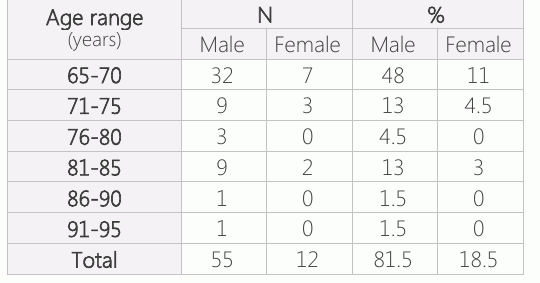
A total of 469 elderly patients were treated between January 2013 and December 2016 in the department of Radiation Oncology, FMRI. Of these 67 patients were head and neck cancers. The cohort had 55 (82%) males and 12 (18%) females. The median age was 70 years. The majority (59%) presented in the age group of 65-70 years and 21% in the age group 71- 75 years (Table-1).
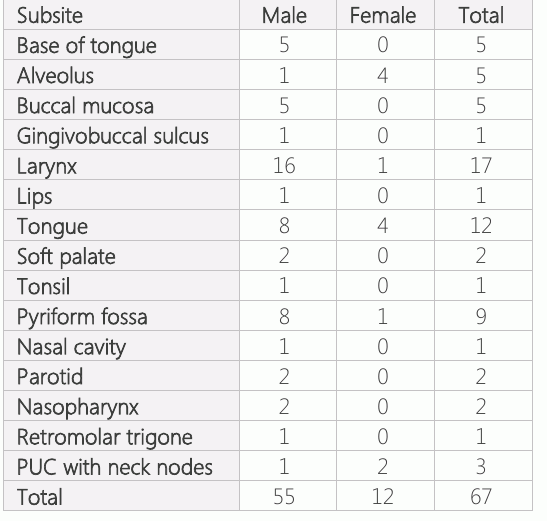
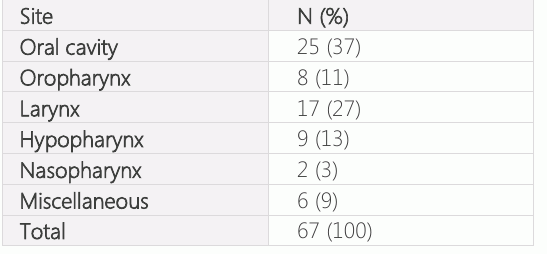
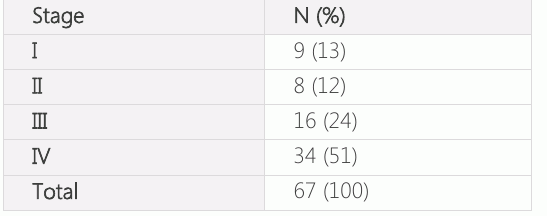
Most frequent site seen was oral cavity 25 (37%) followed by larynx 18 (27%), oropharynx 7 (11%) and hypopharynx 9 (13%) as shown in Tables-2 and 3. Only 17 (24%) patients had Stage I-II disease, whereas 50 (75%) patients had Stage III-IV disease (Table-4). Palliative radiotherapy regimen delivered included doses between 20Gy in 5#s to 30 Gy/10#s in 10 patients. Of all the patients of stage IV disease, four patients had metastatic disease, and one patient developed solitary lung metastasis that was treated by radiation.
None of the metastatic patients was treated with radical radiation therapy doses. Only one patient received concurrent chemotherapy along with radiation.
Discussion
The study analysed the clinical characteristics, and management approaches in elderly (aged >65 years) head and neck cancer patients according to referrals to radiation oncology in our institution. The elderly head and neck cancer population in the study represents 14% of all sites in the elderly population presented for treatment in radiation oncology department for the said duration. The hospital is a multi-specialty corporate hospital, has higher treatment costs as compared to the state-run hospitals. Therefore, higher socioeconomic category and well-educated patients visit only this hospital for treatment. Hence, the figures in this study may not be representative of the population in general. In a study by Patel et al., the prevalence of neglect in the geriatric population in India is 17% (13). This is a large proportion of the population, and it may affect the early diagnosis of cancer in the geriatric population, thereby affecting survival and quality of life. It adds to the health burden of the population. Neglect may well be considered to be the factor due to the increased proportion of Stage III/IV patients. In this study, there is a significant difference between males and females presenting to the department for treatment- 18% vs 82%. The overall incidence of head and neck cancer in females as reported in the study by Pothamsetty et al. is 15% (14). The results of both studies are similar, and the difference is marginal. In a study by Patil et al. of a hospital-based registry in Kerala, approximately 46% of the patients received curative-intent treatment in the rural set-up (15). In this study, 85% of patients received curative-intent treatment even in locally advanced stages where treatment was palliative with curative intent. It is encouraging data that shows that the elderly population in affluent strata of our society are aware and better cared for as compared to the rural patient population. The reason for this rural-urban difference could also be a lack of finances and carers to look after the elderly population. The median age was 75 years in the study by Patil et al., whereas, in the present study, the median age is 70 (15). In the present cohort, laryngeal cancer is the commonest subsite with 17 (25%) patients followed by tongue in 12 (17%) patients. In the broad site division, oral cavity cancer is the commonest (25, 37%) followed by laryngeal cancer. In the study published by Dhillon et al. lip and oral cavity, cancers are the commonest amongst head and neck cancer (16). Contrary to this, in the study by Huang et al., laryngeal cancers were the most prevalent, followed by oral cavity cancers (17).
Siddiqui et al. have reported a locally advanced stage of cancer in two-thirds of the elderly head and neck cancer patients in the Western population (18). In the present study, 75% of patients had stage III or IV disease. Of the stage IV patients, five patients had distant metastases. These figures are in congruence with 77% Stage III and IV elderly patients in the multicentric study by Thiagrajan et al. (19). The purpose of any analysis is to strive to fill the knowledge gaps. Corporate establishments work on the fundamentals of demand and provide. By analysing the number of geriatric patients visiting the hospital, the scope of improvement in the provision of facilities and any service gaps may be filled. An important aspect of geriatric care is the availability of adequate dedicated staff for each patient during hospital stay hours, dedicated psychologists as a part of cancer care and individual slots for the elderly patients to cut down wait times.
If the patient numbers justify the financial investment on the part of hospital for providing dedicated wards, comfortable waiting areas etc. the observational study has served the purpose. In the present study, there has been a lack of proper geriatric assessment before taking the patients for treatment. This gap in management needs to be covered in future by delineating a staff for it to avoid treatment delays in routine works. The large proportion of locally advanced head and neck cancers seen in the study indicates the need to create awareness in the neighbouring communities to avoid neglect of health of elderly members of the household.
Conclusion
Improvement in access to healthcare shall increase the ageing population in our country. The likelihood of an increased proportion of older adults with head and neck cancers will continue to grow. Many of the patients we see in the clinic would not have been eligible for the “standard-of-care” treatment approaches for locally advanced head and neck cancers. Therefore, blindly following available evidence cannot be applied to our patient population of geriatric population. As highlighted above, there is a significant number of geriatric patients of head and neck cancers presenting to the hospital in the last three years. The present study has laid the foundation for studying the management of these patients and their outcomes. At the same, it reinforces the concept of having a department treatment protocol for geriatric patients of head and neck cancers. Similar analyses of other sites will help in establishing management goals and processes for other disease sites as well.
Declarations
- Author contributions (CRediT)
- All authors contributed equally to all 14 CRediT roles (Conceptualization, Data curation, Formal analysis, Funding acquisition, Investigation, Methodology, Project administration, Resources, Software, Supervision, Validation, Visualization, Writing – original draft, Writing – review & editing).
- Funding
-
Funding information was not reported in the published version of this article.
- Conflicts of interest
- The author has declared no conflict of interest for the present article.
- Ethics approval
- Ethics approval details were not reported in the published version of this article.
- Data availability
- A data availability statement was not reported in the published version of this article.
References (19)
15 of 19 references are linked to their DOI.
- Francis CJK. Trends in incidence of head and neck cancers in India. ESMO Asia 2016 Congress. Aetiology, Epidemiology, Screening and Prevention Head and Neck Cancers. 17 December 2016. DOI Crossref PubMed Google Scholar
- Surveillance Epidemiology and End Results (SEER): SEER Cancer Statistics Review, 1975-2015 PubMed Google Scholar
- Subramaniam NR, Srinivasalu VK, Balasubramanian D, Pushpaja KU, Nair AR, Prameela C et al. Radical radiotherapy for carcinoma of the larynx in the elderly: Functional and oncological outcomes from a tertiary cancer care center in India. Indian J Cancer. 2017 Jul-Sep; 54(3):493-497 DOI Crossref PubMed Google Scholar
- Mospi.gov.in[internet] http://www.mospi.gov.in/sites/default /files/publication_reports/ElderlyinIndia_2016.pdf, page 9. Accessed on June 12, 2019 PubMed Google Scholar
- Irminger-Finger I. Science of cancer and aging. J Clin Oncol 2007;25(14):1844– 51 DOI Crossref PubMed Google Scholar
- Jaime Gomez-Millan. Radiation therapy in the elderly: More side effects and complications? Critical Reviews in Oncology/ Hematology 71(2009):70-78 DOI Crossref PubMed Google Scholar
- Hirano M, Mori K. Management of cancer in the elderly: therapeutic dilemmas. Otolaryngol Head Neck Surg. 1998 Jan; 118(1):110-4 DOI Crossref PubMed Google Scholar
- Pignon T, Horiot JC, Van den Bogaert W, Van Glabbeke M, Scalliet P. No age limit for radical radiotherapy in head and neck tumours. Eur J Cancer 1996; 32A (12):2075 –81 DOI Crossref PubMed Google Scholar
- Chin R, Fisher RJ, Smee RI, Barton MB. Oropharyngeal cancer in elderly. Int J Radiat Oncol Biol Phys 1995; 32(4):1007 -16 DOI Crossref PubMed Google Scholar
- Lusinchi A, Bourhis J, Wibault P, Le Ridant AM, Eschwege F. Radiation therapy for head and neck cancers in the elderly. Int J Radiat Oncol Biol Phys 1990; 18(4):819– 23 DOI Crossref PubMed Google Scholar
- Allal AS, Maire D, Becker M, Dulguerov P. Feasibility and early results of accelerated radiotherapy for head and neck carcinoma in the elderly. Cancer 2000; 88(3):648– 52 DOI Crossref PubMed Google Scholar
- Tyagi BB, Mohanti BK, Kabra V, Munshi A, Bhardwaj NK, Sahai SK et al. Morbidity Patterns in Oncology Patients at FMRI, Gurgaon:A Hospital Based Study at a New Tertiary Care Institute. American Journal of Cancer Epidemiology and Prevention 2014, 3:8-22 PubMed Google Scholar
- Patel VK, Tiwari DS, Shah VR, Patel MG, Raja HH, Patel DS. Prevalence and Predictors of Abuse in Elderly Patients with Depression at a Tertiary Care Centre in Saurashtra, India. Indian J Psychol Med. 2018 Nov-Dec; 40(6): 528-533 DOI Crossref PubMed Google Scholar
- Pothamsetty RK, Ghosh RR, Thaliath BP. Cancer Magnitude in Elderly Indian Women, an Experience from Regional Cancer Centre, India. Invest Gynecol Res Women’s Health, 2017;1(3) DOI Crossref PubMed Google Scholar
- Patil VM, Chakraborty S, Dessai S, Kumar SS, Ratheesan K, B indu T et al. Patterns of care in geriatric cancer patients – An audit from a rural based hospital cancer registry in Kerala. Indian J Cancer 2015; 52:157-61 Head and Neck Cancer in Geriatric Population Meena Tiwari DOI Crossref PubMed Google Scholar
- Dhillon PK, Mathur P, Nandakumar A, Fitzmaurice C, Kumar GA, Mehrotra R et al. The burden of cancers and their variations across the states of India: the Global Burden of Disease Study 1990–2016. Lancet Oncol 2018; 19: 1289–306 PubMed Google Scholar
- Huang SH, Brian O’Sullivan, Waldron J, Lockwood G, Bayley A, Kim J et al. Patterns Of Care In Elderly Head-And-Neck Cancer Radiation Oncology Patients: A Single-Center Cohort Study; Int. J. Radiation Oncology Biol. Phys., 2011; Vol. 79, No. 1, pp. 46–51 DOI Crossref PubMed Google Scholar
- Siddiqui F, Gwede CK. Head and Neck Cancer in the Elderly Population. Semin Radiat Oncol 2012, 22:321-333 DOI Crossref PubMed Google Scholar
- Thiagarajan S, Babu T, Chakraborthy S, Patil VM, Bhattacharjee A, Balasubramanian S. Head and neck cancer in geriatric patients: Analysis of the pattern of care given at a tertiary cancer care center. Indian J Cancer 2015; 52:387-90 DOI Crossref PubMed Google Scholar
Respond to this article
Comments on a published article are welcome as a Letter to the Editor.
Get an e-mail when new articles in your fields are published
Questions to the authors
Questions are moderated: an editor approves each question, the authors answer, and an editor approves the answer before both appear here.
No answered questions yet.
Ask the authors a question
Discussion
Comments are moderated: they appear after the writer confirms the e-mail address and an editor approves them. Each comment carries a conflict-of-interest statement.
No comments yet.
Write a comment
Read the full text
Open the PDF here
Loading the PDF…
If the PDF does not show here, use the download button above.
How to cite this article
Tiwari M. Head and Neck Cancer in Geriatric Population in A Tertiary Care Institute in India: Lessons Learnt. Ulutas Med J. 2019;5(3):215-220. doi:10.5455/umj.20190813065101
Tiwari, M. (2019). Head and Neck Cancer in Geriatric Population in A Tertiary Care Institute in India: Lessons Learnt. The Ulutas Medical Journal, 5(3), 215–220. https://doi.org/10.5455/umj.20190813065101
Tiwari, M. (2019) 'Head and Neck Cancer in Geriatric Population in A Tertiary Care Institute in India: Lessons Learnt', The Ulutas Medical Journal, 5(3), pp. 215–220. doi: 10.5455/umj.20190813065101.
@article{umj61237,
  title = {Head and Neck Cancer in Geriatric Population in A Tertiary Care Institute in India: Lessons Learnt},
  author = {Tiwari, Meena},
  journal = {The Ulutas Medical Journal},
  year = {2019},
  volume = {5},
  number = {3},
  pages = {215--220},
  doi = {10.5455/umj.20190813065101},
  url = {https://www.ulutasmedicaljournal.com/?mno=61237},
  issn = {2149-388X}
}