The Ulutas Medical Journal · ISSN 2149-0430 (print), 2149-388X (online) · https://www.ulutasmedicaljournal.com/?mno=69569
Original Article · Open access
Comparison of Partial Internal Sphincterotomy and Partial Internal Sphincterotomy with Additional Advancement Flap Anoplasty in the Treatment of Chronic Anal Fissure
- General Surgery, Health Ministry Gebze Fatih State Hospital General Surgery Clinic, Kocaeli, Turkey ROR
- General surgery specialist, Health Ministry Gebze Fatih State Hospital General Surgery Clinic, Kocaeli, Turkey ROR
Abstract
- Introduction
- We aimed to compare the results of our patients who have undergone lateral internal sphincterotomy and lateral internal sphincterotomy with additional advancement flap anoplasty. The success rate and complication rate of both methods were compared concerning the literature.
- Materials and methods
- We have retrospectively evaluated charts of patients who have undergone the operation for chronic anal fissure between January 2015 and July 2018. A total of 123 patients were separated into two groups as partial Lis+anoplasty (group-I, n:76) and only partial Lis (group-II, n:47) groups. Age, sex, follow up time, anal examination findings, pain, bleeding, constipation score, patient satisfaction score, VAS pain score during rest or stooling, and recurrence and continence rates of patients were recorded.
- Results
- 61 male (49,59%) and 62 female (50,41%) total 123 patients were included. The mean age of the patients was 42,87±11,69 years. The duration of the operation was 28,50±11,61 min. The hospital stay was 1,50±0,70 days. The mean follow-up time was 24±10 months. In group-II patients (15.22%), the recurrence was higher than group I. Similarly, bleeding (10.87%), pain (13.04%), and discomfort (15.22%) were higher in group-II compared to group-I. Bleeding, constipation score, VAS stooling and resting scores were higher in group-II, while the satisfaction score was found higher in group-I. There was no difference between the two groups in terms of incontinence rate.
- Conclusion
- Adding advancement flap anoplasty to partial internal sphincterotomy has increased the success rate by decreasing recurrences in our study and similar studies in the literature.
Keywords
Full text
Introduction
A chronic anal fissure is a non-healing tear of distal anal mucosa below the dentate line (1). It was reported that 10% of the visits to the colorectal clinical units are for anal fissure and it is more frequent between 20-39 years of age (2). It usually occurs because of factors such as constipation, diarrhea and surgery all of which cause trauma at the anal canal (3). The tear occurring at anoderm triggers spasm at the internal anal sphincter. This spasm, in turn, causes pain and further tears and decreases the blood supply of anoderm. This pain, spasm and ischemia vicious cycle may lead to a non-healing chronic anal fissure (4). Fissures lasting more than four weeks tend to become chronic. Induration within the margins of the fissure, presence of internal sphincter fibers at the base, presence of sentinel polyp, or fibro-epithelial polyp is findings in favor of fissure chronicity (5). In acute fissures, medical and conservative treatment methods may suffice for healing without surgery; however, in chronic fissures success rate is much lower (3). In patients who are considered chronic and did not respond to medical therapy surgical treatment is mostly necessary.
Lateral internal sphincterotomy (LIS) with a 92-100% healing rate is considered as the golden standard (5). LIS is described as open-closed, complete-incomplete, depending on the discretion of the surgeon and patient preference (6, 7). Besides, surgical methods such as fissurectomy and advancement flaps with various methods are also described (8, 9). Although very high healing rates were reported for the LIS, the most important complications of the procedure are permanent or transient incontinence and recurrence(10). Partial internal sphincterotomy (tailored) is described with lower incontinence and a similar healing rate (11). In lower anal tonus, fissurectomy and flap, method is recommended rather than LIS (12). Recently, in some studies results with higher success rate and low complication rate was published for LIS+flap combined operations(3). The aim of this study was to compare the results of patients who have undergone partial sphincterotomy and partial sphincterotomy with additional advancement flap anoplasty.
Materials and Methods
The charts of patients who have undergone operation by a single surgeon with the diagnosis of the anal fissure between January 2015 – July 2018 were retrospectively reviewed. Patients with symptoms at least 6 months or patients who did not respond to 4 weeks of medical therapy were considered as having chronic anal fissure patients and were operated. Patients with a diagnosis of Crohn, ulcerative colitis and patients who had additional surgical procedures for conditions such as fistula and hemorrhoids were excluded from the study. The findings of examination and diagnosis of patients, operation notes and outpatient follow-up reports were reviewed. Patients who have undergone partial LIS or partial LIS+ anoplasty were included in the study. At the beginning of the study, all patients underwent LIS. LIS+anaoplasty was performed in all subsequent patients. At the end of the follow-up period, all patients were invited for outpatient control via telephone. Patients who did not show up for outpatient control were excluded from the study. One hundred thirty patients who showed up for outpatient control visits were separated into two groups: partial LIS+anoplasty (group-I, n:76) and partial LIS (group-II, n:47). The answers of the person to the questionnaire about age, sex, follow-up time, anal examination findings, pain and bleeding symptoms, Wexner constipation score (13), patient satisfaction score, VAS stooling, and resting pain score, and the examination findings were recorded by using excel program. Patient satisfaction score was measured between 1-4: Not satisfied at all, 1; less satisfied, 2; satisfied, 3; very much satisfied, 4. VAS scores were recorded twice: first after stooling and then at resting state.
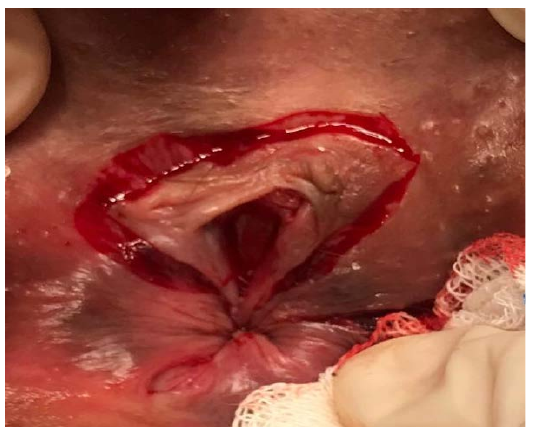
Rectal enema was used before the operation. Spinal anesthesia was applied after the use of prophylactic antibiotics. After proper cleansing, the operation was started while the patients were in a prone position. In the first group, sphincter was exposed and 75% of sphincter was resected by using a cautery device (open partial sphincterotomy). The operation was completed by suturing the incision. In the second group, after the partial sphincterotomy, the fissure tract was removed and skin and mucosa flaps were prepared. Anoplasty was done (figure-1).
Statistical analysis was carried out by using SPSS version 17.0 program. Histogram graphics and Kolmogorov-Smirnov tests controlled the conformity of variables with the normal distribution. Mean, standard deviation, median and minimum and maximum were used while presenting descriptive analysis.Categorical data were compared by using Pearson Chi-Square and Fisher’s Exact Test. When variables with non-normal distribution (non-parametric) were assessed between groups, the Mann Whitney U test was used. A P-value<0.05 was considered statistically significant.
Results
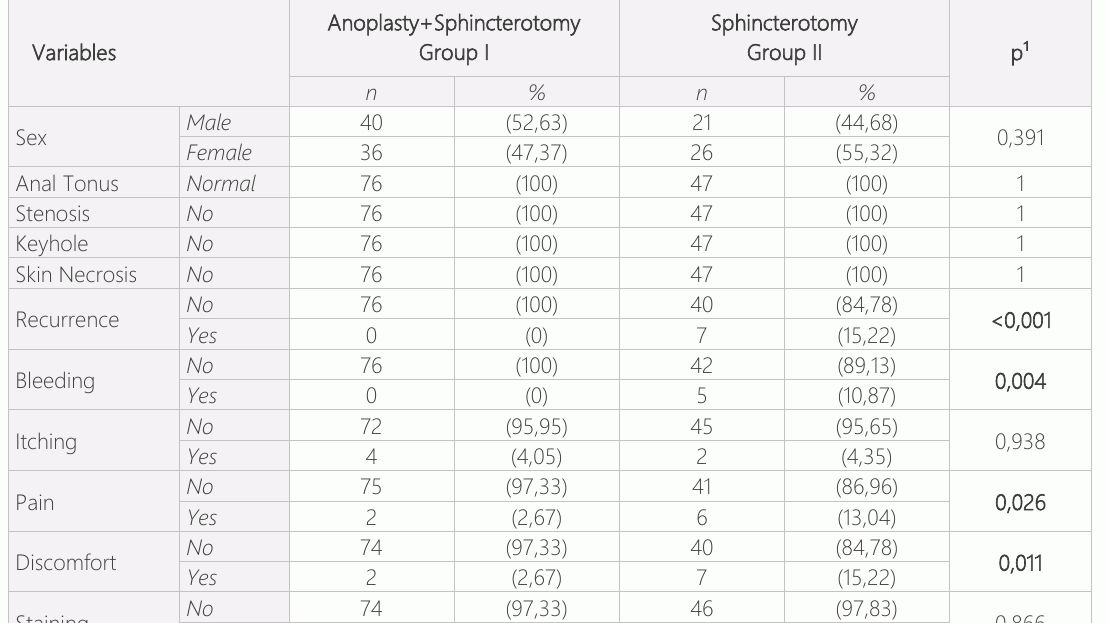
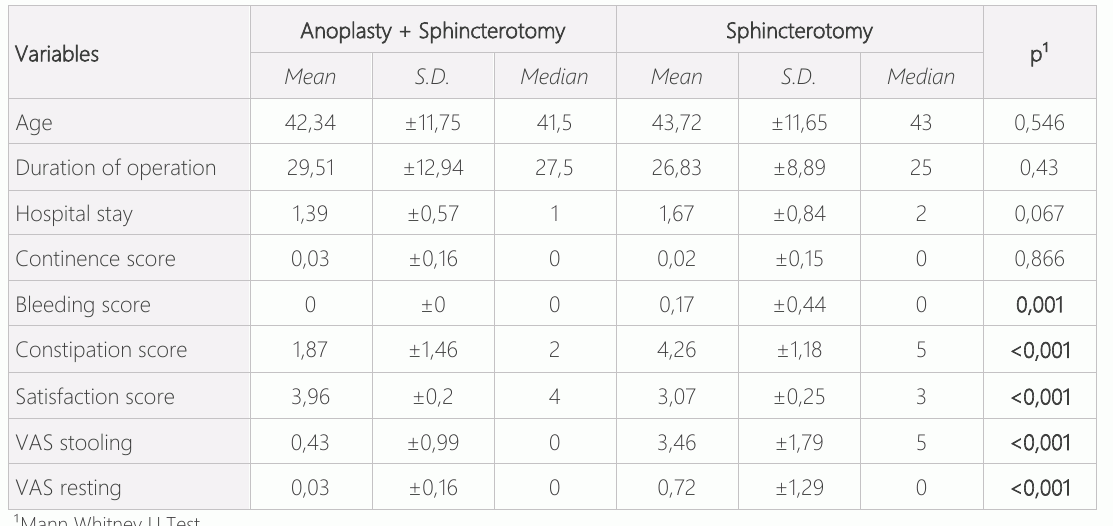
61 male (49,59%) and 62 female (50,41%) total 123 patients were included. The mean age of the patients was 42,87±11,69 years. The mean duration of operation was 28,50±11,61 min. The mean hospital stay was 1,5±0,7 days, while follow-up took 24±10 months. The patients were separated into two groups according to the operation: group-I; partial sphincterotomy +anoplasty 76 (61,79%), group-II; only partial sphincterotomy 47 (38.31%). The results were reviewed according to the type of operation. Thus, there was a very significant correlation between the operation type and recurrence, bleeding, pain and discomfort. In the group-II, the recurrence rate (15.22%) was higher than the group-I. Similarly, bleeding (10.87%), pain (13.04%), and discomfort (15.22%) were higher in group-II compared to group-I. (Table-1). Age, duration of operation, hospital stay, continence, bleeding score and constipation score, patient satisfaction, VAS stooling and resting score according to the type of operation were compared. Accordingly, bleeding and constipation scores and VAS stooling and resting scores were higher in group-II patients and patient satisfaction score was higher in group-I patients (Table-2).
Discussion
Surgical therapy is used in chronic anal fissure patients who did not respond to medical therapy. Lateral internal sphincterotomy is the preferred method for surgical therapy and the healing rate is between 85%-95%. However, recurrence is reported in 5% of patients, and incontinence varies between 2-20%(14–16). One of the issues leading to complications and confusion is the inability to standardize the internal sphincter region and the grade of lateral sphincterotomy. In a study by Farouk et al. patients recurring after LIS were examined via endoanal USG. They reported factors other than LIS grade for the recurrence (17).
The main disadvantage of LIS is its potential for perianal abscess and perianal deformity in addition to bloating (gas), mucus, and fecal incontinence (18–23). Exact incontinence grade could not be detected due to inadequate recording of the patients’ condition after LIS (20–23). Lewis et al. have detected incontinence in 17% of the patients (20). This complication was transient in only two-thirds of the patients. Khubchandani and Reed have reported staining in 22% of patients and incontinence in the form of flatulence (passing gas) in 35.1% of the patients after LIS (24). Magdy et al. have reported incontinence rates as 14% in the group who had undergone conventional LIS (25). In other series, fecal incontinence was reported between 1.3% and 66% (26–29).
Alternative procedures such as anocutaneous advancement flap (AAP) were employed particularly in patients with a higher risk of incontinence in order to prevent potential sphincter damage (30–36). In their study, Leong et al. have compared LIS and AAP in chronic anal fissure. 50 patients were randomized in each group. All of the patients have recovered from the illness after surgery in the LIS group, on the other hand in AAP group in 2 patients the treatment has failed. In the LIS group moderate anal incontinence was observed (37). In ACPGBI (Association of Coloproctology of Great Britain and Ireland), Guidelines AAP is recommended for the treatment of the patients with lower sphincter pressures. William Chambers has reported that V-Y advancement flap may be used successfully as the first choice of treatment independent from sphincter pressures (35).
Theoretically, as an advantage, AAP does not disrupt sphincter complex and thus, it is preventive against the development of incontinence. This is particularly important for patients who had previous surgery or patients with gynecologic complications.A disadvantage of employing only AAP may be a slower healing and a higher recurrence risk. Adding partial sphincterotomy to AAP increases success rate up to 96% and decreases the recurrence rate to as low as 2%. In a series including 150 patients, Magdy et al. have separated the patients into three groups as total LIS, V-Y advancement flap and partial sphincterotomy+V-Y advancement flap. Healing rate after one year follow up was reported as 84%, 48%, 96% respectively, and the recurrence rate was reported as 4%, 22%, 2%, respectively (25).
Hegazi et al. have compared open partial sphincterotomy plus V-Y advancement flap with open sphincterotomy only in 20 patients. In the post-op, early period (first two weeks) in the total LIS-only patients, transient gas incontinence and transient liquid incontinence was found to be extremely higher. However, in the one year follow up, there was no permanent incontinence in both groups. Moreover, time to wound healing was shorter with relatively less pain in partial sphincterotomy plus V-Y advancement flap group (38).
Elbalshy et al. have compared conventional-way open LIS with KIS+mucosal advancement flap combination in a prospective study including 100 patients. In the combination group, it was reported that post-op early period pain was less, the recovery rate was a fast and earlier return to regular activity was possible. Incontinence rate was not different between both groups (2%)(9). In the study by Anaraki et al. fissurectomy and V-Y flap were done in a total of 30 patients with healthy, high and low anal tonus. Gas incontinence could not be detected in any of the patients. Recurrence rate was 5.9%. (8). Quassi et al. have done anoplasty by mucosal advancement flap in 26 patients, after two years of follow-up, they reported no recurrence or incontinence(39).
In meta-analysis of Sahabally et al. compared advancement flaps and LIS results of 4 studies by using pooled data of a total of 300 patients and reviewed the results. Incontinence was detected in one (0.6%) patient out of 150 who had advancement flap, and incontinence was detected in 17 (11.3%) patients out of 150 who had LIS. (12). Non-healing fissure was reported in 31 (20.6%) AAP patients and in 14 (9.3%) LIS patients (12). Wound site complication was observed in 10 (6.6%) and 7 (4.6%) LIS (12). When the literature is reviewed, it has observed that employing partial sphincterotomy lowers the rate of incontinence significantly. In our study, both groups had sphincterotomy. We detected rarely occurring gas incontinence (Pescori score 1) in 2 patients. We have learned that these patients had similar pre-operative symptoms, and gas incontinence did not increase after the operation. No difference was observed in terms of incontinence between the two groups. We found that the incontinence rate of our partial LIS cases was consistent with the literature. In light of these findings, we may suggest that to perform partial sphincterotomy was a preventive factor for both groups. In the literature, lower incontinence rate was reported in patients who had undergone partial LIS or flap-only operations compared to total LIS but recurrence rates were higher. In our study, in LIS-only group recurrence rate was higher compared to partial LIS+advancement flap patients. In the partial LIS+advancement flap group, both recurrence rate and incontinence rate were lower. In the comparison of both groups, bleeding, pain, and discomfort rates were higher and the patient satisfaction score was lower in the group-II. In both groups, anal stenosis, keyhole, and skin necrosis were not observed.
Conclusion
In the surgical treatment of chronic anal fissure, both in our study and other studies in the literature, despite higher success rates, LIS is directly correlated with higher incontinence risk; however, partial sphincterotomy-only method may lead to lower incontinence rates with the price of lower healing rates. We have found that adding advancement flap to partial internal sphincterotomy has increased success rates and decreased incontinence and recurrence rates both in our study and similar studies in the literature. However, studies about combined operations still lack in the literature. Prospective, multi-centered studies in large series will be helpful to clarify this issue better.
Declarations
- Author contributions (CRediT)
- All authors contributed equally to all 14 CRediT roles (Conceptualization, Data curation, Formal analysis, Funding acquisition, Investigation, Methodology, Project administration, Resources, Software, Supervision, Validation, Visualization, Writing – original draft, Writing – review & editing).
- Funding
-
Funding information was not reported in the published version of this article.
- Conflicts of interest
- The authors have declared no conflict of interest for the present article.
- Ethics approval
- Ethics approval details were not reported in the published version of this article.
- Data availability
- A data availability statement was not reported in the published version of this article.
References (39)
32 of 39 references are linked to their DOI.
- Jonas M, Scholefield JH. Anal fissure. Gastroenterology Clinics of North America. 2001;30(1):167-81 PubMed Google Scholar
- Garner J, McFall M, Edwards D. The medical and surgical management of chronic anal fissure. Journal of the Royal Army Medical Corps. 2002;148(3):230-5 DOI Crossref PubMed Google Scholar
- Beaty JS, Shashidharan M. Anal fissure. Clinics in colon and rectal surgery. 2016;29(01):030-7 PubMed Google Scholar
- Smink DS. Schwartz's principles of surgery. Annals of Surgery. 2015;261(5):1026 PubMed Google Scholar
- Poh A, Tan K-Y, Seow-Choen F. Innovations in chronic anal fissure treatment: a systematic review. World journal of gastrointestinal surgery. 2010;2(7):231 DOI Crossref PubMed Google Scholar
- Acar T, Acar N, Güngör F, Kamer E, Güngör H, Candan MS, et al. Treatment of chronic anal fissure: Is open lateral internal sphincterotomy (LIS) a safe and adequate option? Asian journal of surgery. 2018 DOI Crossref PubMed Google Scholar
- Jain BK, Sharma N, Gupta H. Lateral Internal Partial Sphincterotomy Technique for Chronic Anal Fissure: an Avoidable Risk to the Surgeon's Finger. The Indian journal of surgery. 2018;80(2):203 DOI Crossref PubMed Google Scholar
- Anaraki F, Foroughifar T, Laleh SH, Etemad O. Evaluation of outcomes in fissurectomy and V–Y advancement flap for the treatment of chronic anal fissure. Journal of Coloproctology (Rio de Janeiro). 2018;38(2):132-6 DOI Crossref PubMed Google Scholar
- Elbalshy MA, Eldesouky MS. Combined mucosal advancement and lateral internal sphincterotomy in treatment of chronic anal fissure: could be an effective alternative procedure? International Surgery Journal. 2019;6(2):475-81 DOI Crossref PubMed Google Scholar
- Fernandes GOdS, Murad-Regadas SM, Regadas FSP, Rodrigues LV, Dealcanfreitas ID, Pereira JdJR, et al. Clinical, functional and morphologic evaluation of patients undergoing lateral sphincterotomy for chronic anal fissure treatment. Identification of factors that can interfere with fecal continence. Journal of Coloproctology (Rio de Janeiro). 2014;34(3):174-80 DOI Crossref PubMed Google Scholar
- Nessar G, Topbas M. Lateral internal partial sphincterotomy technique for chronic anal fissure. Indian Journal of Surgery. 2017;79(3):185-7 DOI Crossref PubMed Google Scholar
- Sahebally SM, Walsh SR, Mahmood W, Aherne TM, Joyce MR. Anal advancement flap versus lateral internal sphincterotomy for chronic anal fissure-a systematic review and meta-analysis. International Journal of Surgery. 2018;49:16-21 DOI Crossref PubMed Google Scholar
- Agachan F, Chen T, Pfeifer J, Reissman P, Wexner SD. A constipation scoring system to simplify evaluation and management of constipated patients. Diseases of the colon & rectum. 1996;39(6):681-5 DOI Crossref PubMed Google Scholar
- Rakinic J. Anal fissure. Clinics in colon and rectal surgery. 2007;20(02):133-8 PubMed Google Scholar
- Ayantunde AA, Debrah SA. Current concepts in anal fissures. World journal of surgery. 2006;30(12):2246-60 DOI Crossref PubMed Google Scholar
- Hananel N, Gordon PH. Lateral internal sphincterotomy for fissure-in-ano—revisited. Diseases of the colon & rectum. 1997;40(5):597-602 DOI Crossref PubMed Google Scholar
- Farouk R, Monson J, Duthie G. Technical failure of lateral sphincterotomy for the treatment of chronic anal fissure: a study using endoanal ultrasonography. British journal of surgery. 1997;84(1):84-5 DOI Crossref PubMed Google Scholar
- Pernikoff B, Eisenstat T, Rubin R, Oliver G, Salvati E. Reappraisal of partial lateral internal sphincterotomy. Diseases of the colon & rectum. 1994;37(12):1291-5 DOI Crossref PubMed Google Scholar
- Lund J, Scholefield J. Aetiology and treatment of anal fissure. British journal of surgery. 1996;83(10):1335-44 DOI Crossref PubMed Google Scholar
- Lewis TH, Corman ML, Prager ED, Robertson WG. Long-term results of open and closed sphincterotomy for anal fissure. Diseases of the Colon & Rectum. 1988;31(5):368-71 DOI Crossref PubMed Google Scholar
- García- Aguilar J, Montes CB, Perez JJ, Jensen L, Madoff RD, Wong WD. Incontinence after lateral internal sphincterotomy. Diseases of the colon & rectum. 1998;41(4):423-7 DOI Crossref PubMed Google Scholar
- Hsu T-C, MacKeigan JM. Surgical treatment of chronic anal fissure. Diseases of the colon & rectum. 1984;27(7):475-8 DOI Crossref PubMed Google Scholar
- Madoff RD, Fleshman JW. AGA technical review on the diagnosis and care of patients with anal fissure. Gastroenterology. 2003;124(1):235-45 DOI Crossref PubMed Google Scholar
- Khubchandani I, Reed J. Sequelae of internal sphincterotomy for chronic fissure in ano. British journal of surgery. 1989;76(5):431-4 DOI Crossref PubMed Google Scholar
- Magdy A, El Nakeeb A, Youssef M, Farid M. Comparative study of conventional lateral internal sphincterotomy, VY anoplasty, and tailored lateral internal sphincterotomy with VY anoplasty in the treatment of chronic anal fissure. Journal of Gastrointestinal Surgery. 2012;16(10):1955-62 DOI Crossref PubMed Google Scholar
- Abcarian H. Surgical correction of chronic anal fissure: results of lateral internal sphincterotomy vs. fissurectomy— midline sphincterotomy. Diseases of the Colon & Rectum. 1980;23(1):31-6 DOI Crossref PubMed Google Scholar
- Blessing H. Late results after individualized lateral internal sphincterotomy. Helvetica chirurgica acta. 1993;59(4):603-7 PubMed Google Scholar
- Pfeifer J, Berger A, Uranüs S. Surgical therapy of chronic anal fissure--do additional proctologic operations impair continence? Der Chirurg; Zeitschrift fur alle Gebiete der operativen Medizen. 1994;65(7):630-3 PubMed Google Scholar
- Sultan AH, Kamm MA, Nicholls RJ, Bartram CI. Prospective study of the extent of internal anal sphincter division during lateral sphincterotomy. Diseases of the colon & rectum. 1994;37(10):1031-3 DOI Crossref PubMed Google Scholar
- Singh M, Sharma A, Gardiner A, Duthie GS. Early results of a rotational flap to treat chronic anal fissures. International journal of colorectal disease. 2005;20(4):339-42 DOI Crossref PubMed Google Scholar
- Owen HA, Edwards DP, Khosraviani K, Phillips RK. The house advancement anoplasty for treatment of anal disorders. Journal of the Royal Army Medical Corps. 2006;152(2):87-8 DOI Crossref PubMed Google Scholar
- Samson RB, Stewart WR. Sliding skin grafts in the treatment of anal fissures. Diseases of the Colon & Rectum. 1970;13(5):372-5 DOI Crossref PubMed Google Scholar
- Nyam D, Wilson R, Stewart K, Farouk R, Bartolo D. Island advancement flaps in the management of anal fissures. British journal of surgery. 1995;82(3):326-8 DOI Crossref PubMed Google Scholar
- Kenefick N, Gee A, Durdey P. Treatment of resistant anal fissure with advancement anoplasty. Colorectal Disease. 2002;4(6):463-6 DOI Crossref PubMed Google Scholar
- Chambers W, Sajal R, Dixon A. V–Y advancement flap as first-line treatment for all chronic anal fissures. International journal of colorectal disease. 2010;25(5):645-8 DOI Crossref PubMed Google Scholar
- Giordano P, Gravante G, Grondona P, Ruggiero B, Porrett T, Lunniss PJ. Simple cutaneous advancement flap anoplasty for resistant chronic anal fissure: a prospective study. World journal of surgery. 2009;33(5):1058-63 DOI Crossref PubMed Google Scholar
- Leong A, Seow-Choen F. Lateral sphincterotomy compared with anal advancement flap for chronic anal fissure. Diseases of the colon & rectum. 1995;38(1):69-71 DOI Crossref PubMed Google Scholar
- HEGAZI T, Soliman S. Combined Tailored Lateral Internal Sphincterotomy with V-Y Advancement Flap Versus Lateral Internal Sphincterotomy Alone in Treatment of Chronic Anal Fissure. Med J Cairo Univ. 2013;81:959-6 PubMed Google Scholar
- Ouaïssi M, Giger U, Sielezneff I, Yawovi K, Pamela A, Pirro N, et al. Mucosal advancement flap anoplasty for chronic anal fissure resistant to conservative therapy. World journal of surgery. 2011;35(4):900-4 DOI Crossref PubMed Google Scholar
Read the full text
Open the PDF here
Loading the PDF…
If the PDF does not show here, use the download button above.
How to cite this article
Celik Y, Demircan F. Comparison of Partial Internal Sphincterotomy and Partial Internal Sphincterotomy with Additional Advancement Flap Anoplasty in the Treatment of Chronic Anal Fissure. Ulutas Med J. 2019;5(4):243-250. doi:10.5455/umj.20191014070931
Celik, Y., & Demircan, F. (2019). Comparison of Partial Internal Sphincterotomy and Partial Internal Sphincterotomy with Additional Advancement Flap Anoplasty in the Treatment of Chronic Anal Fissure. The Ulutas Medical Journal, 5(4), 243–250. https://doi.org/10.5455/umj.20191014070931
Celik, Y. and Demircan, F. (2019) 'Comparison of Partial Internal Sphincterotomy and Partial Internal Sphincterotomy with Additional Advancement Flap Anoplasty in the Treatment of Chronic Anal Fissure', The Ulutas Medical Journal, 5(4), pp. 243–250. doi: 10.5455/umj.20191014070931.