The Ulutas Medical Journal · ISSN 2149-0430 (print), 2149-388X (online) · https://www.ulutasmedicaljournal.com/?mno=78686
Letter to the Editor · Open access
Novel ß-lactam/ß-lactamase Inhibitor Combinations in the Treatment of Elderly Patients with Complicated Urinary Tract Infections
- Tainan city ROR
Abstract
Urinary tract infection is a common health problem in elderly patients. In addition, urinary tract infections can be associated with increased morbidity and mortality and cause a significant healthcare burden. Furthermore, the increase of antimicrobial resistance in this clinical condition has negatively impacted the outcome of elderly patients with urinary tract infection. More and more mechanisms of antimicrobial resistance, such as including extended-spectrum-lactamases, AmpC-β-lactamase, and carbapenemases have developed and largely limited the options of appropriate antibiotics. All these facts trigger the urgent need of new agents to enhance our antibiotic armamentarium in this critical situation.
Keywords
Full text
To the Editor
Urinary tract infection is a common healthy problem in elderly patients (1, 2). In addition, urinary tract infection can be associated with increased morbidity and mortality and cause a significant healthcare burden(1, 3). Furthermore, the increase of antimicrobial resistance in this clinical condition has negatively impact the outcome of the elderly patients with urinary tract infection (3). More and more mechanisms of antimicrobial resistances, such as including extended-spectrum-lactamases, AmpC-β-lacta mase, and carbapenemases have developed (4) and largely limited the options of appropriate antibiotics. All these facts trigger the urgent needs of new agent to enhance our antibiotic armamentarium in this critical situation.
Recently, several novel β-lactam/β-lactamase inhibitor combinations, including ceftazidime/avibactam, ceftolozane/tazobactam, merope nem/vaborbactam,aztreonam/avibactam,imipe nem/cilastatin/relebactam,ceftarolin/avibactam cefepime/zidebactam and meropenem/nacu bactam have been investigated to overcome the threaten of multidrug resistant organisms (5). Three of them - ceftazidime/avibactam, ceftolo zane/tazobactam, and meropenem/vaborbactam have been evaluated in the treatment of complicated urinary tract infection (cUTI) and acute pyelonephritis (APN) in phase 3 studies (6–8). However, the clinical efficacy of these novel β-lactam/β-lactamase inhibitor combinations for treating cUTI among elderly patients remains unclear. Therefore, the data of elderly patients from these three studies extracted (6–8) and did an integrated analysis to assess their usefulness in the treatment of elderly patients with cUTIs.
A RECAPTURE trial by Wagenlehner et al compared ceftazidime/avibactam with doripe nem for treating cUTI/APN (6). ASPECT-cUTI trial by Wagenlehner et al compared ceftolo zane/tazobactam with levofloxacin in the treatment of cUTI/APN (7). TANGO-I trial by Kaye et al compared the clinical efficacy and tolerability of meropenem/vaborbactam and piperacillin/tazobactam in the treatment of cUTI/APN (8). All three trials were randomized, double-blind, multicenter, and multinational studies (6–8)(Table-1).
Overall success-composite outcome of clinical cure and microbial eradication for the micro biologic modified intention-to-treat (mMITT) population was extracted as the primary outcome. Modified intent-to-treat (MITT) population was defined as all intent-to-treat patients who received at least one dose of study drug and microbiological MITT (mMITT) population was defined as MITT patients who met the disease definition of cUTI/APN and had a baseline pathogen.
Overall, 598 elderly patients with cUTI/APN were included in this analysis. 286 and 312 patients received novel β-lactam/β-lactamase inhibitor combinations and comparators, respectively. The overall success rates of novel β-lactam/β-lactamase inhibitor combinations and comparators were 71% (203/286) and 64.7% (202/312), respectively. No significant difference in terms of overall success between novel β-lactam/β-lactamase inhibitor combinations was observed (odds ratio [OR], 1.68; 95% confidence interval [CI], 0.76 to 3.58; I(2)=67). In the pooled analysis of two studies reported the clinical efficacy in the subgroups - 65-74 years and 75 years and older, we found the similar trends. For patients aged 65-74 years, the overall success rates of novel β-lactam /β-lactamase inhibitor combinations and comparators were 72.9% and 69.4% (OR, 1.1; 95% CI, 0.58 to 2.11; I(2)=0), respectively. For patients aged 75 years and older, the overall success rates of novel β-lactam/β-lactamase inhibitor combinations and comparators were 70% and 70.7%, respectively (OR, 1.85; 95% CI, 0.22 to 15.45; I(2)=56).
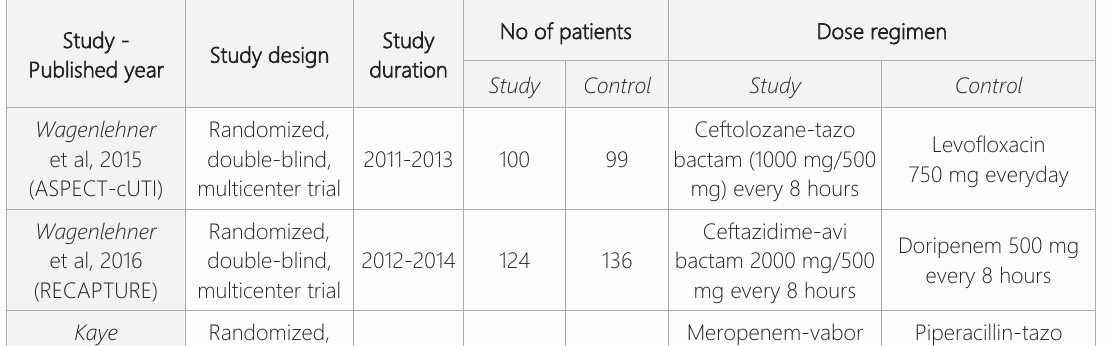
In this study, we demonstrated the clinical efficacy of novel β-lactam/β-lactamase inhibitor combinations was noninferior to comparators in the treatment of cUTI/APN among elderly patients. The non-inferiority of novel β- lactam/β-lactamase inhibitor combinations to comparators was found in both overall elderly population and subgroup analysis. These findings could be supported by previous in vitro studies(9, 10), in which novel β-lactam/β- lactamase inhibitor combinations show potent activity against most of Gram-negative bacteria from patients with UTI including high potencies against multidrug-resistant organisms. There fore, it should suggest that novel β-lactam/β- lactamase inhibitor combinations could play a significant role for treating elderly patients with cUTI/APN.
However, this study had several limitations. First, the numbers of enrolled patients and study were limited. Second, we did not perform a more detail analysis, such as the usefulness of novel β-lactam/β-lactamase inhibitor combinations for antibiotic-resistant organism, and for different types of infections – cUTI or APN. Third, safety profile remains another important concern, however, we did not assess the tolerability of these agents in the elderly patients. Further large-scale study is warranted to clarify these issues.
In conclusion, novel β-lactam/β-lactamase inhibitor combinations exhibit comparable efficacy with comparator in elderly patients with cUTI/APN. Novel β-lactam/β-lactamase inhibitor combinations may be considered as one potential therapeutic option in this clinical entity.
Declarations
- Author contributions (CRediT)
- All authors contributed equally to all 14 CRediT roles (Conceptualization, Data curation, Formal analysis, Funding acquisition, Investigation, Methodology, Project administration, Resources, Software, Supervision, Validation, Visualization, Writing – original draft, Writing – review & editing).
- Funding
-
Funding information was not reported in the published version of this article.
- Conflicts of interest
- The authors declare that they have no conflict of interests.
- Ethics approval
- Ethics approval details were not reported in the published version of this article.
- Data availability
- Data sharing is not applicable to this article as no new data were created or analysed in this study.
References (10)
9 of 10 references are linked to their DOI.
- Detweiler K, Mayers D, Fletcher SG. Bacteruria and urinary tract infections in the elderly. Urol Clin North Am. 2015;42(4):561-8 DOI Crossref PubMed Google Scholar
- Mouton CP, Bazaldua OV, Pierce B, Espino DV. Common infections in older adults. Am Fam Physician. 2001;63(2):257-68 PubMed Google Scholar
- Nguyen HQ, Nguyen NTQ, Hughes CM, O'Neill C. Trends and impact of antimicrobial resistance on older inpatients with urinary tract infections (UTIs): A national retrospective observational study. PLoS One. 2019;14(10):e0223409 DOI Crossref PubMed Google Scholar
- Bader MS, Loeb M, Brooks AA. An update on the management of urinary tract infections in the era of antimicrobial resistance. Postgrad Med. 2017;129(2):242-58 DOI Crossref PubMed Google Scholar
- Karaiskos I, Galani I, Souli M, Giamarellou H. Novel beta-lactam-beta-lactamase inhibitor combinations: expectations for the treatment of carbapenem-resistant Gram-negative pathogens. Expert Opin Drug Metab Toxicol. 2019;15(2):133-49 DOI Crossref PubMed Google Scholar
- Wagenlehner FM, Sobel JD, Newell P, Armstrong J, Huang X, Stone GG, et al. Ceftazidime-avibactam versus doripenem for the treatment of complicated urinary tract Infections, including acute pyelonephritis: RECAPTURE, a phase 3 randomized trial program. Clin Infect Dis. 2016;63(6):754-62 DOI Crossref PubMed Google Scholar
- Wagenlehner FM, Umeh O, Steenbergen J, Yuan G, Darouiche RO. Ceftolozane-tazobactam compared with levofloxacin in the treatment of complicated urinary-tract infections, including pyelonephritis: a randomised, double-blind, phase 3 trial (ASPECT-cUTI). Lancet. 2015;385(9981): 1949-56 DOI Crossref PubMed Google Scholar
- Kaye KS, Bhowmick T, Metallidis S, Bleasdale SC, Sagan OS, Stus V, et al. Effect of meropenem-vaborbactam vs piperacillin-tazobactam on clinical cure or improvement and microbial eradication in complicated urinary tract infection: The TANGO I randomized clinical trial. JAMA. 2018;319(8):788-99 DOI Crossref PubMed Google Scholar
- Flamm RK, Sader HS, Farrell DJ, Jones RN. Ceftazidime-avibactam and comparator agents tested against urinary tract isolates from a global surveillance program (2011). Diagn Microbiol Infect Dis. 2014;80(3):233-8 DOI Crossref PubMed Google Scholar
- Pfaller MA, Bassetti M, Duncan LR, Castanheira M. Ceftolozane/tazobactam activity against drug-resistant Entero bacteriaceae and Pseudomonas aeruginosa causing urinary tract and intraabdominal infections in Europe: report from an antimicrobial surveillance programme (2012-15). J Antimicrob Chemother. 2017;72(5):1386-95 DOI Crossref PubMed Google Scholar
Read the full text
Open the PDF here
Loading the PDF…
If the PDF does not show here, use the download button above.
How to cite this article
Chao CM. Novel ß-lactam/ß-lactamase Inhibitor Combinations in the Treatment of Elderly Patients with Complicated Urinary Tract Infections. Ulutas Med J. 2020;6(1):49-52. doi:10.5455/umj.20201220072153
Chao, C. M. (2020). Novel ß-lactam/ß-lactamase Inhibitor Combinations in the Treatment of Elderly Patients with Complicated Urinary Tract Infections. The Ulutas Medical Journal, 6(1), 49–52. https://doi.org/10.5455/umj.20201220072153
Chao, C.M. (2020) 'Novel ß-lactam/ß-lactamase Inhibitor Combinations in the Treatment of Elderly Patients with Complicated Urinary Tract Infections', The Ulutas Medical Journal, 6(1), pp. 49–52. doi: 10.5455/umj.20201220072153.