The Ulutas Medical Journal · ISSN 2149-0430 (print), 2149-388X (online) · https://www.ulutasmedicaljournal.com/?mno=90703
Original Article · Open access
Trace Element and Lipid Profile in Patients with Type-II Diabetes Mellitus
Also available in: العربية · Türkçe · 中文
- Hatay Mustafa Kemal University, Medical Faculty, Department of Biochemistry, Hatay, Turkey ROR
- Hatay Mustafa Kemal University, Medical Faculty, Department of Medical Biology, Hatay, Turkey ROR
- Adıyaman University, Medical Faculty, Department of Biochemistry, Adıyaman, Turkey ROR
- Adıyaman University, Medical Faculty, Department of Internal Diseases, Adıyaman, Turkey ROR
Abstract
- Introduction
- This study aimed to investigate the relationship between trace element levels and T2DM in patients from Adıyaman province in southeastern Turkey.
- Materials and Methods
- This study included 49 healthy subjects and 80 patients diagnosed with T2DM. The study population was divided into healthy controls and patients with T2DM and good glycemic control (GGC) and with T2DM and poor glycemic control (PGC). Biochemical parameters and trace element levels were compared in the three groups.
- Results
- Fasting blood glucose (FBG) and triglyceride (TG) levels were significantly higher in both diabetic groups and were higher in the PGC than in the GGC group (p<0.05). Low-density lipoprotein cholesterol (LDL-C) and cholesterol (CHO) levels were higher in the PGC than in the control group (p < 0.05). CHO levels were also higher in the PGC than in the GGC group (p<0.05). Elevated manganese (Mn) and chromium (Cr) levels were found in both diabetics, and calcium (Ca) levels were significantly higher in the PGC group than in the controls (p<0.05).
- Conclusions
- The hyperglycemic and dyslipidemic profiles were significantly elevated in the PGC group compared to the GGC group, suggesting the importance of regular follow-up and treatment in T2DM. The observed positive correlation between T2DM and the levels of the trace elements Mn, Cr, and Ca requires further confirmation in future studies.
Keywords
Full text
Introduction
Diabetes mellitus is a metabolic disorder characterized by high blood glucose levels (1, 2). It carries the potential risk of life-threatening health problems that can result in reduced quality of life and increased mortality (3). Type II diabetes mellitus (T2DM) is characterized by hyperglycemia that occurs as a result of insulin resistance, whereby muscle or adipose cells fail to respond adequately to normal levels of insulin (1). High blood glucose levels lead to general vascular damage that affects the heart (4), eyes (5), kidneys (6), and nerves (7) and lead to various adverse complications.
Unfortunately, the global prevalence of diabetes mellitus is currently increasing and imposing a burden on health systems and national economies. The International Diabetes Federation data in 2017 indicated that 451 million people aged 18–99 years live with diabetes, and this number is estimated to increase to 693 million by 2045 (8). Changes in lifestyle due to urbanization and economic development, which lead to decreased physical activity and increased obesity, now ensure that the prevalence of T2DM will continue to increase dramatically (9).
One complication of T2DM is an impairment of trace metal metabolism (10). Trace elements play an important role in living systems by acting as essential components or cofactors of enzymes that perform regulatory, immunologic, and antioxidant functions in biological systems (10, 11). However, the association between diabetes and impaired trace metal homeostasis remains unclear (2), as trace metal elements could affect the synthesis, secretion, release, and/or mechanism of action of insulin (12, 13). Several ideas have been proposed regarding the relationship between trace elements and T2DM (14–20), but the available evidence is contradictory. This may reflect variations in ethnicity, geographical characteristics, eating habits, and the limitations of the selected study populations. Further studies are therefore required to verify the apparent relationship between diabetes and trace elements in patients with T2DM.
The present study aimed to investigate the relationship between T2DM and trace elements in Adıyaman province, in the southeastern region of Turkey. The selected T2DM patient population was compared with a healthy control group in terms of the biochemical parameters of fasting blood glucose (FBG), cholesterol (CHO), triglyceride (TG), high-density lipoprotein cholesterol (HDL-C), and low-density lipoprotein cholesterol (LDL-C) and in terms of the levels of the following trace elements: selenium (Se), manganese (Mn), zinc (Zn), copper (Cu), chromium (Cr), sodium (Na), potassium (K), calcium (Ca), and magnesium (Mg).
Materials and Methods
Subjects
This study included a total of 129 individuals consisting of 49 healthy controls without any disorders (including diabetes mellitus) in their medical histories and 80 patients diagnosed with T2DM who were admitted to the Internal Clinic of the Adiyaman University Training and Research Hospital. This study population was divided into three groups: the healthy controls (control group; n=49) and two T2DM groups: patients with good glycemic control (GGC group; n=38) and patients with poor glycemic control (PGC group; n=42). The patients were assigned to the groups with good and poor glycemic control according to their FBG values, as recommended by the American Diabetes Association, with patients with FBG levels ≥7.0 mmol/L identified as the PGC group (21). Pregnant women, individuals under the age of 18, individuals with other chronic diseases (cancer, autoimmune disease, etc.) were not included in the study.
Ethical Statement
The study was approved by the Adiyaman University Ethics Committee (2011/02-1) and written consent was obtained from each subject after the participants were properly informed about the study. All experiments abided by the tenets of the Declaration of Helsinki.
Laboratory Analysis
Venous blood samples were collected into EDTA tubes and centrifuged at 3000 rpm for 10 min. After centrifugation, the blood serum and plasma portion were separated and stored at -20°C until analysis. Biochemical parameters (FBG, CHO, TG, HDL-C, and LDL-C) were measured spectrophotometrically (Advia Centaur 1800, Siemens) from serum samples, while trace elements (Se, Mn, Zn, Cu, Cr, Na, K, Ca, and Mg) were measured by inductively coupled plasma mass spectrometry (ICP-MS; Perkin Elmer, Nexion-350X) from blood plasma samples (22, 23). These results were then evaluated by comparisons between groups.
Statistical analysis
Statistical analyses were performed with SPSS 21 software. Biochemical parameter values and trace element levels of the groups were analyzed by ANOVA and Kruskal Wallis test. After ANOVA analysis, the least significant difference (LSD) and Tamhane’s analysis were used for binary comparisons. After Kruskal Wallis's analysis, the Bonferroni correction (Mann-Whitney U test) was used for binary comparisons. A value of p<0.05 was accepted as statistically significant for all analyses except the Bonferroni correction.
Results
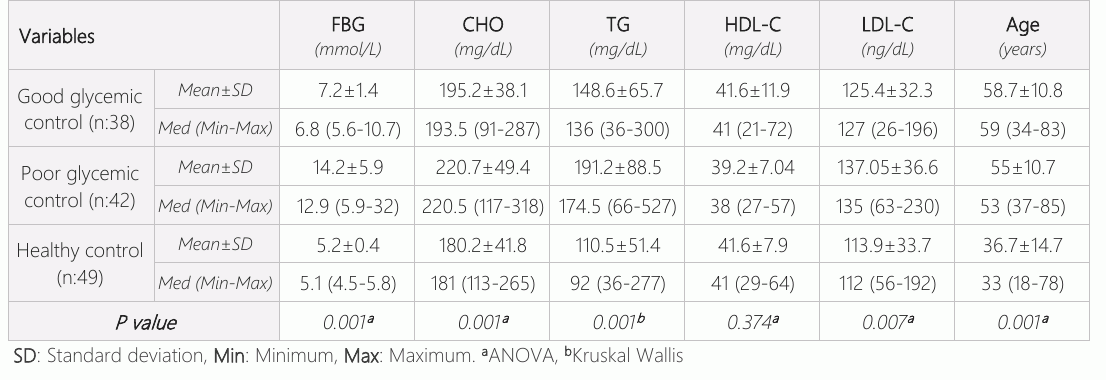
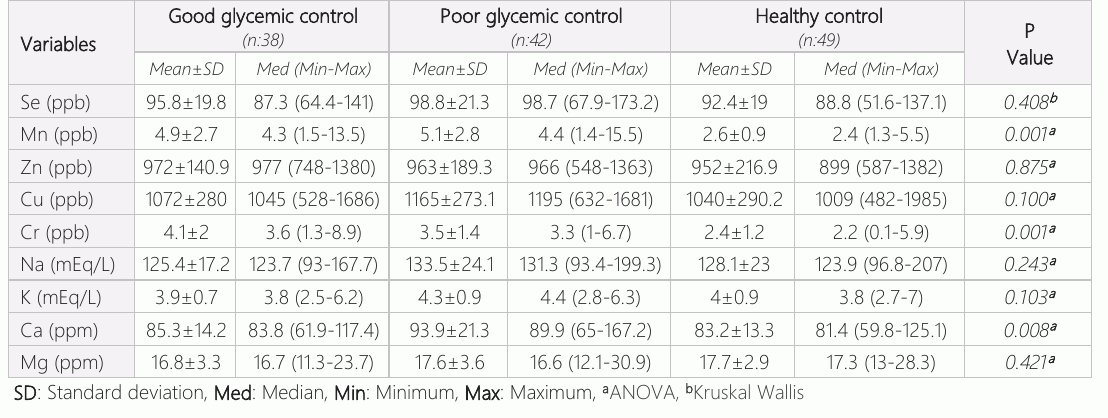
In our study, a significant difference was observed in all paired comparisons of FBG (p=0.001 in all paired comparisons) and TG (p=0.003 and p=0.001 in GGC-Control and PGC-Control comparisons, respectively). They were observed to be significantly higher in both diabetic groups when compared to the control group. Moreover, FBG (p=0.001) and TG (p=0.013) levels were found to be significantly higher in PGC group in comparison to GGC (Table 1). CHO levels were observed to be significantly higher in the PGC group when compared to both control (p=0.001) and GGC (p=0.010) groups. Additionally, the LDL-C level was found to be significantly higher in the PGC group when compared to control (p=0.002). No significant difference was observed between the diabetic and control groups in terms of HDL-C level (p>0.05). Descriptive data of biochemical analyses were displayed in Table 1. Study groups were compared in terms of trace elements Se, Mn, Zn, Cu, Cr, Na, K, Ca, and Mg in another phase of the study. Mn and Cr levels were found to be significantly higher in both diabetic groups when compared to the control group (p=0.001 in all comparisons in terms of Mn whereas p=0.001 and p=0.002 in GGC- Control and PGC-Control comparisons in terms of Cr, respectively). However, no significant differences were observed between GGC and PGC groups (p>0.05). Ca level was seen to be significantly higher in the PGC group compared to the control group (p=0.021) when there was not any significance between other pairs (p>0.05). The difference did not reach the level of significance level in terms of Se, Zn, Cu, Na, K, and Mg between study groups (Table 2).
Discussion
T2DM is a chronic disease characterized by insulin resistance, a disorder that is defined as a reduced ability of tissues to respond to insulin as a result of impaired glucose metabolism (17). The resulting hyperglycemic condition due to insulin resistance damages blood vessels and nerve cells and leads to microvascular diseases, such as nephropathy (6), retinopathy (5), and neuropathy (7), as well as cardiovascular disease, which is the major cause of mortality among people with T2DM (4). Therefore, T2DM is a major public health problem that is steadily increasing in response to lifestyle changes due to urbanization and economic development, and that now imposes high economic costs in industrialized countries.T2DM is also associated with impaired trace element metabolism and this impairment may further contribute to insulin resistance and abnormal glucose metabolism (24). Maintenance of trace element homeostasis is therefore essential for the regulation of numerous metabolic events in the human body, including blood glucose levels. Various studies have investigated the relationship between trace elements and diabetes mellitus, but the available data are not consistent and are sometimes even conflicting. In our study, we compared the biochemical parameters of FBG, CHO, TG, LDL-C, and HDL- C and the levels of the trace elements Se, Mn, Zn, Cu, Cr, Na, K, Ca, and Mg in the GGC and PGC groups and the healthy controls. A significant rise was noted in FBG, CHO, TG, and LDL-C levels between the groups, but no significant differences were noted for HDL-C levels. The FBG levels were significantly higher in both diabetic groups than in the control group, confirming characteristic hyperglycemic condition in T2DM. The FBG was also significantly higher in the PGC group than in the GGC group. Evaluation of the lipid profile between the groups revealed significantly higher TG levels in both diabetic groups than in the control group. Similar to the FBG results, the TG levels were significantly higher in the PGC group than in the GGC group. Similarly, the CHO level was higher in the PGC group than in either the GGC or the healthy control groups. The LDL-C level was significantly higher in the PGC group than in the control group, whereas the LDL-C level did not differ between the GGC and control subjects, indicating the importance of good glycemic control in T2DM.
Our results are supported by previous studies. For example, Mishra et al. (2017) evaluated fasting plasma glucose (FPG), CHO, TG, LDL-C, and HDL-C levels in both complicated and uncomplicated T2DM groups as well as in healthy control subjects and found significantly higher FPG, CHO, TG, and LDL-C levels in both diabetic groups than in healthy subjects (25). Similarly, Zhang et al. (2017) observed significantly elevated FBG, TG, and CHO levels in a T2DM group than in healthy control subjects, although they did not find any difference in LDL-C levels between their study groups, in contrast to our results (24). Another study also reported significantly higher CHO and LDL-C levels in a T2DM group than in healthy subjects (26). In all these previous studies, the HDL-C level was significantly lower in the T2DM groups than in the control group (24–26). This finding contradicted our results, which indicated a dyslipidemic condition in diabetes, in agreement with other previous studies, and which emphasized the importance of regular glycemic control in the context of maintaining healthy blood lipid levels.
Previous studies have also noted the association between trace element status in T2DM; however, the data show quite notable differences. Some of the previous studies have reported lower Se (27–29), Zn (25, 26, 28–32), and Cu (26, 32) levels in patients with T2DM than in healthy subjects. For example, Nashiry et al. (2019) found lower Se and Zn levels in hair specimens of T2DM subjects who were employed than in samples from non-working subjects. The hair samples also revealed a lower level of Cu in patients with poorly controlled blood glucose. By contrast, the Cu level was lower in patients with good blood glucose control when the analysis was performed using nail specimens (33). Contrary to these studies, Zhang et al. (2017) demonstrated higher Se, Zn, and Cu levels in patients with T2DM than in a control group (24). Similarly, Badran (28) and Oyedeji (29) reported increased Cu levels in subjects with T2DM. Cancarini et al. (2017) found increased Se and Zn levels in serum and tear fluid samples from patients with T2DM (34). Skalnaya et al. (2007) demonstrated elevated Na and K levels, but decreased Mg and Zn levels, in hair samples from patients with T2DM (35). Other studies have reported lower Mg in T2DM than in healthy (24–26, 28–30, 36).
In the present study, we did not find any significant differences between groups in terms of Se, Zn, Cu, Na, K, or Mg levels. Cancarini (34) and Ekmekçioğlu (27) did not report any significant differences in terms of Zn and Cu levels between T2DM and healthy subjects, in agreement with our results. Similarly, Diwan (36) and Hussain (30) did not observe any differences in terms of Zn and Cu levels in a T2DM group and healthy subjects, respectively. Masood et al. (2009) also did not observe any significance between patients with T2DM and healthy subjects in terms of Mg levels (31). Cancarini et al. (2017) did not report any significant differences in Se levels in tear fluid samples from diabetic and control subjects (34). In our study, we found statistically significant differences in terms of Mn, Cr, and Ca levels between our study groups. The Mn and Cr levels were significantly higher in both diabetic groups than in the healthy subjects. The Ca level was also significantly higher in the PGC group than in the controls, but these levels did not differ from that of the GGC group. Cancarini et al. (2017) observed elevated Mn and Cr levels in the tear fluid samples of patients with T2DM, in agreement with our results. However, serum Cr levels were significantly lower in the patient group but the Mn levels did not differ between the groups (34). Ekin et al. (2003) demonstrated significantly higher Mn levels in patients with T2DM than in healthy subjects (37). In contrast to our results, other previous studies have reported lower Mn (26, 28) and Cr (28, 29, 32) levels in patients with T2DM than in healthy subjects. Skalnaya et al. (2017) also found lower Ca levels from hair samples of patients with T2DM than in healthy subjects (35). Zhang et al. did not report any significant differences in terms of Mn, Cr, or Ca levels between T2DM and control subjects (24). Similarly, Hussain et al. (2009) did not observe any significant differences in Mn levels between T2DM and healthy subjects (30).
Various studies have explored the relationship between trace elements and diabetes mellitus in the past. However, the data obtained are not consistent and are sometimes even conflicting. This may reflect differences in the study populations in terms of ethnicity, geographical characteristics, and eating habits. Therefore, further studies are required to verify the relationship between T2DM and trace elements.
We found dramatically higher FBG levels and dyslipidemia profiles in terms of CHO and TG levels in the PGC group in comparison to the GGC patients. Regular follow-up and treatment improved the chronic hyperglycemic and dyslipidemic conditions, which are the major characteristics of diabetes mellitus. Elevated levels of Mn, which acts as an antioxidant enzyme cofactor in biological systems, may be associated with the increased oxidative stress status associated with T2DM. These elevated levels appear to emerge as a compensatory mechanism that prevents the exacerbation of the disease. Besides, the increase in the Cr level can be interpreted as the body’s attempt to augment the activity of the insulin receptor, which cannot take up sufficient insulin into the cells in T2DM. This response, which can also be regarded as a contribution to compensatory mechanisms, prevents disease from increasing in severity by promoting a lowering of the blood sugar levels. The Ca increase was higher in the PGC group than in the controls, and this may be associated with elevated levels of insulin in T2DM. This causes a further release of insulin, thereby further increasing the levels of insulin that already cannot be metabolized. These findings emphasize the importance of glycemic control in combating high insulin levels, a key characteristic of T2DM.
Declarations
- Author contributions (CRediT)
- All authors contributed equally to all 14 CRediT roles (Conceptualization, Data curation, Formal analysis, Funding acquisition, Investigation, Methodology, Project administration, Resources, Software, Supervision, Validation, Visualization, Writing – original draft, Writing – review & editing).
- Funding
-
This study was supported by a grant from the Adıyaman University Scientific Research Projects Unit (TIPFBAP/2014-0002), Turkey.
- Conflicts of interest
- The authors declare no conflict of interest.
- Ethics approval
- The study was approved by the Adiyaman University Ethics Committee (2011/02-1) and written consent was obtained from each subject after the participants were properly informed about the study. All experiments abided by the tenets of the Declaration of Helsinki.
- Data availability
- A data availability statement was not reported in the published version of this article.
References (37)
30 of 37 references are linked to their DOI.
- Van Belle TL, Coppieters KT, von Herrath MG. Type 1 diabetes: etiology, immunology, and therapeutic strategies. Physiol Rev 2011; 91(1):79-118 DOI Crossref PubMed Google Scholar
- Lin CC, Huang YL. Chromium, zinc and magnesium status in type 1 diabetes. Curr Opin Clin Nutr Metab Care 2015; 18(6):588-92 DOI Crossref PubMed Google Scholar
- Baena-Diez JM, Penafiel J, Subirana I, Ramos R, Elosua R, Marin-Ibanez A, et al. Risk of Cause-Specific Death in Individuals With Diabetes: A Competing Risks Analysis. Diabetes Care 2016; 39(11):1987-95 DOI Crossref PubMed Google Scholar
- Einarson TR, Acs A, Ludwig C, Panton UH. Prevalence of cardiovascular disease in type 2 diabetes: a systematic literature review of scientific evidence from across the world in 2007-2017. Cardiovasc Diabetol 2018; 17(1):83 DOI Crossref PubMed Google Scholar
- Hammes HP, Lemmen KD, Bertram B, German Diabetes A. Diabetic retinopathy and maculopathy. Exp Clin Endocrinol Diabetes 2014; 122(7):387-90 DOI Crossref PubMed Google Scholar
- Waanders F, Visser FW, Gans RO. Current concepts in the management of diabetic nephropathy. Neth J Med 2013; 71(9):448-58 PubMed Google Scholar
- Abbott CA, Malik RA, van Ross ER, Kulkarni J, Boulton AJ. Prevalence and characteristics of painful diabetic neuropathy in a large community-based diabetic population in the U.K. Diabetes Care 2011; 34(10):2220-4 DOI Crossref PubMed Google Scholar
- Cho NH, Shaw JE, Karuranga S, Huang Y, da Rocha Fernandes JD, Ohlrogge AW, et al. IDF Diabetes Atlas: Global estimates of diabetes prevalence for 2017 and projections for 2045. Diabetes Res Clin Pract 2018; 138:271-81 DOI Crossref PubMed Google Scholar
- Whiting DR, Guariguata L, Weil C, Shaw J. IDF diabetes atlas: global estimates of the prevalence of diabetes for 2011 and 2030. Diabetes Res Clin Pract 2011; 94(3):311-21 DOI Crossref PubMed Google Scholar
- Lobo JC, Torres JP, Fouque D, Mafra D. Zinc deficiency in chronic kidney disease: is there a relationship with adipose tissue and atherosclerosis? Biol Trace Elem Res 2010; 135(1-3):16-21 DOI Crossref PubMed Google Scholar
- Yerlikaya FH, Toker A, Aribas A. Serum trace elements in obese women with or without diabetes. Indian J Med Res 2013; 137(2):339-45 PubMed Google Scholar
- Wolide AD, Zawdie B, Alemayehu T, Tadesse S. Association of trace metal elements with lipid profiles in type 2 diabetes mellitus patients: a cross sectional study. BMC Endocr Disord 2017; 17(1):64 DOI Crossref PubMed Google Scholar
- Praveeena S, Pasula S, Sameera K. Trace elements in diabetes mellitus. J Clin Diagn Res 2013; 7(9):1863-5 PubMed Google Scholar
- Siddiqui K, Bawazeer N, Joy SS. Variation in macro and trace elements in progression of type 2 diabetes. Scientific World Journal 2014; 2014:461591 DOI Crossref PubMed Google Scholar
- Pittas AG, Lau J, Hu FB, Dawson-Hughes B. The role of vitamin D and calcium in type 2 diabetes. A systematic review and meta-analysis. J Clin Endocrinol Metab 2007;92(6):2017-29 DOI Crossref PubMed Google Scholar
- Mertz W. Chromium in human nutrition: a review. J Nutr 1993; 123(4):626-33 DOI Crossref PubMed Google Scholar
- Kazi TG, Afridi HI, Kazi N, Jamali MK, Arain MB, Jalbani N, et al. Copper, chromium, manganese, iron, nickel, and zinc levels in biological samples of diabetes mellitus patients. Biol Trace Elem Res 2008; 122(1):1-18 DOI Crossref PubMed Google Scholar
- Bleys J, Navas- Acien A, Guallar E. Serum selenium and diabetes in U.S. adults. Diabetes Care 2007; 30(4):829-34 DOI Crossref PubMed Google Scholar
- Tang X, Shay NF. Zinc has an insulin-like effect on glucose transport mediated by phosphoinositol-3-kinase and Akt in 3T3-L1 fibroblasts and adipocytes. J Nutr 2001; 131(5):1414-20 DOI Crossref PubMed Google Scholar
- Volpe SL. Magnesium, the metabolic syndrome, insulin resistance, and type 2 diabetes mellitus. Crit Rev Food Sci Nutr 2008; 48(3):293-300 DOI Crossref PubMed Google Scholar
- American Diabetes Association. Standards of medical care in diabetes-2015. Diabetes Care 2015; 38(1):8-16 PubMed Google Scholar
- Degueldre C, Favarger PY. Thorium colloid analysis by single particle inductively coupled plasma-mass spectrometry. Talanta 2004; 62(5):1051-4 DOI Crossref PubMed Google Scholar
- Degueldre C, Favarger PY, Rosse R, Wold S. Uranium colloid analysis by single particle inductively coupled plasma-mass spectrometry. Talanta 2006; 68(3):623-8 DOI Crossref PubMed Google Scholar
- Zhang H, Yan C, Yang Z, Zhang W, Niu Y, Li X, et al. Alterations of serum trace elements in patients with type 2 diabetes. J Trace Elem Med Biol 2017; 40:91-6 DOI Crossref PubMed Google Scholar
- Mishra S, Mishra BB. Study of Lipid Peroxidation, Nitric Oxide End Product, and Trace Element Status in Type 2 Diabetes Mellitus with and without Complications. Int J Appl Basic Med Res 2017; 7(2):88-93 DOI Crossref PubMed Google Scholar
- Yeasmin R, Muttalib MA, Sultana N, Bhuiyan NH, Alam R. Status of Some Trace Elements in Type-2 Diabetic Patients and its Relationship with Lipid Profile. J. Bangladesh Acad. Sci. 2016; 40(1):79-85 DOI Crossref PubMed Google Scholar
- Ekmekcioglu C, Prohaska C, Pomazal K, Steffan I, Schernthaner G, Marktl W. Concentrations of seven trace elements in different hematological matrices in patients with type 2 diabetes as compared to healthy controls. Biol Trace Elem Res 2001; 79(3):205-19 DOI Crossref PubMed Google Scholar
- Badran M, Morsy R, Soliman H, Elnimr T. Assessment of trace elements levels in patients with Type 2 diabetes using multivariate statistical analysis. J Trace Elem Med Biol 2016; 33:114-9 DOI Crossref PubMed Google Scholar
- Oyedeji SO, Adesina AA, Oke OT, Tijani YO. evaluation of essential trace metals in female type 2 diabetes mellitus patients in Nigerian population 2014; 13(18):1910-14 PubMed Google Scholar
- Hussain F, Arif Maan M, Sheikh MA, Nawaz H, Jamil A. Trace elements status in type 2 diabetes. Bangladesh Journal of Medical Science 2009; 8(3) PubMed Google Scholar
- Masood N, Baloch GH, Ghori RA, Memon IA, Memon MA, Memon MS. Serum zinc and magnesium in type-2 diabetic patients. J Coll Physicians Surg Pak 2009; 19(8):483-6 PubMed Google Scholar
- Basaki M, Saeb M, Nazifi S, Shamsaei HA. Zinc, copper, iron, and chromium concentrations in young patients with type 2 diabetes mellitus. Biol Trace Elem Res 2012; 148(2):161-4 DOI Crossref PubMed Google Scholar
- Nashiry M, Ishak I, Mohamed J, Budin S, Mohd Fairulnizal MN M, Kamaralzaman S, et al. Evaluation of Trace Elements in Malay Women with Type 2 Diabetes Mellitus. Sains Malaysiana 2019; 48(2):337–45 DOI Crossref PubMed Google Scholar
- Cancarini A, Fostinelli J, Napoli L, Gilberti ME, Apostoli P, Semeraro F. Trace elements and diabetes: Assessment of levels in tears and serum. Exp Eye Res 2017; 154:47-52 DOI Crossref PubMed Google Scholar
- Skalnaya MG, Demidov VA. Hair trace element contents in women with obesity and type 2 diabetes. J Trace Elem Med Biol 2007; 21 Suppl 1:59-61 DOI Crossref PubMed Google Scholar
- Diwan AG, Pradhan AB, Lingojwar D, Krishna KK, Singh P, Almelkar SI. Serum zinc, chromium and magnesium levels in Type 2 diabetes. Int J Diab Dev Ctries 2006 26 (3):122-23 DOI Crossref PubMed Google Scholar
- Ekin S, Mert N, Gunduz H, Meral I. Serum sialic acid levels and selected mineral status in patients with type 2 diabetes mellitus. Biol Trace Elem Res 2003; 94(3):193-201 DOI Crossref PubMed Google Scholar
Respond to this article
Comments on a published article are welcome as a Letter to the Editor.
Get an e-mail when new articles in your fields are published
Questions to the authors
Questions are moderated: an editor approves each question, the authors answer, and an editor approves the answer before both appear here.
No answered questions yet.
Ask the authors a question
Discussion
Comments are moderated: they appear after the writer confirms the e-mail address and an editor approves them. Each comment carries a conflict-of-interest statement.
No comments yet.
Write a comment
Read the full text
Open the PDF here
Loading the PDF…
If the PDF does not show here, use the download button above.
How to cite this article
Arpaci A, Ecevit H, Onderci M, Kucuk MU, Olt S. Trace Element and Lipid Profile in Patients with Type-II Diabetes Mellitus. Ulutas Med J. 2020;6(2):59-66. doi:10.5455/umj.20200305101734
Arpaci, A., Ecevit, H., Onderci, M., Kucuk, M. U., & Olt, S. (2020). Trace Element and Lipid Profile in Patients with Type-II Diabetes Mellitus. The Ulutas Medical Journal, 6(2), 59–66. https://doi.org/10.5455/umj.20200305101734
Arpaci, A. et al. (2020) 'Trace Element and Lipid Profile in Patients with Type-II Diabetes Mellitus', The Ulutas Medical Journal, 6(2), pp. 59–66. doi: 10.5455/umj.20200305101734.
@article{umj90703,
  title = {Trace Element and Lipid Profile in Patients with Type-II Diabetes Mellitus},
  author = {Arpaci, Abdullah and Ecevit, Hasret and Onderci, Muhittin and Kucuk, Meral Urhan and Olt, Serdar},
  journal = {The Ulutas Medical Journal},
  year = {2020},
  volume = {6},
  number = {2},
  pages = {59--66},
  doi = {10.5455/umj.20200305101734},
  url = {https://www.ulutasmedicaljournal.com/?mno=90703},
  issn = {2149-388X}
}