The Ulutas Medical Journal · ISSN 2149-0430 (print), 2149-388X (online) · https://www.ulutasmedicaljournal.com/?mno=106884
Letter to the Editor · Open access
Daptomycin or Vancomycin Plus Ceftaroline for Methicillin-Resistant Staphylococcus Aureus Bloodstream Infections
Also available in: العربية · Türkçe · 中文
- Department of Nursing, Kaohsiung Municipal United Hospital, Taiwan ROR
- Department of Intensive Care Medicine, Chi-Mei Medical Center, Liouying, Taiwan ROR
Abstract
The clinical outcomes of patients with MRSA bacteremia treated with ceftaroline plus vancomycin or daptomycin were similar to those treated with monotherapy with vancomycin or daptomycin. However, this analysis has limited case and study numbers; larger-scale studies are warranted to confirm these findings.
Keywords
Full text
To the Editor
Recently, one randomized clinical trial (RCT) by Tong et al showed that addition of an anti-staphylococcal β-lactam to daptomycin or vancomycin alone was not associated with improve outcome of patients with MRSA bacteremia (1). Moreover, more acute kidney injury occurred in combination group than monotherapy group in this RCT (1). However, another recent retrospectivestudyby Jorgensen et al which investigated the effect of addition of a β-lactam to daptomycin in the treatment of methicillin-resistant Staphylococcus aureus (MRSA) bloodstream infection and found that the combination of a β-lactam and daptomycin was associated with a better outcome than daptomycin monotherapy (2). In addition to different study design between these two studies (1, 2), the choice of β-lactam in each of them was significant different. In Jorgensen et al’s study (2), 87.5% (63/72) of combination therapy used cephalosporin, but most of the patents treated with combining flucloxacillin or cloxacillin (1). Therefore, we wonder whether cephalosporin, especially the ceftaroline, which exhibits potent in vitro anti-MRSA activity can be the better choice of daptomycin-based combination therapy to improve the outcome of patients with MRSA bloodstream infections. To clarify this issue, we conducted this metaanalysis to compare the effect of adding ceftaroline to vancomycin or daptomycin and monotherapy in the treatment of MRSA bacteremia.
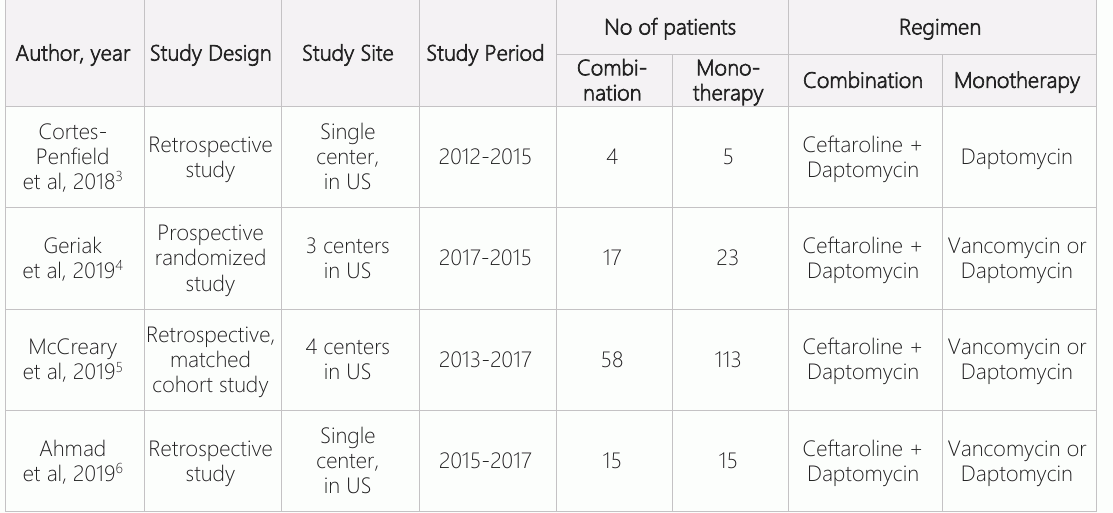
Four studies (3–6) which compared the effect of combining ceftaroline and vancomycin/daptomycin and standard therapy were identified from the literature search. Table 1 summarized the characteristics of these studies. One study was RCT (4) and other three were retrospective studies (3, 5, 6). Each two studies were single(3, 6) and multicenter studies (4, 5). Primary outcomes as 28-day mortality was recorded for analysis. Secondary outcome including 90-day mortality, microbiological relapse and the risk of acute kidney injury were extracted from the enrolled studies.
Overall, 94 and 156 patients received combination therapy with daptomycin plus ceftaroline and monotherapy - vancomycin or daptomycin, respectively. Although 28-day mortality rate of combination therapy group was numerically than monotherapy group (7.4% [7/94] vs 14.7% [23/156]), this difference did not reach statistical significance (risk difference, -0.07; 95% confidence interval [CI], -0.21 ~ 0.08). The similarity between combination therapy and monotherapy was also observed regarding the 90-day mortality (risk difference, 0.08; 95%CI, -0.77 ~ 0.94). In addition, combination therapy was similar to monotherapy (risk difference, -0.06; 95%CI, -0.22 ~ 0.1) in terms of micro biological relapse. Finally, the risk of acute kidney injury was similar between combination therapy and monotherapy (risk difference,-0.21; 95% CI,-0.62~0.2).
Based on the above findings, the clinical outcome of patients with MRSA bacteremia treated by the combination of ceftaroline and vancomycin or daptomycin was similar to those by monotherapy of vancomycin or daptomycin. However, the case and study number are limited in this analysis, further large-scale study is warrant to confirm these findings.
Declarations
- Author contributions (CRediT)
- All authors contributed equally to all 14 CRediT roles (Conceptualization, Data curation, Formal analysis, Funding acquisition, Investigation, Methodology, Project administration, Resources, Software, Supervision, Validation, Visualization, Writing – original draft, Writing – review & editing).
- Funding
-
Funding information was not reported in the published version of this article.
- Conflicts of interest
- The author declared no conflict of interest.
- Ethics approval
- Ethics approval details were not reported in the published version of this article.
- Data availability
- Data sharing is not applicable to this article as no new data were created or analysed in this study.
References (15)
10 of 15 references are linked to their DOI.
- Holick MF, Krane SM, Potts JT. Calcium, phosphorus, and bone metabolism: Calcium-regulation hormones. In: Fauci AS, Braunwald E, Isselbacher KJ, et al (Eds). Harrison's principles of internal medicine. 14th ed. New York: McGraw-Hill; 1995:2214 PubMed Google Scholar
- Thacher TD, Clarke BL. Vitamin D insufficiency. Mayo Clin Proc. 2011;86(1):50-60 PubMed Google Scholar
- Gal-Moscovici A, Sprague SM: Role of Vitamin D deficiency in chronic kidney Disease. J Bone Miner Res. 2007;22:91-94 DOI Crossref PubMed Google Scholar
- Michael F. Holick: Vitamin D for Health and in chronic kidney disease.Seminars in Dialysis - vol 18, No 4, 2005 DOI Crossref PubMed Google Scholar
- Yin K, Agrawal DK. Vitamin D and inflammatory diseases. J Inflamm Res. 2014;7:69-87 DOI Crossref PubMed Google Scholar
- Taskapan H, Wei M, Oreopoulos DG. 25(OH) Vitamin D(3) in patients with chronic kidney disease and those on dialysis: rediscovering its importance. Int Urol Nephrol. 2006;38(2): 323-329 DOI Crossref PubMed Google Scholar
- Hossein-nezhad A, Holick MF. Vitamin D for health: A Global perspective. Mayo Clin Proc. 2013;88(7):720–55 DOI Crossref PubMed Google Scholar
- Türkiye Endokrinoloji ve Metabolizma Derneği. Osteoporoz ve Metabolik Kemik Hastalıkları Tanı ve Tedavi Kılavuzu 2018: 119-27 PubMed Google Scholar
- Jean G, Souberbielle JC, Chazot C. Vitamin D in chronic kidney disease and dialysis patients. Nutrients. 2017;9(4):1-15 DOI Crossref PubMed Google Scholar
- Keung L, Perwad F. Vitamin D and kidney disease. Bone Rep. 2018;9:93-100 DOI Crossref PubMed Google Scholar
- Eknoyan G, Lameire M, Kasiske B. Kidney Disease: Improving Global Outcomes (KDIGO) CKD-MBD Update Work Group. KDIGO 2017 clinical practice guideline update for the diagnosis, evaluation, prevention, and treatment of chronic kidney disease–mineral and bone disorder (CKD-MBD). Kidney Int Suppl. 2017;7:1–59 DOI Crossref PubMed Google Scholar
- Eknoyan G,Levin NM: Bone metabolism and disease in chronic kidney disease. Am J Kidney Dis. 2003;42:1-201 DOI Crossref PubMed Google Scholar
- Gonzales EA,Sachdeva A,Oliver DA et al. Vitamin D insufficiency and deficiency in chronic kidney disease. A single center observational study. Am J Nephrol. 2004;24: 503-510 PubMed Google Scholar
- Tokmak F, Quack I, Schieren G, Sellin L, Rattensperger D, HollandLetz T, Weiner SM, Rump LC: High-dose chole calciferol to correct vitamin D deficiency in haemodialysis patients. Nephrol Dial Transplant. 2008;23:4016-4020 DOI Crossref PubMed Google Scholar
- Tentori F,Stidley C,Brown R et al:Survival does not differ among incident hemodialysis patients treated with the different vitamin D analogs, in vol (F-PO940), American Society of Nephrology Meeting, 2003 PubMed Google Scholar
Respond to this article
Comments on a published article are welcome as a Letter to the Editor.
Get an e-mail when new articles in your fields are published
Questions to the authors
Questions are moderated: an editor approves each question, the authors answer, and an editor approves the answer before both appear here.
No answered questions yet.
Ask the authors a question
Discussion
Comments are moderated: they appear after the writer confirms the e-mail address and an editor approves them. Each comment carries a conflict-of-interest statement.
No comments yet.
Write a comment
Read the full text
Open the PDF here
Loading the PDF…
If the PDF does not show here, use the download button above.
How to cite this article
Lee GM, Chao CM. Daptomycin or Vancomycin Plus Ceftaroline for Methicillin-Resistant Staphylococcus Aureus Bloodstream Infections. Ulutas Med J. 2020;6(3):185-187. doi:10.5455/umj.20200513022718
Lee, G. M., & Chao, C. M. (2020). Daptomycin or Vancomycin Plus Ceftaroline for Methicillin-Resistant Staphylococcus Aureus Bloodstream Infections. The Ulutas Medical Journal, 6(3), 185–187. https://doi.org/10.5455/umj.20200513022718
Lee, G.M. and Chao, C.M. (2020) 'Daptomycin or Vancomycin Plus Ceftaroline for Methicillin-Resistant Staphylococcus Aureus Bloodstream Infections', The Ulutas Medical Journal, 6(3), pp. 185–187. doi: 10.5455/umj.20200513022718.
@article{umj106884,
  title = {Daptomycin or Vancomycin Plus Ceftaroline for Methicillin-Resistant Staphylococcus Aureus Bloodstream Infections},
  author = {Lee, Guang-Mao and Chao, Chien-Ming},
  journal = {The Ulutas Medical Journal},
  year = {2020},
  volume = {6},
  number = {3},
  pages = {185--187},
  doi = {10.5455/umj.20200513022718},
  url = {https://www.ulutasmedicaljournal.com/?mno=106884},
  issn = {2149-388X}
}