The Ulutas Medical Journal · ISSN 2149-0430 (print), 2149-388X (online) · https://www.ulutasmedicaljournal.com/?mno=188729
Original Research · Open access
The Use of Free-Total Prostate Specific Antigen Ratio in Screening Prostate Cancer in Men with Specific Elevations of Prostate Specific Antigen
Also available in: العربية · Türkçe · 中文
- Medical Laboratory Science Department, Ebonyi State University, Abakaliki, Ebonyi State, Nigeria ROR
- Physiology Department , Nnamdi Azikiwe University, Awka, Nnewi Campus Anambra State, Nigeria ROR
- Dept. of Community Medicine, Enugu State University of Science and Technology, Enugu, Nigeria ROR
- Nursing Science Deptment, Ebonyi State University, Abakaliki, Ebonyi Nigeria. ROR
- Department of Physiotherapy, University of Nigeria Teaching Hospital, Enugu, Nigeria. ROR
Abstract
- Aim
- To evaluate the diagnostic performance of free-total PSA ratio using the criteria of total PSA > 4.0 ng/ml as the cut-off for prostate cancer diagnosis in men.
- Method
- A total of sixty patients (mean age 58.03 ± 9.82) were recruited as test subjects from the cancer unit of National Obstetric Fistula Center (NOFIC), Abakaliki, Ebonyi State, Nigeria. All the patients had total PSA value above 4.0ng/ml. Free and total PSA estimations were done using the principle of Enzyme Linked Immunosorbent Assay (ELISA).
- Result
- Free-total PSA ratio indicated high sensitivity (98.2% and 98.2%), specificity (87.9% and 82.9%) and positive predictive values (93.3% and 90%) for detecting undiagnosed prostate cancer at cut-offs of 0.25 and 0.19 respectively. High sensitivity (97.6%) and moderate specificity (61.7%) and positive predictive value (70.0%) were observed at cut off of 0.10. Using the free-total PSA ratio cut-off of ≤ 0.10 for prostate cancer, 70% of the test subjects were diagnosed of prostate cancer, on the other hand when a cutoff of > 0.25 was used, 6.7% of the test subjects were diagnosed of a possible benign prostatic hyperplasia.
- Conclusion
- Free-total PSA ratio is a highly sensitive, specific and useful diagnostic tool alternative to total PSA assay for the screening of undiagnosed prostate cancer. Furthermore, it is highly predictive of the risk for developing prostate cancer at specific cutoff levels.
Keywords
Full text
Introduction
Prostate-specific antigen (PSA), a protein produced by cells of the prostate gland (both normal cells and cancer cells produce PSA) is used to screen men for prostate enlargement be it benign or malignant (1). Serum PSA exists in a free form as well as complex with a number of protease inhibitors (2–6). Most PSA is bound to Alpha-1-antichymotripsin (ACT), and assays for total PSA measure both this bound fraction and free PSA (4, 7). Men with prostate cancer have a greater fraction of complex, or bound serum PSA and a lower percentage of PSA that is free compared (Free PSA) to men without prostate cancer (3, 4). Empirical evidence has shown that cancer patients have a higher percentage of PSA bound to ACT than normal controls (4. 8, 9).
Although prostate specific antigen (PSA) assay is widely considered as the most useful tumor marker for detecting cancer, however, its use as an effective test for prostate cancer has been controversial. Clinical practice recommendations from the American Cancer Society and the American Urologic Association have suggested annual cancer screening with both PSA and digital rectal examinations (10, 11). On the other hand, some advisory groups such as the National Cancer Institute, the American College of Physicians and the US Preventive Services Task Force, have recently recommended against the use of PSA test to screen for prostate cancer because the benefits if any are small and the harm can be substantial (12–14). For example, when used in screening, the PSA test can help detect small tumors that do not cause symptoms. Detecting tumors that are not life threatening is called ‘over-diagnosis’ while treating these tumors is called ‘overtreatment’ (1). Secondly, PSA test lacks specificity and may give false positive of false negative results, thus leading to many unnecessary prostate biopsies particularly for PSA values between 4.0 and 10.0 ng/ml (1, 2). A recent study has shown that some men with normal PSA levels below 4.0 ng/ml have prostate cancer, while others with higher levels do not have prostate cancer but have shown to have benign prostatic hyperplasia (BPH) (15). Furthermore, there is no evidence that PSA testing reduces disease specific morbidity or mortality (13, 14).
The above facts call for a need to develop strategies that can improve the specificity of PSA. Most investigators have recommended the use of free-total- PSA ratio calculated from the measurement of free and total PSA in place of total PSA for prostate cancer screening (6, 9, 16). Several studies from different institutions, evaluating a considerable number of different assays, have confirmed the ability of percent free-PSA to improve specificity in detecting prostate cancer with no loss of sensitivity (17–20). Recent studies have also shown that free-total PSA ratio can be used in clinical practice to discriminate between PSA elevation secondary to benign prostatic disease and prostate cancers thus making better decisions about risks of prostate cancer (17, 18). Free-total PSA ratio is superior to total PSA assay in distinguishing primary carcinoma of prostate (CaP) from benign prostate hyperplasia (BPH) in patients with increased total PSA. In addition, its value is effective in reducing the rate of unnecessary biopsies in men with total PSA higher than 4 ng/mL (21). Research has shown that men who were screened with free-total PSA ratio had a lower rate of death from prostate cancer (22). In this cross-sectional study, we aimed at evaluating the diagnostic performance (sensitivity, specificity, positive predictive value) of free-total PSA ratio by using the criteria of total PSA > 4.0 ng/ml as the cut off for prostate cancer diagnosis in men who reported at the prostate cancer screening unit of National Obstetric Fistula Center (NOFIC) Abakaliki, Ebonyi State, Nigeria.. We also determined the incidence of undiagnosed prostate cancer (PSA level > 4 ng/ml) at different risk levels in this suspected group of men.
Study Design
Sixty men aged 40 years and above, who reported at the cancer screening unit of National Obstetric Fistula Center (NOFIC) Abakaliki, Ebonyi State, Nigeria, were recruited for this study. Those included in the study as test subjects were male patients who attended the prostate cancer screening at the NOFIC, aged ≥ 40 years and had total PSA values > 4.0 ng/ml after PSA estimation. The consent of all the subjects was sought prior to participation in the study. Subjects were allowed to withdraw at any point of the research. This study was approved by the ethical committee of Medical Laboratory Science Department, EBSU.
Sample Collection and Analysis
About 5ml blood samples were collected unto plain container from the subjects in a relaxed mood without any prior prostate manipulation. The blood was centrifuged and serum used for PSA analysis. The serum was used for the analysis the same day and none was stored beyond 24 hours before use. Free and total PSA estimation was done using the principle of Enzyme Linked Immunosorbent Assay (ELISA) by BioCheck Inc: Cat number BC1019. Free-total PSA ratio was calculated.
Data Analysis
Descriptive data was expressed as mean ± standard deviation for continuous variables and as percentages for categorical variables. Comparative analysis involving two variables was performed using independent sample t-test. Correlation analyses between variables were determined using Pearson’s bivariate correlation test. ROC curve analysis was used to determine the diagnostic performance of free-total PSA ratio for detecting prostate cancer. Statistical significance was set at P<0.05. All statistics were done using IBM-SPSS statistical software (version 20).
Results
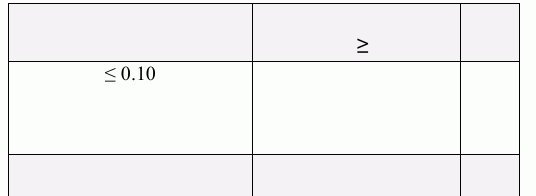
Table-1 shows the mean values of total PSA, free PSA and free-total PSA ratio for the subjects. Table-2 indicates frequency distribution of test subjects according to the level of risk of prostate cancer. Data shows that among the sixty subjects queried for prostate cancer, 42 (70%) had free-total PSA ratio values ≤ 0.10; 12 (20%) had free-total PSA ratio values between 0.11 – 0.18; 2 (3.3%) had values that fell between 0.19-0.25 and 4 (6.7%) had free-total PSA ratio > 0.25.
had values ≥ 0.19. At cutoff level of 0.10, forty two Table-3 shows the sensitivity, specificity and positive predictive value for detecting undiagnosed prostate cancer at free-total PSA ratios of 0.25, 0.19, and 0.10 respectively. As the cutoff level of free-total PSA ratio decreased, the sensitivity, specificity and positive predictive values increased. Similarly, the relative risk of developing prostate cancer also decreased with decrease in free-total PSA ratio cutoff level and indicated significant associations (p<0.001) with undiagnosed prostate cancer at all cut-off levels.


Free-total PSA ratios indicated high sensitivity, specificity and positive predictive values for detecting undiagnosed prostate cancer at cut-offs of 0.25 (98.2%; 87.9%; and 93.3%) and 0.19 (98.2%; 82.9% and 90%) respectively. High sensitivity (97.6%) and moderate specificity (61.7%) and positive predictive value (70.0%) were observed at cut off of 0.10. Further investigation revealed that at cut off level of 0.25, fifty six test subjects had free-total PSA ratio < 0.25 while 4 persons had values ≥ 0.25. At cutoff level of 0.19, fifty four test subjects had values < 0.19 while 6 subjects test subjects had values < 0.10 while 18 subjects had Pearson’s bivariate linear correlation indicated significant and inverse relationship (R= -0.296; p= 0.005) between free-total PSA ratio and total PSA.
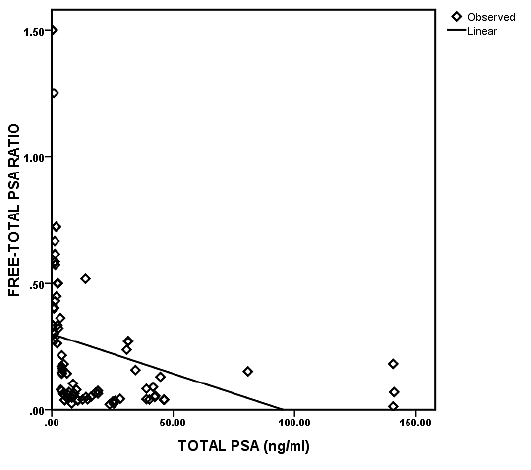
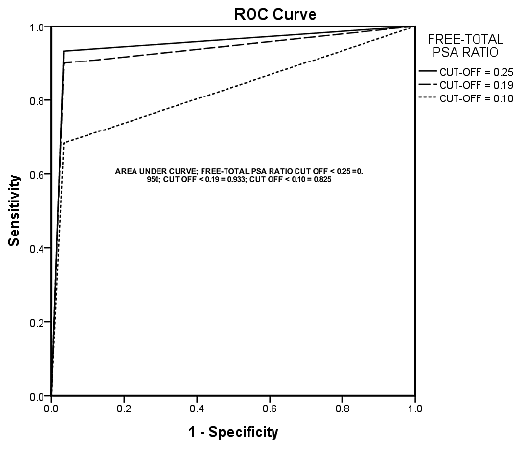
Figure-2 represents the ROC plot for free-total PSA ratio as a diagnostic indicator of undiagnosed prostate cancer at each possible free-total PSA ratio cutoff level. Area under the curve (AUC) revealed a high predictive value for free-total PSA ratio in detecting undiagnosed prostate cancer at cut offs of 0.25, AUC = 0.950; 0.19, AUC=0.933; 0.10, AUC= 0.825 respectively.
Discussion
The PSA assay was considered the most useful tumor marker for detecting prostate cancer until the advisory groups refused to recommend it as a routine screening test for prostate cancer. This is because; there is no evidence that PSA testing reduces disease specific morbidity or mortality (13, 14). Similarly, the lack of specificity by PSA test which leads to unnecessary prostate biopsies is another major concern to clinical practitioners. A previous study reports that PSA test has very poor positive predictive value (23).
In this study, we demonstrated that free-total PSA ratio is both sensitive and specific for detecting undiagnosed prostate cancer. The area under the curve of the ROC plot revealed a high performance of free-total PSA ratio as a useful diagnostic tool for detecting undiagnosed prostate cancer at different cut offs. Our data further indicates a significant association between free-total PSA ratio values and presence of prostate cancer thus demonstrating the predictive capacity of free-total PSA ratio for prostate cancer. Percent free PSA improves sensitivity and specificity in detecting prostate cancer. This agrees with previous studies that free- total PSA ratio may be used to decrease the number of prostate biopsies in patients with serum PSA levels of 4.0 to 10.0 ng/mL. (17–20, 24, 25) The present findings show that the use of free-total PSA ratio in the diagnosis and screening of prostate cancer is an improved way to distinguish cancerous from benign and inflammatory conditions of the prostate gland. The specificity of using PSA to detect prostate cancer lies in free-total PSA ratio and this further nullifies the lack of specificity, unnecessary prostate biopsies and harm often associated with PSA test (12–14).
It is noteworthy that the free-total PSA ratio cut-offs at 0.25 and 0.19 identified a large proportion of the study population with undiagnosed prostate cancer and are at great risk of developing prostate cancer (RR = 28; 95% CI, 6.82-153.8 and RR = 27; 95% CI, 6.31-150.6). Eighteen test subjects with initial PSA level ≥ 4 ng/ml were found not to have prostate cancer when free-total PSA ratio cut-off of <10 was used. These findings demonstrate the clinical utility of free-total PSA ratio in detecting men with an elevated PSA level who do not turn out having prostate cancer and vice versa.
The free-total PSA ratio of < 0.25 is a marker of prostate cancer while free-total PSA ratio ≥ 0.25 is an indicator of benign prostatic hyperplasia. Probability of benign disease is seen in free-total PSA ratio of ≥ 0.25 while probability of malignant disease is seen in free-total PSA ratio of ≤ 0.10 (26). Of all the sixty test subjects who were seen at the prostate cancer unit in NOFIC with suspected prostate cancer, 70% had prostate cancer risk (at free-total PSA ratio ≤ 0.10) while 6.7% presented benign prostatic hyperplasia as determined by Free-total PSA ratio of > 0.25. A multicenter study group assessing the diagnostic performance of free PSA evaluated 1081 men and found that among men diagnosed with prostate cancer, 4% had a free-total PSA ratio of > 0.25, while only 2% of men with BPH had a free-total PSA ratio of < 0.07 (24), this suggests potential clinical utility for free-total PSA ratio.
Conclusion
Free-total PSA ratio is a highly sensitive, specific and useful diagnostic tool alternative to total PSA assay for the screening of undiagnosed prostate cancer. A free-total PSA cut off at 0.25 and 0.19 could identify more individuals with undiagnosed prostate cancer at great risk of developing prostate cancer. Using the free-total PSA ratio cut off of ≤ 0.10 for prostate cancer, 70% of the test subjects were diagnosed of prostate cancer risk. At the cutoff of > 0.25 was used, 6.7% of the test subjects were diagnosed of a possible benign prostatic hyperplasia.
Declarations
- Author contributions (CRediT)
- All authors contributed equally to all 14 CRediT roles (Conceptualization, Data curation, Formal analysis, Funding acquisition, Investigation, Methodology, Project administration, Resources, Software, Supervision, Validation, Visualization, Writing – original draft, Writing – review & editing).
- Funding
-
Funding information was not reported in the published version of this article.
- Conflicts of interest
- The authors declare that no conflict of interest exists in publishing this article.
- Ethics approval
- This study was approved by the ethical committee of Medical Laboratory Science Department, EBSU.
- Data availability
- A data availability statement was not reported in the published version of this article.
References (26)
17 of 26 references are linked to their DOI.
- National Cancer Institute. Prostate specific antigen test. Reviewed 2012. Accessed from http:// www.cancer.gov/PSA on 11th May, 2014. PubMed Google Scholar
- Hoffman RM, Clannon DL, Littenberg B, Frank JJ, Pierce JC. Using the free to total prostate specific antigen ratio to detect prostate cancer in men with non-specific elevations of prostate specific antigen level. J Gen Intern Med. 2000; 15 (10):739-748. DOI Crossref PubMed Google Scholar
- Lilja H, Christensson A, Dahlén U, et al. Prostate-specific antigen in serum occurs predominantly in complex with α1-antichymotrypsin. Clin Chem. 1991; 37:1618-25. DOI Crossref PubMed Google Scholar
- Stenman UH, Leinonen J, Alfthan H, Rannikko S, Tuhkanen K, Alfthan O, et al. A complex between prostate-specific antigen and α1-antichymotrypsin is the major form of prostate-specific antigen in serum of patients with prostatic cancer: assay of the complex improves clinical sensitivity for cancer. Cancer Res. 1991; 51:222-6. PubMed Google Scholar
- Christensson A, Laurell CB, Lilja H, et al. Enzymatic activity of prostate-specific antigen and its reactions with extracellular serine proteinase inhibitors. Eur J Biochem. 1990;194:755-63. DOI Crossref PubMed Google Scholar
- McCormack RT, Rittenhouse HG, Finlay JA, et al. Molecular forms of prostate-specific antigen and the human kallikrein gene family: a new era. Urology. 1995; 45:729– 44. DOI Crossref PubMed Google Scholar
- Lilja H, et al. Regulation of the enzymatic activity of prostate-specific antigen and its reactions with extracellular protease inhibitors in prostate cancer. Scand J Clin Lab Invest Suppl. 1995; 220:47–56. PubMed Google Scholar
- Leinonen J, Lövgren T, Vornanen T, Stenman UH, et al. Double-label time-resolved immunofluorometric assay of prostate-specific antigen and of its complex with α1-antichymotrypsin. Clin Chem. 1993; 39:2098– 103. DOI Crossref PubMed Google Scholar
- Christensson A, Björk T, Nilsson O, Dahlén U, Matikainen MT, et al. Serum prostate specific antigen complexed to alpha 1-antichymotrypsin as an indicator of prostate cancer. J Urol.1993; 150(1):100– 105.. DOI Crossref PubMed Google Scholar
- Mettlin C, Jones G, Averette H, Gusberg SB, Murphy GP, et al. Defining and updating the American Cancer Society guidelines for the cancer related check-up: prostate and endometrial cancers. CA Cancer J Clin. 1993; 43:42–6. DOI Crossref PubMed Google Scholar
- American Urological Association. Early detection of prostate cancer and use of transrectal ultrasound. Baltimore, Md: Williams & Wilkins; 1992. In: American Urological Association 1992 Policy Statement Book. PubMed Google Scholar
- PDQ. (Physician Data Query) [Database online]. Bethesda, Md: National Cancer Institute: 1984 – [updated 9/99]. Screening for prostate cancer. Available from: National Cancer Institute; National Library of Medicine, Bethesda, Md: CDP Technologies, Inc., New York, NY; Lexis-Nexis, Miamisburg, Ohio. PubMed Google Scholar
- American College of Physicians. Screening for prostate cancer. Ann Intern Med. 1997; 126:480–4. PubMed Google Scholar
- U.S. Preventive Services Task Force. Guide to clinical preventive services. 2nd ed. Baltimore: Williams & Wilkins; 1996. PubMed Google Scholar
- Thompson IM, Pauler DK, Goodman PJ, et al. Prevalence of prostate cancer among men with a prostate-specific antigen level < or =4.0 ng per milliliter. New England Journal of Medicine. 2004; 350(22):2239-2246. DOI Crossref PubMed Google Scholar
- Vessella RL, Lange PH, et al. Issues in the assessment of prostate-specific antigen immunoassays. An update. Urol Clin North Am. 1997; 24:261–8. DOI Crossref PubMed Google Scholar
- Walz J, Haese A, Scattoni A, et al. Percent Free Prostate-Specific Antigen (PSA) is an accurate predictor of prostate cancer risk in men with serum PSA 2.5 ng/mL and Lower. Cancer. 2008; 113 (10):2695-2703. DOI Crossref PubMed Google Scholar
- Demura H, Nakamura M, Hasumi H, et al. Effectiveness of percent free prostate specific antigen as a predictor of prostate cancer detection on repeat biopsy. Int J Urol. 2004; 11(7):494-500. PubMed Google Scholar
- Mitrunen K, Pettersson K, Piironen T, et al. A novel dual-label one-step immunoassay for simultaneous measurement of free and total PSA concentrations and ratios in serum. Clin Chem 1995; 41:1115-1120. DOI Crossref PubMed Google Scholar
- Demura T, Shinohara N, Tanaka M, et al. Ratio of free and total prostate-specific antigen: A method of detecting prostate cancer in the cases with PSA levels of 10ng/mL or lower. J Urol. 1996; 155(suppl):S368A. PubMed Google Scholar
- Mione R, Barioli P, Barichello M, Zattoni F, Prayer-Galetti T, Plebani M, Aimo G, Terrone C, Manferrari F, Madeddu G, Caberlotto L, Fandella A, Pianon C, Vianello L, Gion M. Prostate cancer probability after total PSA and percent free PSA determination. Int J Biol Markers. 1998; 13(2):77-86. DOI Crossref PubMed Google Scholar
- Schröder FH, Hugosson J, Roobol MJ, et al. Prostate-cancer mortality at 11 years of follow-up. New England Journal of Medicine. 2012; 366(11):981-990 DOI Crossref PubMed Google Scholar
- Catalona WJ, Richie JP, Ahmann FR, et al. Comparison of digital rectal examination and serum prostate specific antigen in the early detection of prostate cancer: results of a multicenter clinical trial of 6,630 men. J Urol. 1994; 151:1283–90. DOI Crossref PubMed Google Scholar
- Thiel RE, Oesterling JE, Wojno KJ, et al. A multicenter comparison of the diagnostic performance of free PSA. Urology 48(6A suppl):S45-S50, 1996. DOI Crossref PubMed Google Scholar
- Bangma CH, Rietbergen BW, Kranse R, et al. The free-to - total prostate specific antigen ratio improves the specificity of prostate specific antigen in screening for prostate cancer in the general population. J Urol. 1997; 157:2191-2196. DOI Crossref PubMed Google Scholar
- Oesterling JE, Jacobsen SJ, Klee GG, et al. Free, complexed and total serum prostate specific antigen: the establishment of appropriate reference ranges for their concentrations and ratios. J Urol. 1995; 154:1090-1095. DOI Crossref PubMed Google Scholar
Respond to this article
Comments on a published article are welcome as a Letter to the Editor.
Get an e-mail when new articles in your fields are published
Questions to the authors
Questions are moderated: an editor approves each question, the authors answer, and an editor approves the answer before both appear here.
No answered questions yet.
Ask the authors a question
Discussion
Comments are moderated: they appear after the writer confirms the e-mail address and an editor approves them. Each comment carries a conflict-of-interest statement.
No comments yet.
Write a comment
Tell me when this article is cited
Leave your e-mail address and confirm it. These notices are not being sent yet; your confirmed address is kept for them and used for nothing else.
Read the full text
Open the PDF here
Loading the PDF…
If the PDF does not show here, use the download button above.
How to cite this article
Ewenighi C, Dimkpa U, Onyeanusi J, Onoh L, Onoh G, Oti N, et al. The Use of Free-Total Prostate Specific Antigen Ratio in Screening Prostate Cancer in Men with Specific Elevations of Prostate Specific Antigen. Ulutas Med J. 2015;1(2):31-35. doi:10.5455/umj.20150518015721
Ewenighi, C., Dimkpa, U., Onyeanusi, J., Onoh, L., Onoh, G., Oti, N., Obasi, L., & Ezeugwu, U. (2015). The Use of Free-Total Prostate Specific Antigen Ratio in Screening Prostate Cancer in Men with Specific Elevations of Prostate Specific Antigen. The Ulutas Medical Journal, 1(2), 31–35. https://doi.org/10.5455/umj.20150518015721
Ewenighi, C. et al. (2015) 'The Use of Free-Total Prostate Specific Antigen Ratio in Screening Prostate Cancer in Men with Specific Elevations of Prostate Specific Antigen', The Ulutas Medical Journal, 1(2), pp. 31–35. doi: 10.5455/umj.20150518015721.
@article{umj188729,
  title = {The Use of Free-Total Prostate Specific Antigen Ratio in Screening Prostate Cancer in Men with Specific Elevations of Prostate Specific Antigen},
  author = {Ewenighi, Chinwe and Dimkpa, Uchechukwu and Onyeanusi, Joel and Onoh, Linus and Onoh, Gladys and Oti, Nma and Obasi, Linda and Ezeugwu, Uchechukwu},
  journal = {The Ulutas Medical Journal},
  year = {2015},
  volume = {1},
  number = {2},
  pages = {31--35},
  doi = {10.5455/umj.20150518015721},
  url = {https://www.ulutasmedicaljournal.com/?mno=188729},
  issn = {2149-388X}
}