The Ulutas Medical Journal · ISSN 2149-0430 (print), 2149-388X (online) · https://www.ulutasmedicaljournal.com/?mno=19124
Original Article · Open access
Strabismus in Pediatric Age: A Single Center Experience in Turkey
Also available in: العربية · Türkçe · 中文
- Special Internal Medicine Clinic, Adana, Turkey
- Department of Ophthalmology, Adana Ortadogu Hospital, Adana, Turkey ROR
Abstract
- Background
- Strabismus is a clinical situation in which the eyes are not aligned with each other appropriately. The causes, common types, and prevalence of strabismus have not been revealed yet. The study aimed to investigate the prevalence, etiology, and the most common types of strabismus in Turkish children.
- Materials and Methods
- This was a prospective study conducted from April 2014 and July 2018 at our ophthalmology clinic. A total of 70 children with strabismus between 6 months - 18 years of age included in this study. All patients below 6 months and above 18 years were excluded from this study. A detailed history of the complaints, birth, and developmental problems was taken. The examination for strabismus was done with the cover-uncover test, alternative cover test, and Hirschberg-Test.
- Results
- A total of 3800 children attended our clinic during the period of the study. Among them, the total number of children with strabismus was 70. Therefore, the total prevalence of strabismus was 1.84%, in boys was 0.84%, and in girls was 1%. In children between 6 months - 2 years of age, 6 (8.5%) children had trauma, 12 (17.2%) had a febrile convulsion, and 2 (2.8%) had eye diseases. In children between 2 - 10 years of age, 8 (11.4%) children had trauma, 2 (2.8%) had a febrile convulsion, 4 (5.6%) had eye diseases. In children between 10-18 years of age, 6(8.5%) children had trauma, and 12 (17.2%) had eye diseases.
- Conclusion
- Febrile convulsion plays an essential role in strabismus up to the first two years. Trauma is prevalent in strabismus after two years of age. Eye diseases come into prominence in strabismus in advanced ages.
Keywords
Full text
Introduction
Strabismus is a clinical condition in which the eyes are not properly aligned. It is also called as “Squint”. Physiologically, when our eyes are focused on an object, they are aligned to each other so that both visual axes always intersect at the object being viewed. Thus, we can see objects clearly and accurately. If a child has strabismus, abnormal ocular motility, double vision, poor vision, or abnormal head position problems may also be seen. The diagnosis of strabismus at early ages has vital importance. As age progresses, the treatment becomes more difficult. In infants who have strabismus, visual acuity may not develop properly (1, 2). Besides, children and adolescents with strabismus often suffer from various psycho-social and emotional consequences. For this reason, infants with strabismus should be diagnosed and treated to prevent visual impairment and psychological problems.
The most important reasons for strabismus are low birth weight and prematurity (2–4). Other etiological factors may be anisometropia (2, 4) refractive error (5), astigmatism (2), cerebral palsy, intraventricular bleeding (6), parental age, smoking during pregnancy (7, 8), low Apgar (9), retinopathy of prematurity (ROP) (10, 11), and assisted delivery (12).
The causes, common types, and prevalence of strabismus have not been revealed precisely in Turkish children. In the pediatric age group, the causes, common types, and prevalence of strabismus should be investigated in order to make early diagnosis and treatment. In this context, this study aimed to examine the strabismus and related conditions from six months to 18-years-old children and to determine the types, prevalence, etiology, age, and gender distribution of strabismus.
Materials and Methods
This study was performed following the Declaration of Helsinki and was approved by the Ethics Committee of Adana City Hospital in Adana in Turkey. Before the examination, informed consent was obtained from the parents of all children.
A total of 3800 children between 6 months and 18 years admitted to our ophthalmology clinic between April 2014 and July 2018. Seventy of 3800 children had strabismus and were included in the study. All patients below six months and above 18 years were excluded from this study. A detailed history of the complaints, birth, and developmental problems was taken.
Patients were evaluated for visual acuity, both distance and near vision with the naked eye as well as best-corrected visual acuity. Fundus examination was also done with a slit lamp using cyclopentolate. The examination for strabismus was done with the cover-uncover test, alternative cover test, and Hirschberg-Test. If a patient revealed with heterotopia, an alternating prism cover test was used to measure the squint angle in diopters. In patients with refractive error, strabismus examination was performed after the refractive error was corrected.
Strabismus was classified depending on deviation from a primary position such as esotropia, exotropia, and syndromes (vertical deviation). The patients were investigated according to the following criteria: gender, age, etiology, family history, strabismus type, and refractive error (myopia, hypermetropia).
Results
Seventy (1.84%) children had strabismus. 32 (45.7%) were male and 38 (54.3%) were female. The prevalence of strabismus in boys was 0.84% and in girls was 1%.
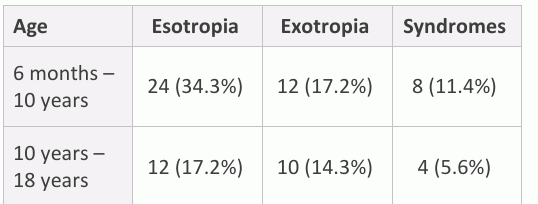
Esotropia was detected in 24 (34.3%) children, exotropia in 12 (17.2%) children, and syndrome in 8 (11.4%) children between 6 months and 10 years. Esotropia was found in 12(17.2%), as exotropia in 10 (14.3%) patients, and syndrome in 4(5.6%) between 10-18 years (Table-1).
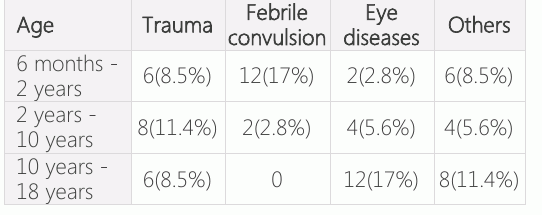
The etiology of strabismus was divided into three age groups: 6 months-2 years,2-10 years, and 10-18 years. In the six months-2-years age group, 6 (8.5%) children had trauma, 12 (17.2%) had a febrile convulsion, 2(2.8%) had eye diseases, and 6 (8.5%) had other causes. In the 2-10 years group, 8 (11.4%) children had trauma, 2(2.8%) children had febrile convulsion, 4(5.6%) children had ophthalmologic diseases, and 4 (5.6%) children had other causes. In the 10-18 years age group, 6(8.5%) children had trauma, 12 (17.2%) had eye diseases, and 8 (11.4%) had other causes (Table-2).
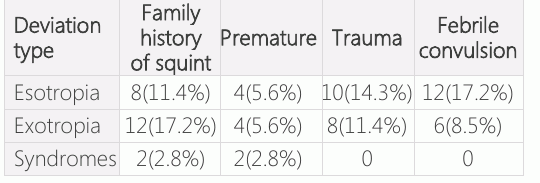
Eight (11.4%) patients with esotropia had a family history, 4 (5.6%) had prematurity, 10 (14.3%) had trauma, and 12(17%) had a febrile convulsion. 12 (17%) patients with exotropia had a family history, 4(5.6%) had prematurity, 8 (11.4%) had trauma, and 6 (8.5%) had a febrile convulsion. Besides, 2 (2.8%) patients with syndromes had a family history of strabismus, and 2 (2.8%) had prematurity (Table-3).
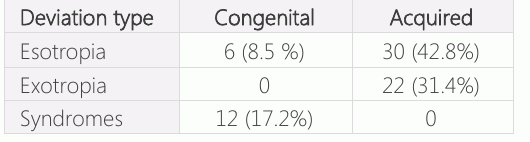
Six (8.5%) of the children with congenital strabismus had esotropia, and 12 (17.2%) had syndromes. 30 (42.8%) of the children with acquired strabismus had esotropia, and 22 (31.4%) had exotropia (Table 4).
54 (77.1%) of the patients had a refractive error. 22 (31.4%) children had myopia, and 32 (45.7%) had hypermetropia.
Discussion
According to our study, the total prevalence of strabismus was 1.84%. In other countries, the prevalence of strabismus was found as 4.3% in England, 1.9% in Africa, 1.28% in Japan, and 4.6% in Finlan (6). Strabismus prevalence in our study was found to be 0.84% in boys and 1% in girls. In the study of Graham, strabismus prevalence was 7.3% in boys and 6.9% in girls. These studies show a considerable variation in prevalence rates in various countries. Genetic, racial, and environmental factors, age groups of children may be useful in this situation.
In the current study, esotropia was found in 51.5% of children with strabismus, exotropia in 31.5% of children, and syndrome in 17% of children. This context suggests that esotropia may be the most common type of strabismus in Turkish children. This finding was similar to the study of Matsuo et al., which reported that exotropia and esotropia were the most common type of strabismus in 86.220 pre-school children (13) On the other hand, Attada et al. reported that esotropia was more common in 3-10 years group while exotropia was more common in 11-16 years group (6). Strabismus in children has been reported to have several risk factors. Remaly et al. suggested that the risk of strabismus increased with low birth weight and maternal smoking during pregnancy. Additionally, they showed that maternal age was also a significant risk factor (15). In another study, a family history of squint was investigated as a risk factor. In this study, a family history of squint was presented in 28% of children (16). The writing committee for the multi-ethnic pediatric eye disease study and the Baltimore pediatric eye disease study groups declared that esotropia was associated with prematurity, smoking during pregnancy, anisometropia, and hyperopia while exotropia was associated with prematurity, smoking during pregnancy, family history of strabismus, female sex, and astigmatism (14). From another perspective, Rachael et al. reported that intensity and duration of exposure to sunlight might be related to strabismus.
In the present study, 31.4% of the patients had a family history of squint, 14% had prematurity, 25.7% had trauma, and 25.7% had a febrile convulsion. When the etiological factors were examined, febrile convulsion was seen in the foreground in early ages. Trauma was prevalent in strabismus after two years. Eye diseases came into prominence in advanced ages.
Previous studies showed that accommodative esotropia was the most common type of esotropia (6). Graham and Mohney reported that accommodative esotropia was more common than non-accommodative esotropia (18, 19). They suggested that accommodative esotropia, intermittent exotropia, and acquired non-accommodative esotropia were the most common forms of strabismus. In the study of Chia et al., 53% had accommodative esotropia, and 23% had congenital esotropia (20). In our study, 25.7% had congenital strabismus, and 74.2% had acquired strabismus. 8.5% of congenital strabismus was esotropia, and 17.2% was related to congenital syndromes. 42.8% of acquired strabismus was esotropia, and 31.4% was exotropia.
In our study, 77.1% of children with strabismus had a refractive error. 31.4% of children had myopia, and 45.7% had hypermetropia. In the study of Attada, 52.4% of the patients had refractive errors, 30.4% was myopia, and 22% was hypermetropia. These findings may warrant an annual checkup of all children. The children who were determined to have any visual morbidity should be examined more frequently to prevent progression.
This study investigated strabismus and related conditions in Turkish children with a different point of view. Early diagnosis and appropriate treatment of strabismus can significantly reduce the disease burden. In this context, regular school or community-based screening of children should be necessary for early diagnosis and management of strabismus in pediatric ages. For example, a comprehensive health investigation, including eye examination, may be performed before starting primary school.
Declarations
- Author contributions (CRediT)
- All authors contributed equally to all 14 CRediT roles (Conceptualization, Data curation, Formal analysis, Funding acquisition, Investigation, Methodology, Project administration, Resources, Software, Supervision, Validation, Visualization, Writing – original draft, Writing – review & editing).
- Funding
-
Funding information was not reported in the published version of this article.
- Conflicts of interest
- None of the authors has a conflict of interest with the present article.
- Ethics approval
- This study was performed following the Declaration of Helsinki and was approved by the Ethics Committee of Adana City Hospital in Adana in Turkey.
- Data availability
- A data availability statement was not reported in the published version of this article.
References (20)
13 of 20 references are linked to their DOI.
- Robaei D, Rose KA, Kifley A, Cosstick M, Ip JM, Mitchell P. Factors associated with childhood strabismus: findings from a population-based study. Ophtha lmology. 2006;113 (7):1146– 1153 DOI Crossref PubMed Google Scholar
- Repka MX, Summers CG, Palmer EA, Dobson V, Tung B, Davis B. The incidence of ophthalmologic interventions in children with birth weights less than 1251 grams. Results through 5 1/2 years. Cryotherapy for retinopathy of prematurity cooperative group. Ophthalmology. 1998;105 (9):1621–1627 DOI Crossref PubMed Google Scholar
- Schalij-Delfos NE, de Graaf ME, Treffers WF, Engel J, Cats BP. Long term follow up of premature infants: detection of strabismus, amblyopia, and refractive errors. J Ophthalmol. 2000;84(9):963– 967 DOI Crossref PubMed Google Scholar
- Cotter SA, Varma R, Tarczy-Hornoch K, McKean-Cowdin R, Lin J, Wen G, Wei J, Borchert M, Azen SP, Torres M, et al. Risk factors associated with childhood strabismus: the multi-ethnic pediatric eye disease and Baltimore pediatric eye disease studies. Ophthalmology. 2011;118(11):2251–2261 DOI Crossref PubMed Google Scholar
- Holmstrom G, Rydberg A, Larsson E. Prevalence and development of strabismus in 10-year-old premature children: a population-based study. J Pediatr Ophthalmol Strabismus. 2006;43(6):346– 352 DOI Crossref PubMed Google Scholar
- Attada TR. Deepika M, Laxmi S. Strabismus in paediatric age (3-16 year): a clinical study. Int J Res Med Sci 2016;4:1903-9. DOI Crossref PubMed Google Scholar
- Chew E, Remaley NA, Tamboli A, Zhao J, Podgor MJ, Klebanoff M. Risk factors for esotropia and exotropia. Arch Ophthalmol. 1994;112(10):1349–1355 DOI Crossref PubMed Google Scholar
- Hakim RB, Tielsch JM. Maternal cigarette smoking during pregnancy. A risk factor for childhood strabismus. Arch Ophthalmol. 1992;110(10):1459–1462 DOI Crossref PubMed Google Scholar
- Mohney BG, Erie JC, Hodge DO, Jacobsen SJ. Congenital esotropia in Olmsted County, Minnesota. Ophthalmology. 1998;105(5):846–850 PubMed Google Scholar
- O'Connor AR, Stephenson TJ, Johnson A, Tobin MJ, Ratib S, Fielder AR. Strabismus in children of birth weight less than 1701 g. Arch Ophthalmol. 2002;120(6):767– 773 DOI Crossref PubMed Google Scholar
- Bremer DL, Palmer EA, Fellows RR, Baker JD, Hardy RJ, Tung B, Rogers GL. Strabismus in premature infants in the first year of life. Cryotherapy for retinopathy of prematurity cooperative group. Arch Ophthalmol. 1998;116(3):329– 333 DOI Crossref PubMed Google Scholar
- Pathai S, Cumberland PM, Rahi JS. Prevalence of and early-life influences on childhood strabismus: findings from the millennium cohort study. Arch Pediatr Adolesc Med. 2010;164(3):250–257 DOI Crossref PubMed Google Scholar
- Matsuo T, Matsuo C. Comparison of prevalence rates of strabismus and amblyopia in Japanese elementary school children between the years 2003 and 2005. Acta Medica Okayama. 2007;61(6):329– 334 DOI Crossref PubMed Google Scholar
- Cotter SA, Varma R, Tarczy-Hornoch K, McKean- Cowdin R, Lin J, Wen G, et al. Borchert Met Joint writing committee for Multi ethnic Pediatric Eye disease study and the Baltimore paediatric eye disease study groups Ophthalmology. 2011; 118(11):2251-61 PubMed Google Scholar
- Remaley NA, Tamboli A, Zhao J, Podgor MJ, Klebanoff M. Risk factors for esotropia and exotropia. Arch Ophthalmol. 1994;112(10):1349-55 PubMed Google Scholar
- Cass EE. Divergent strabismus. Br J Ophthalmol. 1937;21(10): 538-559 PubMed Google Scholar
- Rachael H, Jenkins DB. Demographic variations in the prevalence and management of exotropia. Am Orthopt J. 1992;42:82 PubMed Google Scholar
- Graham PA. Epidemiology of Strabismus Brit J Ophthalmol. 1974;58(3):224-31 PubMed Google Scholar
- Mohney BG. Common forms of childhood strabismus in an incidence report. Am J Ophthalmol. 2007;144(3):465-7 DOI Crossref PubMed Google Scholar
- Chia A, Roy L, Seenyen L, Comitant Horizontal Straismus: an Asian perspective Br J Ophthalmol. 2007;91(10):1337-40 PubMed Google Scholar
Respond to this article
Comments on a published article are welcome as a Letter to the Editor.
Get an e-mail when new articles in your fields are published
Questions to the authors
Questions are moderated: an editor approves each question, the authors answer, and an editor approves the answer before both appear here.
No answered questions yet.
Ask the authors a question
Discussion
Comments are moderated: they appear after the writer confirms the e-mail address and an editor approves them. Each comment carries a conflict-of-interest statement.
No comments yet.
Write a comment
Read the full text
Open the PDF here
Loading the PDF…
If the PDF does not show here, use the download button above.
How to cite this article
Babakhani E, Babakhani E. Strabismus in Pediatric Age: A Single Center Experience in Turkey. Ulutas Med J. 2019;5(3):184-188. doi:10.5455/umj.20191127100430
Babakhani, E., & Babakhani, E. (2019). Strabismus in Pediatric Age: A Single Center Experience in Turkey. The Ulutas Medical Journal, 5(3), 184–188. https://doi.org/10.5455/umj.20191127100430
Babakhani, E. and Babakhani, E. (2019) 'Strabismus in Pediatric Age: A Single Center Experience in Turkey', The Ulutas Medical Journal, 5(3), pp. 184–188. doi: 10.5455/umj.20191127100430.
@article{umj19124,
  title = {Strabismus in Pediatric Age: A Single Center Experience in Turkey},
  author = {Babakhani, Elnaz and Babakhani, Elnaz},
  journal = {The Ulutas Medical Journal},
  year = {2019},
  volume = {5},
  number = {3},
  pages = {184--188},
  doi = {10.5455/umj.20191127100430},
  url = {https://www.ulutasmedicaljournal.com/?mno=19124},
  issn = {2149-388X}
}