The Ulutas Medical Journal · ISSN 2149-0430 (print), 2149-388X (online) · https://www.ulutasmedicaljournal.com/?mno=86226
Original Article · Open access
The Effect of Smoking on Hematological Parameters
- Department of Haematology, Adana City Education and Research Hospital, Adana, Turkey ROR
- Department of Internal Medicine and Haematology, Adana City Education and Research Hospital, Adana, Turkey ROR
- Department of Internal Medicine, Adana City Education and Research Hospital, Adana, Turkey ROR
Abstract
- Introduction
- The purpose of this study was to investigate the effects of smoking on hematological parameters.
- Materials and Methods
- A total of 295 participants who were older than 18 years of age, did not have any known diseases, applied to our clinics for check-ups, and had no diseases revealed in their check-up procedures were included in the study.
- Results
- Compared to the non-smokers, the smokers had higher levels of hemoglobin (15.6 g/dL vs. 13.5 g/dL, respectively; p<0.001), mean corpuscular volume (MCV) (88.1 fL vs. 83.4 fL, respectively; p<0.001), white blood cell (WBC) count (9×10³/µL vs. 6.95×10³/µL, respectively; p<0.001), neutrophil count (5.4×10³/µL vs. 4.1×10³/µL, respectively; p<0.001), lymphocyte count (2.5×10³/µL vs. 2×10³/µL, respectively; p<0.001), monocyte count (0.7×10³/µL vs. 0.5×10³ /µL, respectively; p<0.001), and eosinophil count (0.2×10³/µL vs. 0.1×10³/µL, respectively; p<0.001). There was a significant positive correlation between smoking time and MCV (r=0.155, p=0.038), WBC count (r=0.179, p=0.016), neutrophil count (r=0.147, p=0.049), and monocyte count (r=0.150, p=0.046). There was a positive correlation between the number of cigarettes smoked per day and hemoglobin level (r=0.275, p<0.001) and MCV (r=0.149, p=0.046).
- Conclusion
- We found that hematological parameters, particularly hemoglobin level and WBC count, were affected in smokers compared to non-smokers.
Keywords
Full text
Introduction
According to World Health Organization data, about 5 million people around the world die from smoking-related diseases each year (1). The rate is much higher in developing countries. Despite this high mortality rate, the number of smokers is also increasing every day. It is believed that there are 4.5 billion smokers in the world and this will increase up to about 7.1 billion by 2025 (2).
A cigarette contains about 4,000 compounds that can cause cellular-level damage in the human body (3). Among these compounds, free radicals, nicotine, and carbon monoxide are believed to be responsible for the worst pharmacological effects of smoking. These compounds are often thought to be associated with cancer, lung diseases, and cardiovascular diseases (3). However, compounds mentioned above play a role in the etiopathogenesis of many other diseases, as well.
The formation of hematological components begins in the bone marrow and they continue to mature in the peripheral blood tissue. Therefore, they are affected by many harmful compounds that cause damage to the bone marrow and peripheral blood tissue. Tobacco contains many such harmful compounds. There is a limited number of studies in the literature investigating the effects of smoking on hematological parameters. Some of these studies investigated a limited number of hematological parameters and some have contradictory results. Therefore, the purpose of this study is to perform a comprehensive investigation of the effects of smoking on hematological parameters.
Materials and Methods
This study was conducted in the Hematology and Internal Medicine Clinics of Adana Education and Research Hospital, University of Health Sciences. A total of 295 participants who were older than 18 years of age, did not have any known diseases, applied to our clinics for check-ups, and had no diseases revealed in the check-up procedure were included in the study. Patients admitted to our clinic for check-ups were excluded from the study in the following cases: those with any known acute/chronic disease; those being followed for iron deficiency, vitamin B12 deficiency, or folate-deficiency anemia; and those using vitamin supplements, antioxidants, or anticoagulant/antiaggregant drugs. Clinical and demographic characteristics (gender, age, smoking time, and the number of cigarettes smoked per day) and laboratory findings (hematological parameters incomplete blood count) of the participants were taken from patient files. The neutrophil/lymphocyte ratio (NLR) was calculated by comparing neutrophil count to the lymphocyte count in the same units. The individuals with hemoglobin levels of >16.5g/dL in men and >16 g/dL in women were checked for poly cythemia vera. The study was approved by the Ethics Committee of the Faculty of Medicine of Çukurova University.
Statistical analysis
SPSS for Windows 20 (IBM Corp., Armonk, NY, USA) was used for statistical analysis. The normal distribution of the data was evaluated using the Kolmogorov-Smirnov. The variables with normal distribution were presented as mean±standard deviation and the variables with non-normal distribution were presented as median (min-max). The categorical variables were given as number and percentage. Spearman correlation analysis was used for correlation analysis. All p-values were 2-sided with statistical significance at 0.05.
Results
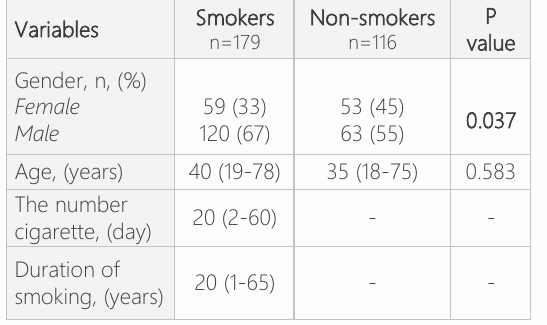
The detailed clinical and demographic findings of the study population are given in Table-1. The ratio of female participants was higher in the non-smoker group, while the ratio of male participants was higher in the smoker group. There was no difference between the groups in terms of median age (smokers: 40 years (19-78) vs. non-smokers: 35 years (18-78); p= 0.583). The smoking rate was higher among the male participants compared to the female participants[120(67%) vs. 59(33%)], respectively; p=0.037).
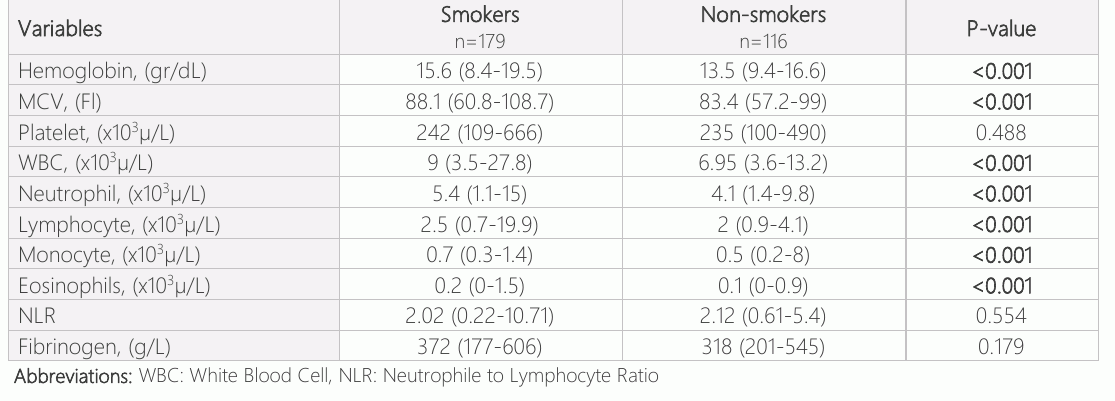
The laboratory findings of the study population showed that the smokers had higher levels of hemoglobin (15.6 g/dL vs 13.5g/dL, respectively; p<0.001), mean corpuscular volume (MCV) (88.1 fL vs. 83.4 fL, respectively; p<0.001), white blood cell (WBC) count (9×10³/µL vs. 6.95× 10³/µL, respectively; p<0.001), neutrophil count (5.4×10³/µL vs 4.1×10³/µL, respectively; p<0.001), lymphocyte count (2.5×10³/µL vs. 2×10³/µL, respectively; p<0.001), monocyte count (0.7× 10³/µL vs. 0.5×10 /µL, respectively; p<0.001), and eosinophil count (0.2×10³/µL vs 0.1×10 /µL, respectively; p<0.001) compared to the non-smokers. There was no significant difference in terms of other parameters (Table-2).
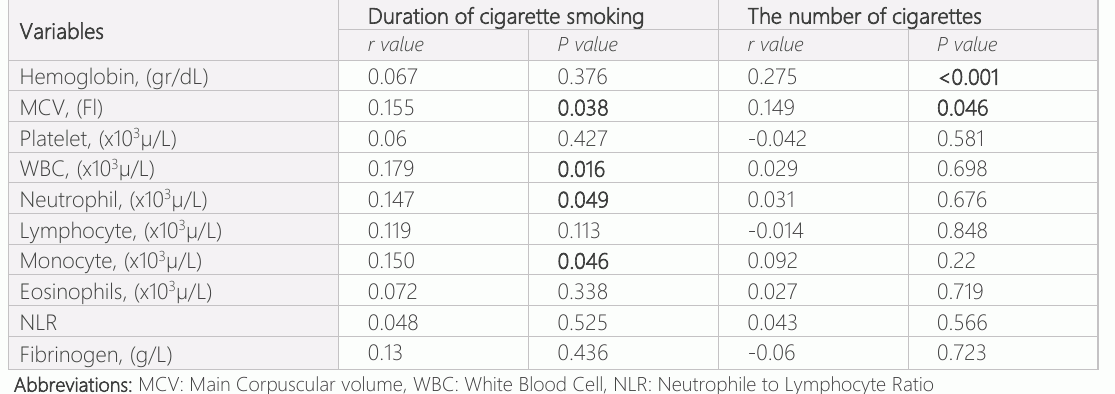
The relationships between smoking time and number of cigarettes smoked day and hematological parameters are shown in Table-3 in detail. There was a significant positive correlation between smoking time and MCV (r=0.155, p=0.038), WBC count (r=0.179, p=0.016), neutrophil count (r=0.147, p=0.049), and monocyte count (r=0.150, p=0.046). There was also a positive correlation between the number of cigarettes smoked per day and hemoglobin level (r=0.275, p<0.001) and MCV (r=0.149, p=0.046).
Discussion
We found that levels of hemoglobin, MCV, WBC count, neutrophil count, lymphocyte count, monocyte count, and eosinophil count were higher in the smoker group compared to the non-smoker group. There was a significant positive correlation between smoking time and MCV, WBC count, neutrophil count, and monocyte count. A positive correlation was also found between the number of cigarettes smoked per day and the hemoglobin and MCV. Smoking causes destruction at a cellular level in all tissues due to the harmful molecules that cigarettes contain. Nicotine triggers the formation of clots in coronary vascular structures, causing endothelial dysfunction (4). Increased carboxyhemoglobin levels due to smoking lead to hypoxia as well as increased vascular permeability and lipid accumulation, resulting in endothelial edema. Increased levels of free radicals and peroxides in smokers increase the synthesis of prostaglandins and thromboxane, and they contribute to the development of chronic inflammatory diseases, carcinogenesis, and atherosclerosis (3). In addition to these harmful compounds, several other molecules in tobacco cause destruction at a cellular level. Recently, researchers have been showing more interest in the effects of smoking on hematological parameters.
Similar to our study, Aula et al. found higher WBC, neutrophil, eosinophil, monocyte, and lymphocyte counts in smokers compared to non-smokers(5). Nadia et al. found hemoglobin levels and WBC counts to be higher in smokers compared to non-smokers, but they did not find a significant difference in terms of MCV (6). Malenica et al. found levels of hemoglobin, WBC count, and MCV to be significantly higher in smokers compared to non-smokers, but there was no significant difference in terms of lymphocyte and monocyte counts (3). We believe that increased hemoglobin and WBC counts in smokers are associated with increased hypoxia due to carbon monoxide and other molecules (7, 8). The synthesis of erythropoietin in renal capillary tubular cells increases in response to hypoxia. The WBC, platelet, and red blood cell production in bone marrow increases due to stimulation by erythropoietin. This, in turn, leads to increased hemoglobin levels (9). The strength of our study compared to the studies mentioned above is that levels of granulocytic and agranulocytic series cells, subgroups of leukocytes, were also higher in smokers. Because we know that smoking increases chronic inflammation (10), causes catecholamine discharge from the adrenal medulla (11), and leads to ischemia or ischemic reperfusion damage due to increased carboxy hemoglobin levels (12), an increase in leukocyte series is expected due to all these factors.
In terms of MCV, different results have been obtained in various studies. In our study, we found smokers to have higher MCV; however, there was no difference between groups in other studies (6). There may be several possible explanations for this situation. The patients included in these studies may have had different B12 and folic acid levels. Similarly, there may be a difference in terms of carboxyhemoglobin levels.
Cho et al. found higher fibrinogen levels in smokers, unlike our study (13). Actually, since smoking triggers atherosclerosis and chronic inflammation, increased fibrinogen levels are expected in smokers. Similarly, Tomoyuki et al. (14) found higher fibrinogen levels in smokers and there was also a positive correlation between increased smoking and fibrinogen levels. Everett et al. found that black smokers and non-smokers had higher fibrinogen levels than non-black smokers and non-smokers (15). We found no difference between the smoker group and the non-smoker group in terms of fibrinogen levels, which might be related to other risk factors (e.g., cigarette brands and the amounts, types, and levels of toxic substances in their contents) (16).
Lakshmi et al. (17) and Whitehead et al. (18) showed that hemoglobin increases depending on the number of cigarettes smoked per day. Tomoyuki et al. (14) also found an association between the number of cigarettes smoked per day and the WBC count. Similar to these studies, we found relationships between smoking time and the number of cigarettes affects the entire society and tobacco is very widely consumed. Another limitation of the study is that we did not have any information about what brands of cigarettes were consumed by the smoker group or about their preferred smoking method (pipes, cigars, cigarettes, hand-rolled cigarettes, etc.). In addition, our lack of information about the smokers’ chronic inflammation markers, reactive oxygen species markers, and toxic substance levels was another limitation.
In conclusion, we found that hematological parameters, particularly hemoglobin level and WBC count, were affected in smokers compared to non-smokers. We also found that this might be specifically related to smoking time and the number of cigarettes smoked per day. Prospective randomized controlled trials are needed to explain the possible reasons why hematological parameters differ in this way between smokers and non-smokers.
Declarations
- Author contributions (CRediT)
- All authors contributed equally to all 14 CRediT roles (Conceptualization, Data curation, Formal analysis, Funding acquisition, Investigation, Methodology, Project administration, Resources, Software, Supervision, Validation, Visualization, Writing – original draft, Writing – review & editing).
- Funding
-
Funding information was not reported in the published version of this article.
- Conflicts of interest
- The authors have declared no conflict of interest for the present article.
- Ethics approval
- The study was approved by the Ethics Committee of the Faculty of Medicine of Çukurova University.
- Data availability
- A data availability statement was not reported in the published version of this article.
References (19)
15 of 19 references are linked to their DOI.
- http://who.int/mediacentre/factsheets/fs339/en - WHOMC PubMed Google Scholar
- Doll R, Peto R, Wheatley K, Gray R, Sutherland I. Mortality in relation to smoking: 40 years' observations on male British doctors. Bmj. 1994;309(6959):901-11 DOI Crossref PubMed Google Scholar
- Malenica M, Prnjavorac B, Bego T, Dujic T, Semiz S, Skrbo S, et al. Effect of cigarette smoking on haematological parameters in healthy population. Medical Archives. 2017;71(2):132 DOI Crossref PubMed Google Scholar
- Gossett LK, Johnson HM, Piper ME, Fiore MC, Baker TB, Stein JH. Smoking intensity and lipoprotein abnormalities in active smokers. Journal of clinical lipidology. 2009;3(6):372-8 DOI Crossref PubMed Google Scholar
- Aula FA, Qadir FA. Effects of cigarette smoking on some immunological and hematological parameters in male smokers in Erbil city. Jordan Journal of Biological Sciences. 2013;147 (624):1-8 DOI Crossref PubMed Google Scholar
- Nadia M, Shamseldein H, Sara A. Effects of Cigarette and Shisha Smoking on Hematological Parameters: An analytic case-control study. IMJH. 2015;10:44-51 PubMed Google Scholar
- Arcavi L, Benowitz NL. Cigarette smoking and infection. Archives of internal medicine. 2004;164(20):2206-16 DOI Crossref PubMed Google Scholar
- Dye JA, Adler KB. Effects of cigarette smoke on epithelial cells of the respiratory tract. Thorax. 1994;49(8):825 DOI Crossref PubMed Google Scholar
- Van Eeden S, Hogg J. The response of human bone marrow to chronic cigarette smoking. European Respiratory Journal. 2000;15(5):915-21 DOI Crossref PubMed Google Scholar
- Tell G, Grimm Jr R, Vellar O, Theodorsen L. The relationship of white cell count, platelet count, and hematocrit to cigarette smoking in adolescents: the Oslo Youth Study. Circulation. 1985;72(5):971-4 DOI Crossref PubMed Google Scholar
- Taylor R, Woodman G, Clarke S. Plasma nicotine concentration and the white blood cell count in smokers. Thorax. 1986;41(5):407 DOI Crossref PubMed Google Scholar
- El-Zayadi A-R, Selim O, Hamdy H, El-Tawil A, Moustafa H. Heavy cigarette smoking induces hypoxic polycythemia (erythrocytosis) and hyperuricemia in chronic hepatitis C patients with reversal of clinical symptoms and laboratory parameters with therapeutic phlebotomy. The American journal of gastroenterology. 2002;97(5):1264 DOI Crossref PubMed Google Scholar
- Cho HM, Kang DR, Kim HC, Oh SM, Kim B-K, Suh I. Association between fibrinogen and carotid atherosclerosis according to smoking status in a Korean male population. Yonsei medical journal. 2015;56(4):921-7 DOI Crossref PubMed Google Scholar
- Kawada T. Relationships between the smoking status and plasma fibrinogen, white blood cell count and serum C-reactive protein in Japanese workers. Diabetes & Metabolic Syndrome: Clinical Research & Reviews. 2015;9(3):180-2 DOI Crossref PubMed Google Scholar
- Everett CJ, Wells BJ, Frithsen IL, Koopman RJ. Smoking, fibrinogen and cancer mortality. Journal of the national medical association. 2007;99(4):328 PubMed Google Scholar
- Zumbado M, Luzardo OP, Rodríguez-Hernández Á, Boada LD, Henríquez-Hernández LA. Differential exposure to 33 toxic elements through cigarette smoking, based on the type of tobacco and rolling paper used. Environmental research. 2019;169:368-76 DOI Crossref PubMed Google Scholar
- Lakshmi A, Anandhi Lakshmanan GKP, Saravanan A. Effect of intensity of cigarette smoking on haematological and lipid parameters. Journal of clinical and diagnostic research: JCDR. 2014;8(7):BC11 DOI Crossref PubMed Google Scholar
- Whitehead T, Robinson D, Allaway S, Hale A. The effects of cigarette smoking and alcohol consumption on blood haemoglobin, erythrocytes and leucocytes: a dose related study on male subjects. Clinical & Laboratory Haematology. 1995;17(2):131-8 PubMed Google Scholar
- Gumus F, Solak I, Eryilmaz M. The effects of smoking on neutrophil/lymphocyte, platelet//lymphocyte ratios. Bratislavske lekarske listy. 2018;119(2):116-9 DOI Crossref PubMed Google Scholar
Read the full text
Open the PDF here
Loading the PDF…
If the PDF does not show here, use the download button above.
How to cite this article
Acik DY, Suyani E, Aygun B, Bankir M. The Effect of Smoking on Hematological Parameters. Ulutas Med J. 2020;6(1):9-14. doi:10.5455/umj.20200209092535
Acik, D. Y., Suyani, E., Aygun, B., & Bankir, M. (2020). The Effect of Smoking on Hematological Parameters. The Ulutas Medical Journal, 6(1), 9–14. https://doi.org/10.5455/umj.20200209092535
Acik, D.Y. et al. (2020) 'The Effect of Smoking on Hematological Parameters', The Ulutas Medical Journal, 6(1), pp. 9–14. doi: 10.5455/umj.20200209092535.