The Ulutas Medical Journal · ISSN 2149-0430 (print), 2149-388X (online) · https://www.ulutasmedicaljournal.com/?mno=98451
Original Article · Open access
The Effect of Monthly Vitamin D Replacement on Bone Turnover Parameters and Inflammation Parameters in Hemodialysis Patients
- Usak University, Faculty of Medicine, Department of Nephrology, Usak, Turkey ROR
- Usak University, Faculty of Medicine, Department of Medical Biochemistry, Usak, Turkey ROR
Abstract
- Introduction
- Vitamin D replacement is recommended for chronic kidney patients as vitamin D prevents the development of secondary hyperparathyroidism. However, the optimal vitamin D level or dosage is controversial. In this study, we investigated the basal vitamin D levels in patients undergoing hemodialysis, and effects of high dose vitamin D supplements on serum Vitamin D, parathormone (PTH), calcium (Ca), phosphorus (P), alkaline phosphatase (ALP), C-reactive protein (CRP), and albumin test levels.
- Materials and Methods
- 61 patients who have been in the routine hemodialysis program for at least six months in Usak University Training and Research Hospital included in the study. The demographic characteristics of the patients, 25(OH) vitamin D, PTH, Ca, P, ALP, albumin, CRP levels collected from the patient records before and after three months of high dose vitamin D (150.000-300.000IU) replacement. The data obtained in this study analyzed with SPSS 21 package program.
- Results
- 31 of the patients were female, 30 were male. The mean age of the patients was 63.39±13.76. Vitamin D level was insufficient or deficient in 95.2% of the patients. Only there was a statistically significant correlation between basal vitamin D levels and dialysis duration (p<0.05). There was no significant difference between the PTH, Ca, P, ALP, and CRP levels of patients before and after vitamin D replacement, but there were a significant difference in serum albumin and vitamin D levels (p<0.005).
- Conclusion
- Although vitamin D treatment is necessary for chronic kidney patients undergoing dialysis, more clinical studies are needed to bring standardization regarding the dosage and duration of administration.
Keywords
Full text
Introduction
Vitamin D is a soluble steroid prohormone. It is produced in the skin as a result of contact with sunlight, and with various metabolic changes in the body, it turns into a hormone known as calcitriol, which plays a significant role in calcium and phosphorus metabolism (1). There are two forms of vitamin D: Vitamin D2 (ergocalciferol) and vitamin D3 (cholecalciferol). The first step in the synthesis of vitamin D3 is the conversion of provitamin D, which is found in the skin, to vitamin D3 (cholecalciferol) with the effect of sun or ultraviolet rays. Then, they transport to target organs by binding to vitamin D-binding proteins (DBP). Another source of vitamin D is intestinal absorption. Dietary vitamin D transport in chylomicrons after being absorbed from enterocytes. Therefore, diseases associated with fat malabsorption can cause vitamin D deficiency. Chylomicrons reach the liver through portal circulation. Here, vitamin D hydroxylated by the 25-hydroxylase enzyme, and 25-hydroxyvitamin D (25OHD) formed. In mitochondria in the proximal tubules of the kidneys, advanced hydroxylation of 25OHD to 1.25-dihydroxyvitamin D (1.25OHD) takes place. 1,25OHD is a physiologically active form of vitamin D (2). As chronic kidney disease (CKD) progresses, 1-α hydroxylase activity decreases in the kidney, calcitriol production decreases, and parathormone levels increase. It thought to be due to decreased residual renal mass, hyperphosphatemia, metabolic acidosis and uremic toxins suppressing 1-α hydroxylase activity (3).
The synthesis of 1,25-OH vitamin D regulates parathormone (PTH), serum calcium, and phosphorus levels. However, its effect is not limited to calcium and phosphorus regulation. It has also shown in several studies that it attains maximum muscle strength and it prevents type-1 diabetes, multiple sclerosis, rheumatoid arthritis, cardiovascular heart disease, hypertension, various cancers with its anti-inflammatory, antiproliferative, immune modulator properties (4).
Based on this information, the use of cholecalciferol or ergocalciferol is necessary for patients with advanced chronic renal failure and dialysis patients. Also, recent studies show that the effectivity of vitamin D supplementation is not only in maintaining renal osteodystrophy control but also against inflammation in the patients with chronic renal failure (5). However, there is no consensus about which dose of vitamin D to use, the dose adjusted according to the level of serum vitamin D. It has not known whether this dose is sufficient to achieve the immunomodulating effect of vitamin D in dialysis patients with vitamin D deficiency (6). The half-life of active vitamin D supplements is less than 4-6 hours. It is possible that this will not have a lasting effect. In normal physiological conditions, the active source of vitamin D is 25-hydroxy vitamin D. It can produce active vitamin D at any time according to the body's needs. Due to the short half-life of active vitamin D drugs, it may not be possible to achieve the same effect continuously.
Based on these studies, we determined basal vitamin D levels in patients and we applied monthly high dose vitamin D supplements to increase the drug compliance in patients undergoing hemodialysis , then we investigated the effect of this monthly dose of vitamin D on PTH, Ca, P, ALP, CRP and albumin levels.
Materials and Methods
Sixty-one patients who have been in routine hemodialysis program for at least six months in Usak University Training and Research Hospital included in the study. Demographic features of the patients such as gender, age, height, weight, body mass index (BMI), duration of dialysis obtained from the patient file records. Serum calcium, phosphorus, ALP, albumin and CRP levels analyzed by a spectro photometric method in Architect c8000 auto analyses (Abbott Diagnostic, Lake Forest, IL, USA); Serum intact PTH test analyzed by chemiluminescence immunoassay method in Centaur XP analyses (Siemens Healthcare United Kingdom). The test results obtained from the from the medical records of the patients. The difference between 25(OH)vitD, PTH, Ca, phosphorus, ALP, albumin and CRP levels examined before and after the vitamin D treatment (300,000 IU for patients with vitamin D <20 ng/mL - 150,000 IU for patients with vitamin D level >20 ng/mL). The relationship between these tests and age, gender, duration of dialysis, and BMI is analyzed. The data obtained in this study analyzed through SPSS 21 package program. The relationship between the variables is analyzed with correlation analysis. The difference between two groups is analyzed by Mann-Whitney U test fort the variables which are not normally distributed and Kruskall-Wallis H test is used in more than two-group comparisons. The difference between the related groups is analyzed by Wilcoxen sign test. A p value <0.05 was used as the level of significance.
Results
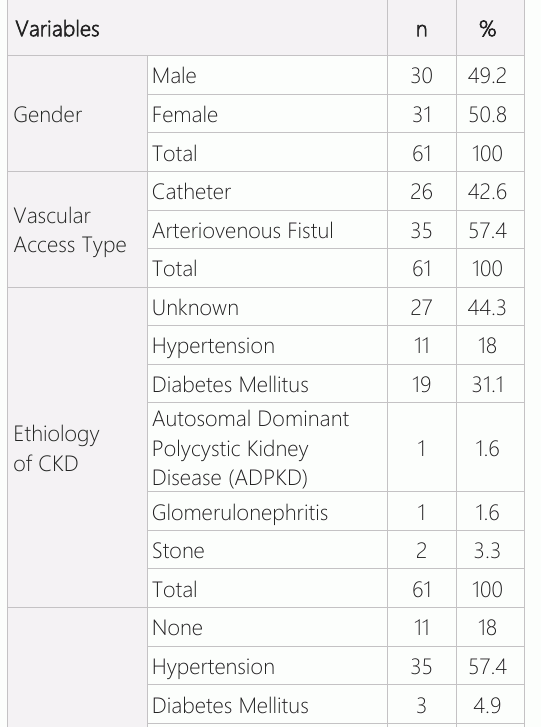
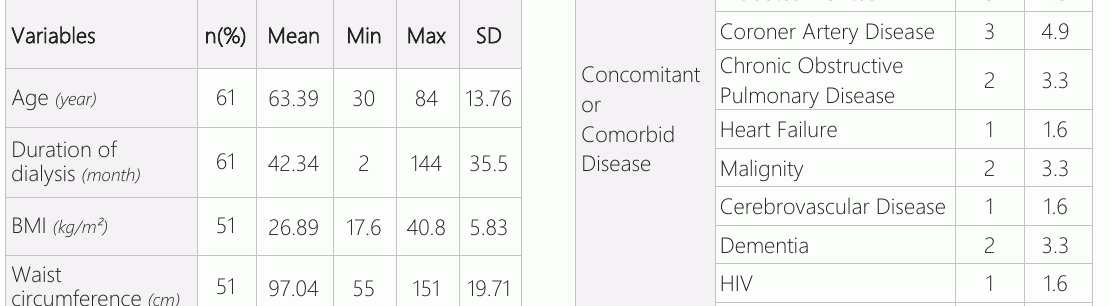
31 (50.2%) of the patients were females, 30 (49.8%) were males. The mean age of the patients was 63.39±13.76, ranged between 30- 84 years. The mean duration of hemodialysis of the patients was 42.34 months, and the average BMI of 51 patients that we could reach the body mass index (BMI) data was 26.89 kg/m2 (Table 1).
If the patients are examined according to their gender; 31 (50.2%) were females and 30 (49.8%) were males of 61 patients. The etiology of chronic kidney diseases (CKD) is not known in 44% of patients and the most common cause of chronic kidney diseases is diabetes mellitus. The most common disease accompanying kidney diseases is hypertension with a rate of 57.4% (Table 2).
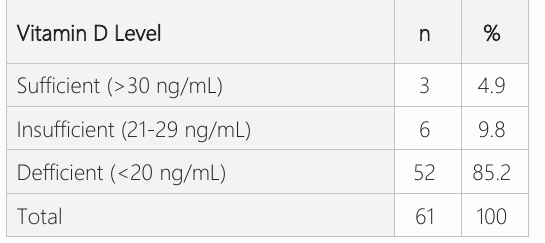
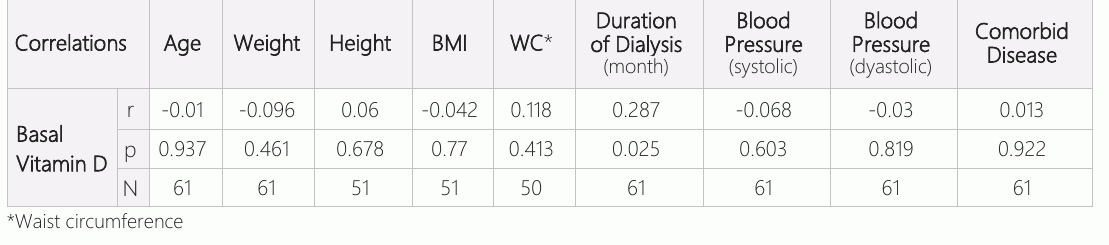
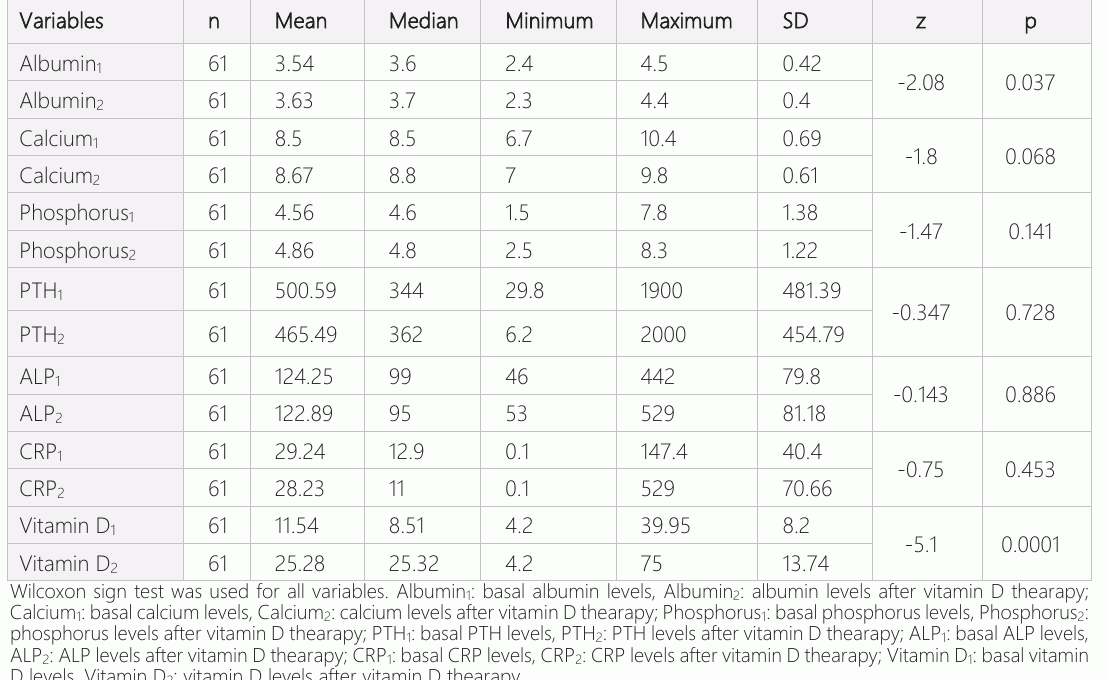
Vitamin D level was insufficient or deficient in 95.2% of the patients (Table 3). There was no relationship between age, gender, BMI, presence of diabetes and basal vitamin D levels (Table 4), but a low level of statistically significant relationship with dialysis duration was found (p<0.05; r=0.287). Average vitamin D levels of patients increased significantly with 3-month vitamin D treatment. Although there was no statistically significant difference between PTH, Calcium, phosphorus, ALP, CRP levels analyzed before and after vitamin D replacement, a difference was observed in serum albumin (p<0.05) (Table 5).
Discussion P i
Vitamin D is the only synthesized vitamin in the human body. Vitamin D and its metabolites have an important clinical role in calcium balance and bone metabolism. It is estimated that around one billion people in the world have vitamin D deficiency. (7). In previous studies, the prevalence of vitamin D deficiency shown to be vary between 40% and 100% in Turkey (8). This prevalence increases in chronic kidney patients. Causes and risk factors of 25 (OH) vitamin D deficiency/insufficiency in chronic kidney disease are age, adiposity, proteinuria, female gender, decreased vitamin D receptor, tubular reabsorption peritoneal dialysis, of 25(OH) D and deterioration of hydroxylation vitamin D (9).
Vitamin D deficiency/insufficiency is associated with secondary hyperparathyroidism and bone cycle markers seen in CKD, low bone mineral density, atherosclerosis, weakened immunity, the progression of kidney disease and mortality results (10, 11). Vitamin D deficiency causes a decrease in intestinal absorption of calcium and phosphorus value. Hypocalcemia induces hyperparathyroidism, and hence phosphaturia develops. According to the K / DOQI guidelines, (12) vitamin D replacement recommended if patients with CKD stages 3 and 4 have hyperparathyroidism. Although there is a low risk of toxicity at the recommended dose, vitamin D replacement therapy is the first-line therapy in patients with secondary hyper parathyroidism with vitamin D deficiency (13). In this study, we used oral high dose vitamin D synthetic preparations for hemodialysis patients for three months. A cut off value of 30 ng/ml is considered as optimal vitamin D level. Although the vitamin D median value of the patients increased significantly within three months after treatment, some of the patients could not reach the optimal vitamin D levels. This condition may be due to the short duration of using vitamin D and need for the higher loading dose in some patients .
The post-treatment CRP level which is a marker for inflammation, the Ca, P, ALP, and iPTH levels we looked to evaluate bone turnover did not change significantly. In the study conducted by Tokmak et al. (14) They did not determine a statistically significant difference in Ca-P balance and PTH levels although they used longer duration (9 months) and a higher dose (20000 IU/day) cholecalciferol to 64 hemodialysis patients. Tentori et al compared the groups who received and did not receive vitamin D treatment in 8000 hemodialysis patients but found no significant difference in Ca levels (15). Body mass index control is associated with nutrition and inflammation, and in our study, the mean BMI of the patients was within normal limits. However, we found that albumin levels, which are negative acute phase markers but also show nutritional status, increased significantly. The presence of chronic inflammation and protein-energy malnutrition are the main factors responsible for mortality in patients with CKD. Therefore, increasing albumin and decreasing CRP is an indicator of a good prognosis. As a result, although vit D doses (150.000 IU and 300.000 IU) used for supportive treatment in chronic kidney patients are sufficient to decrease inflammation, they are insufficient for bone remodeling.
Conclusion
We hope that the results of these studies will clarify the dose and the duration of limits of vitamin D treatment in the future. The limitations of our study are being retrospective, limited number of patients and being a single center study. Multicenter, prospective studies with higher number of patients are needed to be conducted. The followup of patients receiving dialysis is multifactorial. Precautions should be taken by following nutritional status, presence of inflammation, disorders related to bone turnover imbalance, and heart diseases. The patients on dialysis are on high pill burden which makes their medical treatment more difficult and high dose vitamin D supplements used once monthly or longer intervals may improve the compliance of the patients to the vitamin D replacement treatment.
Declarations
- Author contributions (CRediT)
- All authors contributed equally to all 14 CRediT roles (Conceptualization, Data curation, Formal analysis, Funding acquisition, Investigation, Methodology, Project administration, Resources, Software, Supervision, Validation, Visualization, Writing – original draft, Writing – review & editing).
- Funding
-
Funding information was not reported in the published version of this article.
- Conflicts of interest
- The authors declared no conflict of interest.
- Ethics approval
- The Ethical Committee and Institutional Review Board of Usak University Faculty of Medicine, where the study was conducted, approved the study design.
- Data availability
- A data availability statement was not reported in the published version of this article.
References (15)
10 of 15 references are linked to their DOI.
- Holick MF, Krane SM, Potts JT. Calcium, phosphorus, and bone metabolism: Calcium-regulation hormones. In: Fauci AS, Braunwald E, Isselbacher KJ, et al (Eds). Harrison's principles of internal medicine. 14th ed. New York: McGraw-Hill; 1995:2214 PubMed Google Scholar
- Thacher TD, Clarke BL. Vitamin D insufficiency. Mayo Clin Proc 2011; 86(1):50-60 PubMed Google Scholar
- Gal-Moscovici A, Sprague SM: Role of Vitamin D deficiency in chronic kidney Disease. J Bone Miner Res 2007;22:91-94 DOI Crossref PubMed Google Scholar
- Michael F. Holick: Vitamin D for Health and in chronic kidney disease.Seminars in Dialysis - vol 18, No 4, 2005 DOI Crossref PubMed Google Scholar
- Yin K, Agrawal DK. Vitamin D and inflammatory diseases. J Inflamm Res. 2014;7:69–87 DOI Crossref PubMed Google Scholar
- Taskapan H, Wei M, Oreopoulos DG (2006)25(OH) Vitamin D(3) in patients with chronic kidney disease and those on dialysis: rediscovering its importance. Int Urol Nephrol 38(2):323–329 DOI Crossref PubMed Google Scholar
- Hossein-nezhad A, Holick MF. Vitamin D for health: A Global perspective. Mayo Clin Proc 2013 July; 88(7):720– 55 DOI Crossref PubMed Google Scholar
- Türkiye Endokrinoloji ve Metabolizma Derneği. Osteoporoz ve Metabolik Kemik Hastalıkları Tanı ve Tedavi Kılavuzu 2018: 119-27 PubMed Google Scholar
- Jean G, Souberbielle JC, Chazot C. Vitamin D in chronic kidney disease and dialysis patients. Nutrients 2017;9(4):1-15 DOI Crossref PubMed Google Scholar
- Keung L, Perwad F. Vitamin D and kidney disease. Bone Rep 2018;9:93-100 DOI Crossref PubMed Google Scholar
- Eknoyan G, Lameire M, Kasiske B. Kidney Disease: Improving Global Outcomes (KDIGO) CKD-MBD Update Work Group. KDIGO 2017 clinical practice guideline update for the diagnosis, evaluation, prevention, and treatment of chronic kidney disease–mineral and bone disorder (CKD-MBD). Kidney Int Suppl 2017;7:1–59 DOI Crossref PubMed Google Scholar
- Eknoyan G,Levin NM: Bone metabolism and disease in chronic kidney disease. Am J Kidney Dis 2003;42:1-201 DOI Crossref PubMed Google Scholar
- Gonzales EA,Sachdeva A,Oliver DA et al. Vitamin D insufficiency and deficiency in chronic kidney disease. A single center observational study. Am J Nephrol 2004;24: 503-510 PubMed Google Scholar
- Tokmak F, Quack I, Schieren G, Sellin L, Rattensperger D, HollandLetz T, Weiner SM, Rump LC: High-dose chole calciferol to correct vitamin D deficiency in haemodialysis patients. Nephrol Dial Transplant 2008;23:4016-4020 DOI Crossref PubMed Google Scholar
- Tentori F,Stidley C,Brown R et al:Survival does not differ among incident hemodialysis patients treated with the different vitamin D analogs,in vol (F-PO940), American Society of Nephrology Meeting, 2003 PubMed Google Scholar
Read the full text
Open the PDF here
Loading the PDF…
If the PDF does not show here, use the download button above.
How to cite this article
Adibelli Z, Mizrak S. The Effect of Monthly Vitamin D Replacement on Bone Turnover Parameters and Inflammation Parameters in Hemodialysis Patients. Ulutas Med J. 2020;6(3):125-130. doi:10.5455/umj.20200713054707
Adibelli, Z., & Mizrak, S. (2020). The Effect of Monthly Vitamin D Replacement on Bone Turnover Parameters and Inflammation Parameters in Hemodialysis Patients. The Ulutas Medical Journal, 6(3), 125–130. https://doi.org/10.5455/umj.20200713054707
Adibelli, Z. and Mizrak, S. (2020) 'The Effect of Monthly Vitamin D Replacement on Bone Turnover Parameters and Inflammation Parameters in Hemodialysis Patients', The Ulutas Medical Journal, 6(3), pp. 125–130. doi: 10.5455/umj.20200713054707.